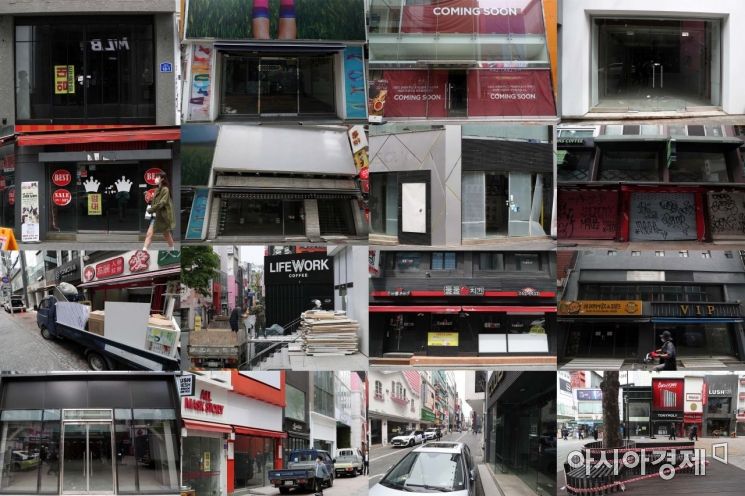
 Due to the prolonged COVID-19 pandemic, vacant stores have been steadily increasing in major commercial districts. Rental inquiries, temporary closure notices, and business termination signs are posted on shops in Myeongdong. Photo by Mun Ho-nam munonam@
[Asia Economy Reporter Lim Hye-seon] Kim Mo (51), who opened a Korean restaurant in Mapo-gu, Seoul last year, closed it after just one year. The COVID-19 outbreak occurred right after opening, increasing debt, and he judged it was no longer sustainable. During the operation, he never made a profit even for a single month. Monthly sales of 3 to 5 million KRW were far from enough to cover rent, material costs, labor costs, and loan payments. He also reduced the number of employees who had worked hard with him since the opening, and from the first half of this year, he worked part-time in delivery and as a substitute driver in the evenings to at least pay the interest on bank loans. Kim said, "Even though I closed the business, I had no way to make a living, so I endured thinking tomorrow would be better, but the debt only increased," adding, "I tried to get a new loan to repay the existing one, but the bank refused, and now I might have to sell my house."
The COVID-19 pandemic has severely impacted self-employed businesses. Self-employed people struggling with business difficulties due to over a year of gathering bans and business restrictions are collapsing. This year, the number of restaurant closures reached about 50,000, more than twice the number during the 1998 foreign exchange crisis.
Self-Employment Ratio at Lowest Level in 39 Years
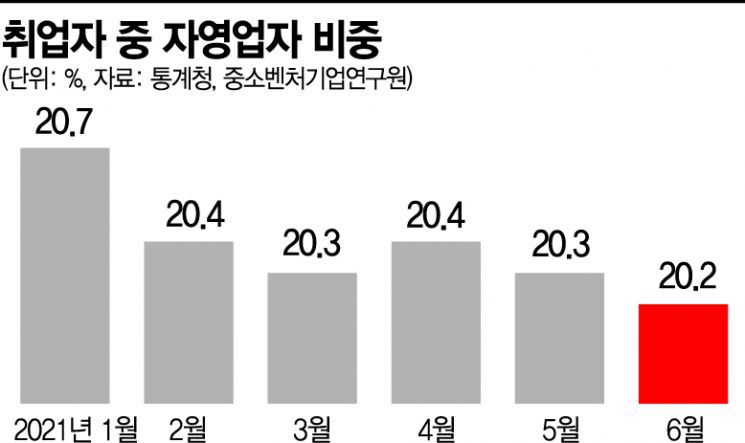
The proportion of self-employed workers among all employed persons in South Korea barely stayed at the 20% level, marking the lowest point in 39 years. According to the Small and Medium Business Research Institute and Statistics Korea on the 5th, the number of self-employed people in June this year was 5.58 million, accounting for 20.2% of the total employed population (27.637 million). This is the lowest level since July 1982. The number of self-employed includes those with employees and those without. Among the self-employed, 1.28 million had employees, accounting for 4.6% of total employment, while those without employees accounted for 15.6% (4.3 million).
No Min-seon, head of the Future Strategy Research Group at the Small and Medium Business Research Institute, explained, "The number of self-employed with employees has been declining for over 30 months. The large decrease in this group mainly contributed to lowering the proportion of self-employed among all employed persons."
Working conditions for employees are also deteriorating. According to data from the Korea Rural Economic Institute, based on working hours, the proportion of regular workers decreased slightly from 63.6% to 62.1%, while temporary workers (11.3% → 12.7%) and daily workers (7.1% → 7.9%) increased. The ratio of companies with employment insurance, an indicator reflecting job quality to some extent, also fell from 26.6% in 2019 to 25.3% last year. Professor Lim Jeong-bin of Seoul National University diagnosed, "Due to business instability related to COVID-19, self-employed people rely more on temporary and daily workers who are relatively easy to dismiss, causing the average job quality to decline. For daily workers, average wages have significantly dropped, increasing their livelihood burdens."
Surge in Closures of Lodging and Food Service Businesses
Closures are also surging across commercial districts nationwide. Analyzing local permit data from the Ministry of the Interior and Safety on the 5th, 31,000 general restaurants closed from January to July this year, 1,200 more than the same period last year. This is more than twice the number of closures (12,492) during the 1998 IMF foreign exchange crisis. Restaurant closures have been rapidly increasing since September last year, rising from 3,615 in September to 6,538 in December. In December, the number of closures exceeded the number of openings (5,575).
The number of closures of rest and food service businesses, including coffee shops and convenience stores, reached 12,500, a 15% increase compared to the previous year. The number of new openings decreased by 10%. The situation is even worse for entertainment bars. This year, 151 new entertainment bars opened, while 561 closed. The lodging industry faces a similar situation, with 562 new openings and 581 closures. The total number of closures combining restaurants and lodging is about 50,000.
The number of closures is expected to increase over time. Sales have plummeted as visitor numbers decline. The average daily number of customers at dining establishments last year was 47.7, down 6.4 from the previous year. According to Statistics Korea, the real sales volume in 2019 was 130.1 trillion KRW, an 11.9% increase compared to 2016. Using the production index for restaurants and bars, last year's estimated sales volume was about 108.9 trillion KRW, likely returning to pre-2016 levels. The restaurant production index dropped by 15.8 points compared to the previous year. This year, with the continuation of social distancing level 4, profitability is expected to worsen further.
There is advice that financial and tax support measures should be devised to save self-employed businesses. Lee Yong-seon, honorary senior researcher at the Korea Rural Economic Institute, said, "Financial support should be expanded for businesses with operational capacity but temporary cash flow shortages," adding, "Since fixed costs like rent continue to burden businesses and may accelerate insolvency, support measures such as tax credits for rent reductions should be prepared."
© The Asia Business Daily(www.asiae.co.kr). All rights reserved.


















