Last Year's CSAT 'Acrylic Partitions' Not Used This Year
Separate Exam Rooms for High Fever or Symptomatic Students
Isolated Test Takers Seated 2m Apart Without Partitions
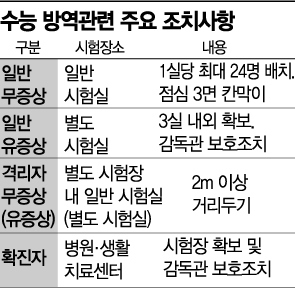
[Asia Economy Reporter Han Jinju] This year, three-sided partitions will be installed only during lunchtime at the CSAT test sites. Examinees with high fever or symptoms will take the exam in separate test rooms within the test site, and those in isolation will take the exam in separate test rooms.
On the 5th, the Ministry of Education announced the '2022 College Entrance Exam Management Directions' after gathering opinions from metropolitan and provincial offices of education, universities, infectious disease experts, and consulting with quarantine authorities.
Last year, acrylic partitions were installed on the front of desks during the CSAT, but this year, no partitions will be placed during the exam. Instead, three-sided partitions will be installed on desks only during lunchtime when masks are removed. This measure reflects examinees' complaints that partitions make desks narrower and interfere with the exam.
Choi Eun-ok, Director of Higher Education Policy at the Ministry of Education, explained, "Considering that students have been vaccinated, everyone wears masks, the exam environment is silent, and all face the front of the classroom, the three-sided partitions will be made of thick paper material and are easy to install. Installation guidelines will be provided in early September."
On the day of the CSAT, examinees will be divided into general, isolated, and confirmed cases, with separate test sites and rooms. General examinees will take the exam at the general test sites they were informed of in advance, while isolated examinees will take the exam in separate test rooms. Examinees must wear masks on the exam day. Ventilation will be conducted during breaks and lunchtime.
Examinees will undergo two temperature checks on the exam day. Those with high fever or symptoms will take the exam in separate rooms prepared within the test site, maintaining at least 2 meters distance between examinees. No partitions will be installed in these separate rooms either. Up to 24 examinees will be seated in general test rooms.
Separate test sites for isolated examinees and hospital or residential treatment center test sites for confirmed cases will be prepared by early October.
Jo Hoon-hee, Director of College Entrance Policy at the Ministry of Education, said, "There are 86 test districts nationwide, and last year, about two isolation test sites were set up per district, totaling around 110 isolation test sites. This year, after the application deadline on September 3, we will review the distribution of applicants and decide the scale of separate test sites within a similar range as last year."
The Ministry of Education will promote the preparation of quarantine supplies, pre-education, and infectious disease prevention education, and detailed quarantine guidelines will be provided to metropolitan and provincial offices of education in September. Measures such as switching to remote classes one week before the CSAT, as done last year, will be decided based on the infectious disease situation.
Vaccination for examinees is planned to be completed by mid-September. High school seniors will start their second dose from the 20th of this month, and graduates and repeat test-takers will begin their first dose on the 10th and complete it by September 11.
The Ministry of Education recommended that universities provide all applicants with the opportunity to take interviews or practical exams as much as possible. For those in self-quarantine, unless fairness is compromised or the nature of the exam makes participation impossible, opportunities should be provided in all selection processes. For confirmed cases who cannot leave the hospital, universities are advised to decide on participation based on their management capabilities and risk levels.
Before conducting university-specific evaluations, universities must prepare general test sites, separate test sites for symptomatic examinees, and isolation test sites on campus according to examinee types. The Ministry of Education will operate a university evaluation task force in cooperation with the Korea Disease Control and Prevention Agency and the Korea Council for University Education. Information on isolated and confirmed applicants will be identified in advance and provided to universities.
© The Asia Business Daily(www.asiae.co.kr). All rights reserved.
















