Korea Real Estate Board August First Week Apartment Price Trends
Capital Region Rises 0.37%, Setting Record High
Seoul Apartment Prices Also Show Largest Increase in 1 Year 8 Months
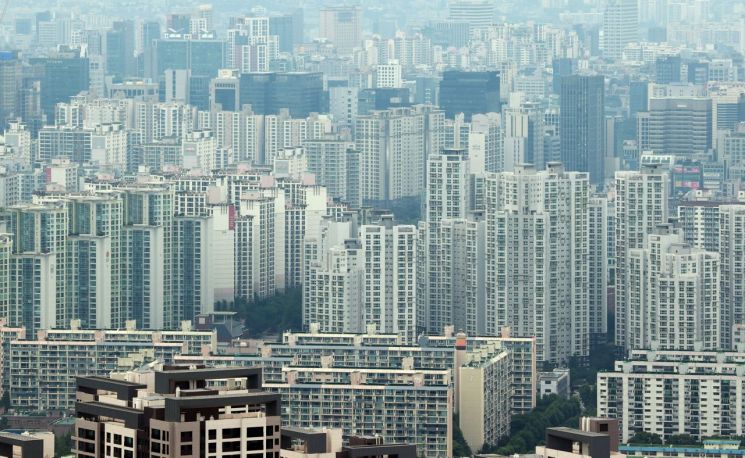 Apartment complexes in the Gangnam-gu area as seen from Daemosan Observatory in Seoul [Image source=Yonhap News]
The apartment price increase rate in the Seoul metropolitan area has once again broken the all-time high record.
According to the weekly apartment price trend for the first week of August announced by the Korea Real Estate Board on the 5th, as of the 2nd, apartment prices in the metropolitan area rose by 0.37%, expanding the increase compared to the previous week (0.36%). This is the highest increase rate since the Real Estate Board started compiling weekly statistics in May 2012.
The apartment prices in the metropolitan area recorded the highest increase of 0.34% in the second week of June, then immediately broke this record with 0.35% in the third week of the same month. A month later, in the third week of last month, it again broke the record with 0.36%, and now it has surpassed it again within just two weeks.
In the metropolitan area, the rise in Seoul and Gyeonggi-do was prominent. The apartment price increase rate in Seoul grew from 0.18% last week to 0.20% this week. This is the largest increase in about 1 year and 8 months since the third week of December 2019 (0.20%).
The Real Estate Board explained, "Although transaction activity slightly decreased due to the summer vacation season and the spread of COVID-19, the upward trend continued mainly in relatively low- to mid-priced areas and reconstruction complexes with redevelopment expectations."
Nowon-gu (0.37%) and Dobong-gu (0.26%), where expectations for easing reconstruction regulations are high, saw relatively large increases, and major reconstruction promotion complexes concentrated in Songpa-gu (0.22%), Seocho-gu (0.20%), and Gangnam-gu (0.18%) also continued their upward trend. Gangdong-gu (0.14%) rose mainly in Godeok, Amsa, and Myeongil-dong but the increase rate slightly narrowed.
Gyeonggi-do rose by 0.47% this week, also expanding the increase compared to the previous week (0.45%). Gunpo-si (0.85%) and Anyang Dongan-gu (0.76%) surged due to transportation benefits, and Anseong-si (0.84%) also saw a significant rise in apartment prices mainly in complexes with official prices below 100 million KRW. Other cities such as Osan-si (0.81%) and Uiwang-si (0.74%) also experienced strong upward trends.
In Incheon, the increase rate slightly narrowed from 0.39% last week to 0.37% this week. Sejong City saw apartment prices fall by 0.06%. Although the decline narrowed compared to the previous week (-0.09%), the accumulation of listings continues, and the downward trend persists mainly in major complexes in Saerom and Dajeong-dong.
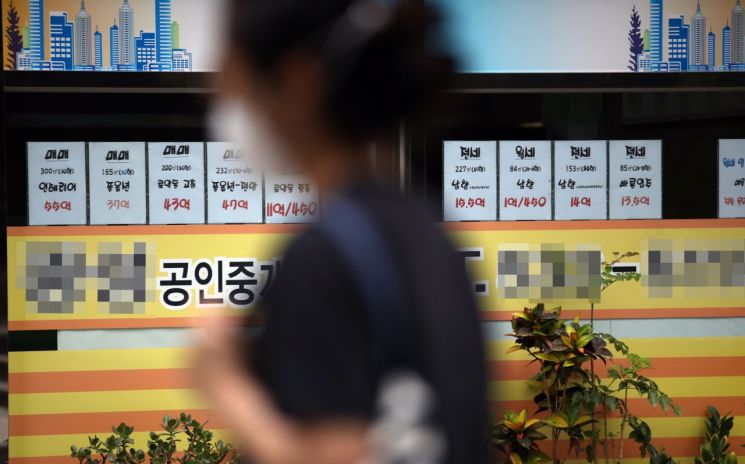 Price list in front of a real estate agency in Banpo-dong, Seocho-gu, Seoul [Image source=Yonhap News]
Instability in the jeonse (long-term lease) market also continues.
Seoul's apartment jeonse prices rose by 0.17% this week, expanding the increase compared to last week (0.16%). The Real Estate Board explained, "Areas affected by new housing supply or those that had previously seen high increases maintained or reduced their increase rates, but the upward trend continued mainly in areas with good school districts and mid- to low-priced areas."
Jeonse prices in Songpa-gu (0.24%) and Nowon-gu (0.21%), where school district demand is high, rose significantly, while Yongsan-gu (0.19%) and Eunpyeong-gu (0.16%) also continued to experience a shortage of jeonse listings. Seocho-gu (0.19%) saw significant jeonse price increases mainly in Banpo, Seocho, and Jamwon-dong due to relocation demand from redevelopment projects, and Gangdong-gu (0.16%), Gangnam-gu (0.13%), Yangcheon-gu (0.28%), and Dongjak-gu (0.21%) also continued to experience jeonse market instability.
In Incheon, the apartment jeonse price increase rate grew from 0.29% to 0.31%. Although the increase rate in Gyeonggi-do (0.35%→0.33%) decreased, high increase rates were maintained mainly in Anseong-si (0.92%), Siheung-si (0.63%), Anyang Dongan-gu (0.62%), Gunpo-si (0.61%), and Ansan Danwon-gu (0.61%).
© The Asia Business Daily(www.asiae.co.kr). All rights reserved.


















