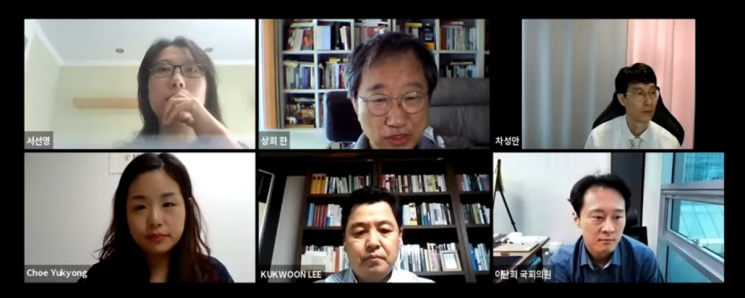
 On the morning of the 5th, an urgent discussion titled 'Why is Shortening Legal Career Experience a Problem?' was held in the form of an online seminar. / Screenshot from YouTube Itanhee TV
[Asia Economy Choi Seok-jin, Legal Affairs Specialist Reporter] An emergency forum was held to examine the issues of the amendment to the Court Organization Act that shortens the required legal career for appointment as a judge from 10 years to 5 years.
On the morning of the 5th, an emergency forum titled "Why is shortening the legal career problematic?" was jointly hosted by the People's Solidarity for Participatory Democracy, the Judicial Center of the Lawyers for a Democratic Society, Rep. Lee Tan-hee of the Democratic Party, and Rep. Shim Sang-jung of the Justice Party.
Considering the COVID-19 situation, the forum was held as an online seminar and was live-streamed on YouTube channels Lee Tan-hee TV, People's Solidarity for Participatory Democracy, and the Lawyers for a Democratic Society.
Rep. Lee, one of the co-hosts, said in his congratulatory remarks, "In May, I learned that a bill was proposed to reduce the required years of legal experience for judge applicants under the unified legal profession system, and that it passed the Legislation and Judiciary Committee subcommittee within two months." He pointed out, "What is regrettable is that the 2011 Court Organization Act was passed through direct and indirect involvement and agreement among the ruling and opposition parties, the executive, and the judiciary, but this amendment was hastily made in a very short period."
He continued, "The Court Administration Office claims to have gone through a public discussion process by listening to some bar association executives over the past two months, but it is as if the majority of the public affected by the judicial system were treated as invisible," adding, "Although late, we decided to hold this forum with the thought that a process should be created to allow sufficient discussion and to hear opinions from various social actors."
Rep. Shim also expressed concern in her congratulatory remarks, saying, "Although the amendment has not yet been submitted to the full Legislation and Judiciary Committee meeting, it is seriously worrisome."
She said, "In 2007, there was a major decision in South Korea's judicial system. It was a decision to appoint legal professionals with diverse social experience and expertise as judges," and criticized, "Stopping this at the transitional stage before proper implementation goes against judicial reform."
She added, "The appointment of judges with experienced legal professionals was proposed as an effort to solve chronic problems such as the judiciary's closed nature, hierarchy, and preferential treatment of former judges," emphasizing, "Pushing to shorten the legal career requirement due to judge supply issues means that the judiciary, the last bastion of human rights, will inevitably be shaken by administrative convenience."
Earlier, on the 15th, the Legislation and Judiciary Committee’s 1st Subcommittee approved an amendment to the Court Organization Act to reduce the minimum legal career requirement for judge appointments from 10 years to 5 years to address the shortage of judges.
Since the unified legal profession system was fully implemented in 2013, courts have faced difficulties in appointing judges, leading to an excessive workload for judges and delays in case processing, which could affect promptness and fairness, potentially causing harm to the public. This is the background for the bill’s proposal.
At the forum, Professor Kim In-hoe of Inha University Law School presented on "Unified Legal Profession and Judges' Career" focusing on the 2004 Judicial Reform Committee discussions. Following him, Seo Sun-young, Chair of the Court Reform Subcommittee at the Lawyers for a Democratic Society Judicial Center, spoke on "Problems with the Argument for Shortening the Unified Legal Profession Career," and Professor Lee Guk-woon of Handong University Law Department presented on "Causes of the Decrease in Judge Appointment Applicants."
Discussants included Dr. Choi Yoo-kyung from the Korea Legislation Research Institute and Professor Cha Sung-an from the Seoul National University of Science and Technology Law School.
© The Asia Business Daily(www.asiae.co.kr). All rights reserved.

















