Less than 15% Fully Vaccinated
Insufficient to Contain Delta Variant
Asymptomatic Infections During Vacation Season Pose a Variable
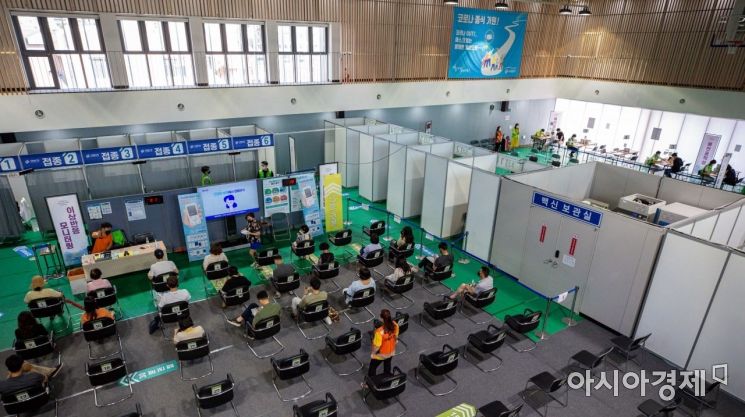 On the 5th, as the nationwide first-dose COVID-19 vaccination rate approaches 40 percent, citizens who visited the vaccination center set up at Bukahyeon Culture and Sports Center in Seodaemun-gu, Seoul, are waiting to monitor for adverse reactions after completing their vaccinations. Photo by Jinhyung Kang aymsdream@
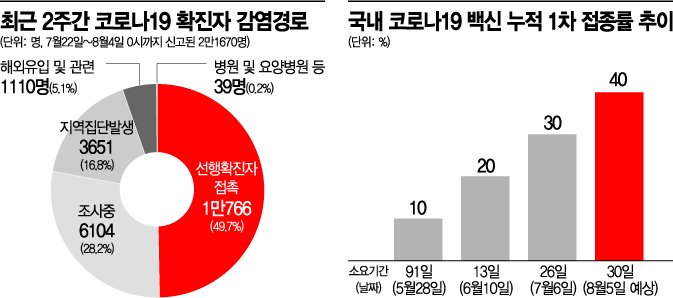
[Asia Economy reporters Seo So-jeong and Kim Ji-hee] South Korea's COVID-19 first-dose vaccination rate is expected to surpass 40% as early as the 5th. However, the completion rate of the second dose remains below 15%, which is considered insufficient to contain the flames of the fourth wave fueled by the Delta variant. There are also warnings that asymptomatic hidden infections will significantly increase during the holiday season.
According to the COVID-19 Vaccination Response Promotion Team, 164,924 people newly received their first dose yesterday, bringing the cumulative first-dose vaccination rate to 39.6% (20,336,252 people). The vaccination rate has steadily increased over the past two weeks from 37.9% → 38.8% → 39.3% → 39.6%, making it highly likely to surpass 40% today. The completion rate for full vaccination stands at 14.4% (7,402,059 people).
Since the beginning of this month, vaccine supply has eased, accelerating the vaccination rate. Nearly 4 million doses were supplied just yesterday, including 2.53 million doses of the Pfizer vaccine and 1.188 million doses of the AstraZeneca (AZ) vaccine. Today, an additional 1.185 million doses of individually contracted AZ vaccines will be shipped, bringing the total COVID-19 vaccine doses introduced from August 1 to 5 to 6.085 million. On the 6th and 7th, 1.3 million doses of the Moderna vaccine, which were postponed from last month, will arrive. The government announced the introduction of 28.6 million doses this month, and this week alone, a quarter of that amount is scheduled to be supplied as planned.
Earlier, 2 million priority vaccination candidates who receive voluntary vaccinations at local governments began pre-booking appointments on the 3rd, and from today, people with developmental disabilities, disabilities related to heart and liver diseases, and users of vocational rehabilitation facilities for the disabled will start pre-booking. From next week, pre-booking will be fully underway for those aged 18 to 49.
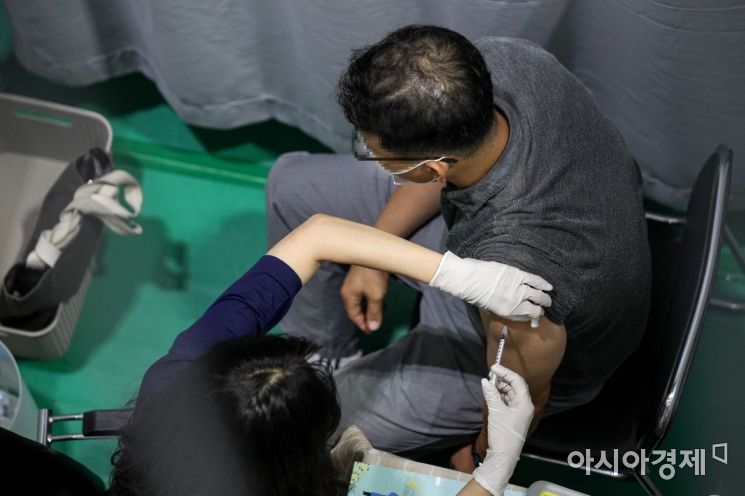 On the 5th, as the nationwide first-dose COVID-19 vaccination rate approaches 40 percent, a citizen visiting the vaccination center set up at Bukahyeon Culture and Sports Center in Seodaemun-gu, Seoul, is receiving the vaccine. Photo by Jinhyung Kang aymsdream@
However, the number of new domestic COVID-19 cases remains high at 1,776 today, indicating that the spread of infection continues. In particular, increased movement of hidden infected individuals during the holiday season is expected to pose a challenge to quarantine efforts. According to an analysis of mobile phone movement data by the Central Disaster and Safety Countermeasure Headquarters, nationwide movement during the past week (July 29 to August 1) totaled 234.15 million trips, a 3.6% (8.11 million trips) increase compared to the previous week (226.04 million trips).
Professor Cheon Eun-mi of Ewha Womans University Mokdong Hospital expressed concern, saying, "Most people do not get tested before symptoms appear even after returning from holiday destinations, so there are likely many hidden infections in the community."
The rapid spread of the Delta variant is also contributing to the increase in hidden infections. Moreover, among those infected with the Delta Plus variant, which combines the Delta variant with the K417N mutation, one case has an unidentified local transmission route. The Delta Plus variant is known to reduce vaccine effectiveness by approximately 2.7 to 5.4 times compared to the non-mutated virus.
Professor Lee Jae-gap of Hallym University Kangnam Sacred Heart Hospital emphasized, "With the baseline number of confirmed cases elevated due to the Delta variant, if the current situation continues for 2 to 3 weeks, the healthcare system could collapse. It is necessary for the quarantine authorities to make bold policy decisions on whether to continue current social distancing measures and slowly reduce the number of confirmed cases until 70% of the population is vaccinated, or to control the outbreak through 'plus alpha' measures."
© The Asia Business Daily(www.asiae.co.kr). All rights reserved.



















