[Asia Economy Reporter Jeong Hyunjin] A study has found that the Anshim Income System, which provides differentiated support based on income primarily targeting low-income groups, has a greater effect on reducing income disparity and relatively smaller negative impacts on the labor market and gross domestic product (GDP) compared to the universal basic income system that provides a fixed amount regardless of income or the expansion of the current welfare system.
The Korea Economic Research Institute under the Federation of Korean Industries announced this on the 5th through a report titled "Costs and Economic Effects of the Anshim Income System." The report estimated the additional budget required for the Anshim Income System at 29.7437 trillion KRW (based on 2019) and proposed a plan to support 50% of the amount obtained by subtracting current income from the standard income. The target was households with an annual income below the standard income, which was 55.36 million KRW for a four-person household (2019 median income).
Based on this, when calculating the eligible recipients and support amounts, it was estimated that 9.175 million households, accounting for 45% of all households, would receive an average of 5.002 million KRW per household annually. By household size, 58.9% of single-person households would receive 3.09 million KRW, 52.4% of two-person households would receive 5.566 million KRW, 29.4% of three-person households would receive 7.078 million KRW, 26.7% of four-person households would receive 7.099 million KRW, 41.6% of five-person households would receive 9.466 million KRW, and 50.9% of households with six or more members would receive 11.515 million KRW.
Professor Park Kisung of Sungshin Women’s University and Jo Kyungyeop, head of economic research at KERI, who authored the report, stated, "The central government's budget for welfare, labor, and health projects is expected to increase by 73 trillion KRW from 2020 to 2023. The 29.7437 trillion KRW required for the Anshim Income System accounts for 40.7% of the net increase in the budget and 85.2% of the recently passed supplementary budget of 34.9 trillion KRW in the National Assembly," adding, "We believe it is possible to secure the funds if the government has the will."
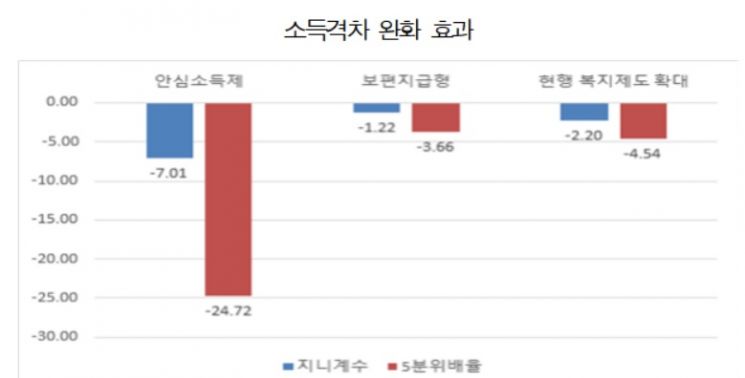
Using a Computable General Equilibrium (CGE) model, they compared the cases of using the additional budget of 29.7437 trillion KRW required for implementing the Anshim Income System on ▲ the Anshim Income System ▲ the universal basic income system ▲ and the expansion of the current welfare system.
As a result, the Anshim Income System reduced the Gini coefficient of disposable income by 7.0% and the quintile ratio by 24.7%, whereas the universal basic income system showed smaller reductions of 1.2% and 3.7%, respectively. The expansion of the current welfare system was analyzed to reduce the Gini coefficient by 2.20% and the quintile ratio by 4.54%. Since lower values of the Gini coefficient and quintile ratio indicate less income inequality, the claim is that the Anshim Income System has the greatest effect in alleviating income disparity.
Professor Park and Director Jo also projected that transfer income from the government to households induces an income effect that reduces labor supply, but the Anshim Income System would reduce labor supply the least. The increase in the unemployment rate due to the Anshim Income System was 0.03 percentage points, which was lower than the 0.30 percentage points increase caused by both the universal basic income system and the expansion of the current welfare system. Notably, the unemployment rates for the first and second income quintiles were expected to decrease by 1.4 percentage points and 0.18 percentage points, respectively, under the Anshim Income System.
They explained, "This is the result of the Anshim Income System replacing the livelihood benefits of the National Basic Livelihood Security System, which has hindered work incentives," estimating that the decrease in employed persons would be 186,000 under the Anshim Income System, while the universal basic income system and the expansion of the current welfare system would see decreases of 219,000 and 277,000 employed persons, respectively. Correspondingly, the GDP decline rates were analyzed as 0.24% for the Anshim Income System, 0.54% for the universal basic income system, and 0.49% for the expansion of the current welfare system, with the Anshim Income System showing the lowest impact.
Professor Park stated, "Instead of the complicated eligibility screening of existing welfare and labor systems, the Anshim Income System determines eligibility and support amounts based on income. It can be supported monthly and reconciled at year-end, similar to how the National Tax Service withholds taxes and conducts year-end tax adjustments," adding, "The Anshim Income System is a comprehensive welfare system that fills the blind spots of existing welfare programs and provides additional support."
© The Asia Business Daily(www.asiae.co.kr). All rights reserved.

















