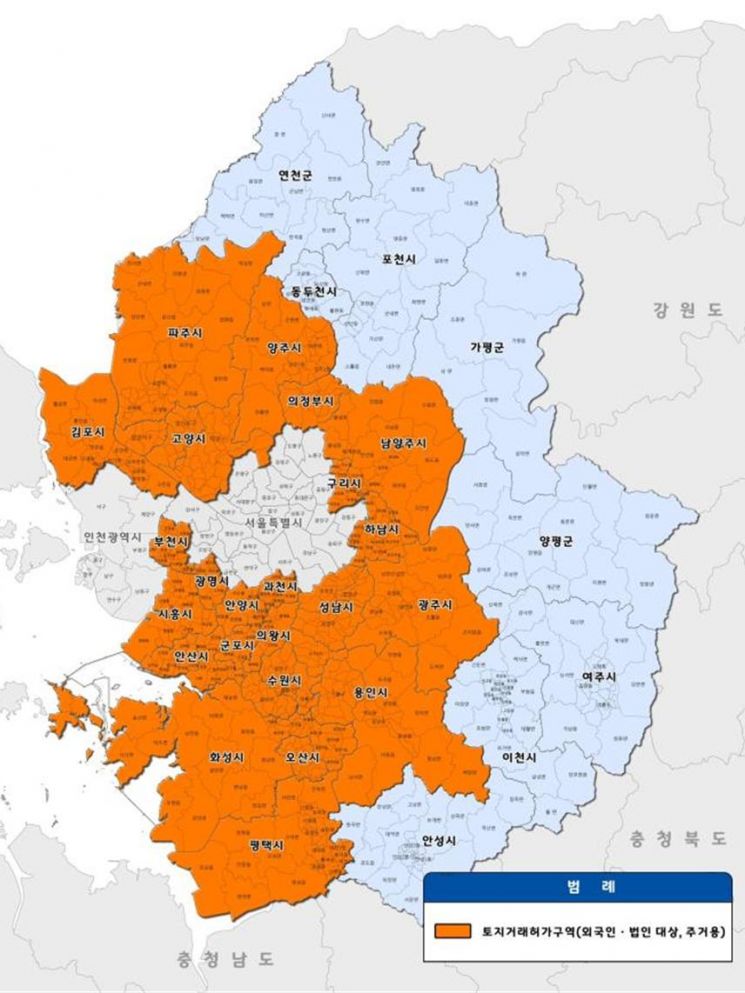
[Asia Economy (Suwon) = Reporter Lee Young-gyu] As a result of Gyeonggi Province designating the entire areas of 23 cities, including Suwon, as 'Land Transaction Permission Zones' for corporations and foreigners to curb speculative demand, the volume of housing transactions by corporations and foreigners decreased by 85% and 39%, respectively, compared to before the designation.
Earlier, on October 31 last year, Gyeonggi Governor Lee Jae-myung designated 23 entire areas (5,249.11㎢) within Gyeonggi Province, excluding Yeoncheon-gun, Pocheon-si, Dongducheon-si, Gapyeong-gun, Yangpyeong-gun, Yeoju-si, Icheon-si, and Anseong-si, as land transaction permission zones for foreigners and corporations.
The province compared the volume of housing transactions for corporations and foreigners in these areas during the 8 months before the designation (March to October last year) and the 8 months after the designation (November last year to June this year). The number of transactions by corporations dropped sharply from 10,376 before designation to 1,543 after designation, an 85% decrease. Housing transactions by foreigners also decreased by 39%, from 2,550 before designation to 1,565 after designation.
On the other hand, in the eight cities and counties, including Anseong-si, which were not designated as land transaction permission zones, the volume of housing transactions by corporations decreased by only 4%, from 926 to 887 during the same period. Housing transactions by foreigners rather increased by 40%, from 162 to 226.
In areas designated as land transaction permission zones for corporations and foreigners, corporations and foreigners wishing to acquire land including housing must obtain permission from the competent market authority, considering mandatory usage periods and actual demand.
Accordingly, the land transaction permission zones effectively make it impossible to engage in so-called 'gap investment,' where buyers purchase housing with jeonse (long-term deposit lease) without actual residence. Additionally, a mandatory usage period of two years is imposed, eliminating transactions aimed at short-term capital gains. Violations of permission-related regulations are punishable by imprisonment of up to two years or a fine of up to 30% of the individual publicly announced land price at the time of contract conclusion.
Kwon Kyung-hyun, head of the Land Information Division of the province, explained, "As a result of designating land transaction permission zones to suppress speculative demand from corporations and foreigners who fuel real estate price increases based on enormous financial power, the volume of real estate transactions by these two entities has decreased. This can be considered evidence that speculative demand has been curbed, and we will continue to implement strong and effective measures to stabilize the real estate market."
Meanwhile, the province has re-designated these 23 areas as land transaction permission zones until April 30 next year. This re-designation is based on the judgment that the recent surge in real estate transactions by corporations and foreigners was for speculative purposes rather than for business or actual residence.
© The Asia Business Daily(www.asiae.co.kr). All rights reserved.
![Clutching a Stolen Dior Bag, Saying "I Hate Being Poor but Real"... The Grotesque Con of a "Human Knockoff" [Slate]](https://cwcontent.asiae.co.kr/asiaresize/183/2026021902243444107_1771435474.jpg)
















