Lee Jae-myung's 'Basic Housing' Followed by Lee Nak-yeon's 'Relocate Seoul Airport for Housing Supply'
Funding Secured, Tax Resistance and Other Challenges... Effectiveness and Specificity Lacking
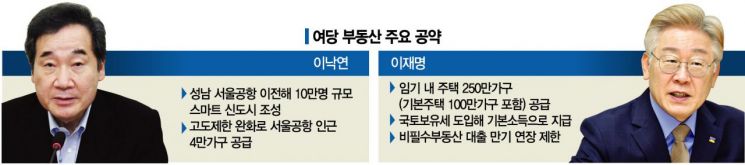
[Asia Economy Reporters Koo Chae-eun and Jeon Jin-young] The competition over real estate pledges among ruling party presidential candidates has intensified. On the 4th, former Democratic Party leader Lee Nak-yeon announced a pledge to expand supply by relocating Seoul Airport and building new towns, while earlier, Gyeonggi Province Governor Lee Jae-myung proposed the supply of 1 million “basic housing” units.
However, experts advised that there are many challenges such as site issues, securing funding, and tax resistance, and that it may take considerable time to realize these plans, so the pledges need to be further specified and refined.
On the morning of the same day, former leader Lee announced a real estate pledge centered on the “relocation of Seoul Airport” at the National Assembly communication center. Currently, Seoul Airport serves missions such as operating the presidential aircraft, hosting state guests, and operating transport and reconnaissance aircraft, but he proposed moving these functions elsewhere to use the site for housing.
He stated that 30,000 public housing units would be supplied on the Seoul Airport site, and an additional 40,000 units would be supplied in nearby areas by lifting height restrictions. Lee particularly said, “We will design various supply methods such as 50-year mortgages and 20-30 year long-term leases to create exclusive complexes for youth and newlyweds.”
However, he added, “We will protect the Greenbelt and raise the development profit recovery rate to 50% to prevent speculation.” The functions of presidential and state guest aircraft takeoff and landing will be relocated to Gimpo Airport, the US military flight squadron to Osan Pyeongtaek base, and the metropolitan area air defense functions to other bases.
The day before, Governor Lee also announced a real estate pledge centered on “2.5 million housing units during the term, including 1 million basic housing units.” This adds at least 450,000 units to the 2.05 million units the Moon Jae-in administration planned to supply by 2025 through the 2·4 supply plan, aiming to supply them by May 2027, when the next president’s term ends. Basic housing refers to high-quality public housing in good locations where anyone without a home, including the middle class, can live for life at affordable rents close to construction cost for over 30 years. He also proposed introducing a land ownership tax. This tax would be levied on all privately owned land, and the revenue would be paid as basic income through local currency.
Experts pointed out that the effectiveness and specificity of the two candidates’ pledges are lacking. Professor Seo Jin-hyung of Gyeongin Women’s University (President of the Korean Real Estate Society) said, “Both candidates seem to ignore the failures and side effects caused by various regulations under the Moon Jae-in administration and intend to control the market with even stronger regulations, which raises serious concerns.” Regarding Governor Lee’s “land ownership tax,” Professor Seo said, “There are lands that do not generate income, so it could excessively infringe on private property rights and result in double taxation with property tax.”
Regarding the relocation of Seoul Airport, he said, “Considering that even relocating the Air Force Academy took more than 10 years, (relocating the airport site) could take a very long time. It is a strategic key point, so it must be a cautious choice,” adding, “There will be many difficulties such as selecting alternative sites and consulting with local residents.” Professor Kwon Dae-jung of Myongji University’s Department of Real Estate said, “The relocation of Seoul Airport has repeatedly failed because it is a military facility,” and “It seems difficult to realize without coordination with the government.”
© The Asia Business Daily(www.asiae.co.kr). All rights reserved.
![Clutching a Stolen Dior Bag, Saying "I Hate Being Poor but Real"... The Grotesque Con of a "Human Knockoff" [Slate]](https://cwcontent.asiae.co.kr/asiaresize/183/2026021902243444107_1771435474.jpg)
















