Deliberation on Exceptions for Kindergarten and Grades 1-2 in Phase 4
Based on Concerns over Learning Loss, Social Skills, and Expanding Vaccination Rates
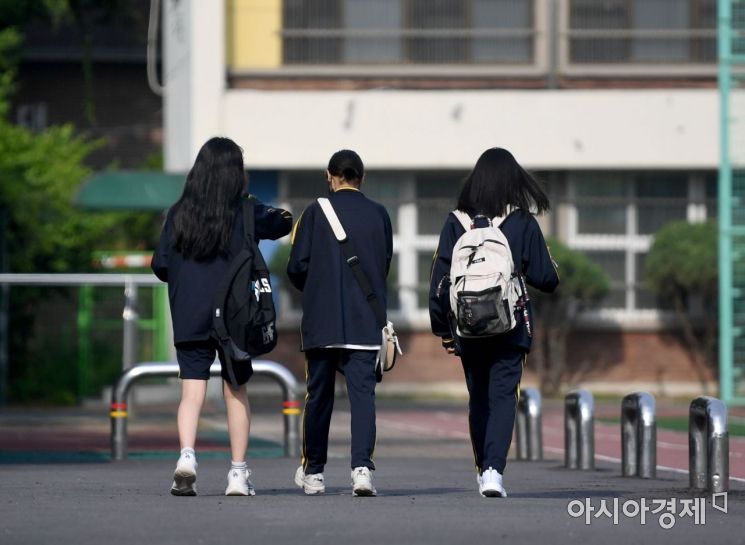 On the 14th, when in-person classes at middle schools in the Seoul metropolitan area were expanded, students are attending school at Eonju Middle School in Gangnam-gu, Seoul. 2021.6.14 Photo by Joint Press Corps (The school requested that students' faces not be shown. Please apply appropriate mosaics when using this image in print.)
Despite the spread of COVID-19, the Ministry of Education has decided to maintain its policy of expanding in-person attendance for the second semester. While full remote classes will be implemented under social distancing level 4, exceptions are being considered for kindergarteners and 1st to 2nd graders in elementary school. This decision is influenced by the accumulated learning and social deficits caused by over a year of remote classes, as well as the high vaccination rate, which supports maintaining the policy of expanding school attendance.
On the 3rd, Deputy Prime Minister and Minister of Education Yoo Eun-hye said at a meeting with representatives of teachers' organizations, "Health experts have also expressed the opinion that expanding in-person attendance is necessary for kindergartens and lower grades of elementary school." She added, "There is a diagnosis that students have had difficulty developing social skills through relationships with friends and teachers for one and a half years, and are experiencing emotional and psychological deficits, so it is necessary to quickly recover through in-person classes." Yoo explained, "Vaccinations for school staff will be completed by August, vaccinations for parents' age groups are planned to be completed by September, and vaccinations for academy workers are also steadily progressing," adding, "The increase in vaccination rates creates an environment that makes further expansion of in-person attendance possible."
The Ministry of Education is also considering changing school density standards according to social distancing criteria. There is a possibility that, as in the first semester, kindergartens and lower grades of elementary school may be excluded from the school density standards. This is based on the judgment that continuing remote classes until this semester under level 4 social distancing would negatively affect students' emotional development. The proportion of students below basic academic skills increased in last year's academic achievement assessment, and a survey by the National Education Council showed that 85.7% of parents and 87.6% of teachers are concerned about students' social skill development.
The Ministry plans to discuss vaccination plans for children aged 12 to 16 around the start of the second semester. If the vaccination target expands beyond high school seniors, the burden of increasing in-person classes can be reduced. Discussions are expected to intensify as early as the end of August.
Opinions on expanding in-person attendance are divided among teachers' organizations. More groups support expanding attendance, and some suggest adjusting school density by allowing full attendance at level 3 and prioritizing lower grades for in-person classes at level 4. A representative of the Korean Teachers and Education Workers Union (KTU) said, "We agree that students have suffered greatly from inadequate in-person classes and that educational recovery is necessary. Since it is difficult to predict the consequences if this damage accumulates, we believe that options to open schools as much as possible should be considered."
The Korea Federation of Teachers' Associations (KFTA) is negative about repeatedly revising school density standards according to social distancing levels. A KFTA official said, "Rather than suddenly changing student density standards by existing quarantine levels, since full in-person attendance in the second semester has become practically impossible, it is more important to clarify the position on this and promptly inform schools of the changed guidelines to minimize confusion," adding, "Quarantine safety is as important as children's social development, and it is natural to seek agreement from parents and teachers."
The Ministry of Education plans to announce details related to the operation of the second semester next week, reflecting opinions from meetings with metropolitan and provincial education offices, infectious disease experts, quarantine authorities, and teachers' organizations.
© The Asia Business Daily(www.asiae.co.kr). All rights reserved.

















