Last week, 1,929 of 2,109 confirmed variant cases were Delta variant
2 additional Delta Plus variant cases... "Possible community exposure"
Both cases were breakthrough infections 2 weeks after completing AZ vaccine vaccination
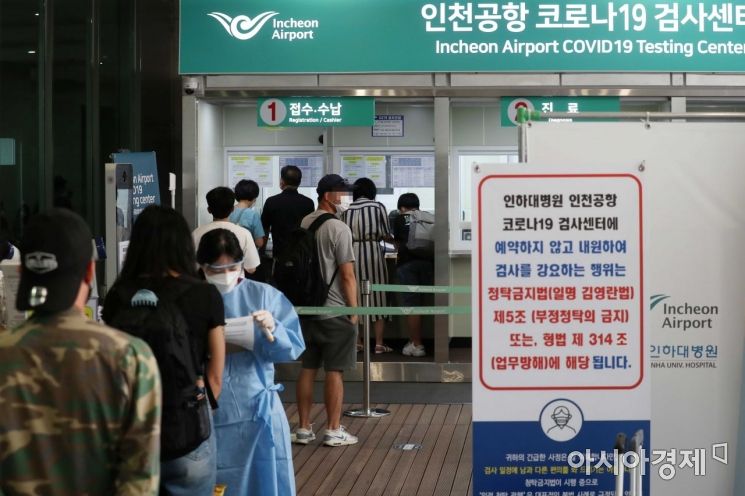 On the 29th, as the spread of the novel coronavirus infection (COVID-19) continues, citizens are waiting for tests at the COVID-19 testing center set up in the outdoor space on the west side of the basement level 1 of Terminal 2 at Incheon International Airport. The Korea Disease Control and Prevention Agency Central Disaster and Safety Countermeasures Headquarters announced that as of midnight, 1,674 new confirmed cases were reported, bringing the total number of confirmed cases to 195,099. Of the new confirmed cases, 1,632 were domestic transmissions and 42 were imported cases. Photo by Moon Honam munonam@
[Asia Economy Reporter Kim Ji-hee] Last week, 70% of domestic COVID-19 confirmed cases were found to be infected with variant viruses. Among the four major variants, the Delta variant accounted for an overwhelming majority. Additionally, the so-called 'Delta Plus' variant, derived from the Delta variant, was also confirmed, raising concerns among health authorities.
According to the Central Disease Control Headquarters (CDCH) on the 3rd, genetic analysis of COVID-19 confirmed cases over the past week (July 25?31) revealed that a total of 2,109 people were infected with variant viruses. Since December last year, the total number of variant virus cases confirmed domestically has increased to 8,125. Among the newly added 2,109 cases, the Delta variant originating from India accounted for 1,929 cases, making up more than 90% of all variants. This was followed by the UK-originated 'Alpha' variant with 176 cases, the South African 'Beta' variant with 2 cases, and the Brazilian 'Gamma' variant with 2 cases.
Regarding the infection routes, 1,869 cases were domestic infections, and 240 were imported cases. Among domestic infections, 1,701 were infected with the Delta variant. For imported cases, genetic analysis was conducted on 249 individuals, revealing a variant detection rate of as high as 96.4%. Combining domestic and imported cases, the overall variant detection rate was recorded at 70%.
Lee Sang-won, head of the Epidemiological Investigation and Analysis Division at the Central Disease Control Headquarters, emphasized during the regular COVID-19 briefing that "the most threatening factor for future outbreak forecasts is the emergence and dominance of variant viruses." He added, "Variants are known to increase transmission speed and reduce vaccine effectiveness, but this does not mean the role of vaccines has diminished. Until stabilization through high vaccination rates is achieved, it is still necessary to adhere to preventive measures and social distancing as outbreak suppression strategies."
Furthermore, the 'Delta Plus' variant derived from the Delta variant was confirmed domestically for the first time. Lee stated, "The Delta Plus variant has a neutralization resistance effect approximately 2.7 to 5.4 times greater than the original virus (how much the virus entering the body is blocked by antibodies). This is a figure not significantly different from the Delta variant, and further analysis is needed to understand its detailed characteristics."
There are a total of two confirmed cases of the Delta Plus variant in Korea. One is a man in his 40s with no history of overseas travel. After testing his family and coworkers, only one cohabiting family member has been additionally confirmed positive so far. The other case was confirmed positive after entering Korea from the United States.
Authorities are particularly focusing on the Delta Plus variant case with no overseas travel history. Park Young-jun, head of the Epidemiological Investigation Team at CDCH, explained, "The infection route is still under investigation, but there is no special overseas travel history, and the primary infected person has not yet been identified. We are investigating with the possibility that infection occurred through exposure in the local community in mind." He added, "Currently, one cohabiting family member has tested positive for COVID-19, while the other two cohabiting family members have tested negative. Approximately 280 contacts, including coworkers, were retested, but no additional confirmed cases have been found."
It is also notable that both Delta Plus variant cases were 'breakthrough infections' confirmed after completing two doses of the AstraZeneca (AZ) vaccine. The man in his 40s with no overseas travel history completed his second dose in mid-May and was confirmed positive at the end of last month. The imported case also received the AZ vaccine domestically, traveled to the United States, and tested positive on the 23rd of last month. Park emphasized, "Since this has only been confirmed in some cases so far, it is difficult to conclude that the possibility of breakthrough infection is higher based solely on these cases."
© The Asia Business Daily(www.asiae.co.kr). All rights reserved.

















