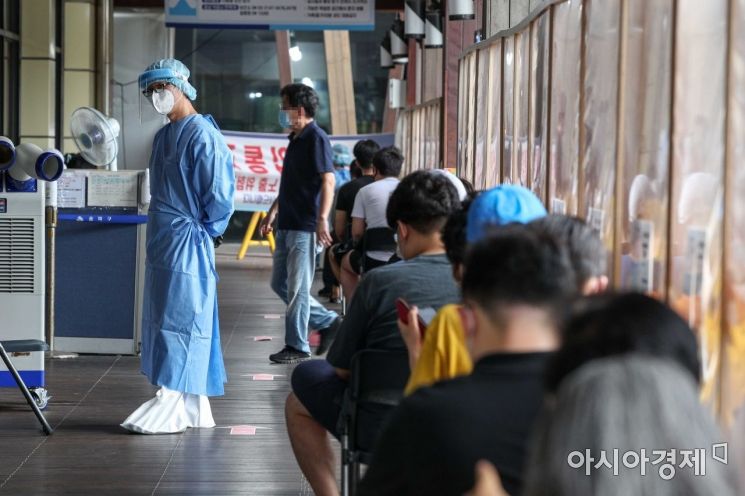
 On the 3rd, 1,202 new COVID-19 cases were reported, marking the fourth consecutive week with numbers in the 1,000s. Citizens waiting to be tested are lined up at a screening clinic set up at the Songpa-gu Public Health Center in Seoul. Photo by Jinhyung Kang aymsdream@
[Asia Economy Reporter Lee Chun-hee] As the spread of the 4th wave of COVID-19 subsides, the daily increase in new confirmed cases appears to be somewhat slowing down. While attention is focused on the effectiveness of the implementation of high-intensity social distancing measures, authorities are still taking a cautious stance.
According to the Central Disease Control Headquarters on the 3rd, as of midnight, the number of new COVID-19 confirmed cases was 1,202. This marks the second consecutive day with figures in the 1,200 range. Even considering the so-called "weekend effect," where the number of diagnostic tests decreases on weekends, this is an 11.8% decrease compared to 1,363 cases on the same day last week.
This trend of new confirmed cases is the first stagnation observed since the 4th wave began. Since the early part of last month when the wave intensified, the number of confirmed cases increased daily compared to the previous week, but from the 31st of last month, the numbers have slightly decreased for five consecutive days compared to the previous week. Accordingly, the weekly average number of locally transmitted cases, a key indicator for adjusting social distancing levels, is also showing a downward trend. It had nearly reached 1,521.1 cases on the 30th of last month but has significantly decreased to 1,467 as of today.
While authorities express hope regarding this decline, they remain cautious. Prime Minister Kim Boo-kyum presided over the Central Disaster and Safety Countermeasure Headquarters meeting this morning and said, "Although the increase in the metropolitan area has somewhat slowed recently, the overall spread seems to continue." Son Young-rae, head of the Social Strategy Division at the Central Disaster and Safety Countermeasure Headquarters, also stated at a briefing yesterday, "The stagnation of the COVID-19 spread in the metropolitan area is a meaningful achievement," but added, "It is still difficult to know whether this will turn into a decline, so we need to observe the trend this week."
Experts also expressed that it is still difficult to ease the reins on quarantine measures and that the situation must be monitored. Professor Chun Eun-mi of the Department of Respiratory Medicine at Ewha Mokdong Hospital said, "The current stagnation is partly due to the effect of social distancing, but it is also a kind of optical illusion caused by the reduced floating population in the metropolitan area during the holiday season," and predicted, "There is a high possibility that the spread will increase again as infections occur at holiday destinations." She advised, "The best measure is to block movement," and recommended, "Increasing remote work, strengthening restrictions on operating hours of multi-use facilities, and banning gatherings at entertainment establishments outside the metropolitan area are necessary to close gaps in quarantine."
Authorities are deliberating adjustments to social distancing measures to be applied from next week. The current social distancing levels?Level 4 in the metropolitan area and Level 3 in non-metropolitan areas?are set until the 8th. Authorities plan to observe the trend of the outbreak a little longer this week and announce the final discussion results toward the end of the week. Prime Minister Kim said, "This week is the last chance to stop the outbreak," and urged, "Local governments should also carefully analyze the quarantine situation by region and boldly implement additional quarantine strengthening measures if necessary."
© The Asia Business Daily(www.asiae.co.kr). All rights reserved.

















