July Consumer Price Trends
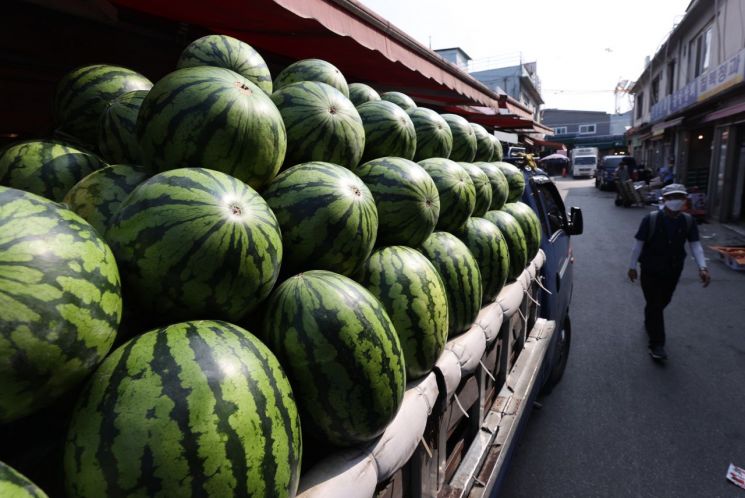 Watermelon prices are soaring under the scorching heat. The photo shows watermelons loaded on a truck at a traditional market in Seoul.
 [Image source=Yonhap News]
[Asia Economy reporters Son Seon-hee (Sejong), Jang Se-hee, Moon Chae-seok (Sejong)] As the Chuseok holiday approaches next month, alarm bells have been rung over price management in the second half of the year. Due to the aftermath of avian influenza (AI) causing a shortage of laying hens, combined with livestock deaths from the heatwave, egg prices have soared to unprecedented levels. Prices of livestock products, vegetables, and fruits have also continued to surge amid a sharp increase in demand during the vacation season. Not only food prices but also transportation costs have risen due to high oil prices, increasing the burden on the everyday economy.
◆ Consumer Price Index for Living Necessities Rises Most in 3 Years and 11 Months... Impact on Low-Income Households' Food Prices= According to Statistics Korea on the 3rd, food prices last month rose 6.4% compared to the same month last year. Looking at detailed items, fruit prices surged by 19.5%, overshadowing other categories. According to the Korea Agro-Fisheries & Food Trade Corporation (aT) Agricultural Products Distribution Information System (KAMIS), as of the previous day, the price of spinach (standard grade, 1kg) was 20,631 KRW, nearly double (94.0%) compared to last year (10,634 KRW). In Daegu, where the heatwave was severe, it was traded at 29,950 KRW (highest price), nearly reaching 30,000 KRW. Summer seasonal fruits such as watermelon (standard grade, 1 piece) were priced at 24,458 KRW, up 36.6% from 17,904 KRW a year ago, and oriental melon (standard grade, 10 pieces) rose 22.0% to 16,507 KRW from 13,521 KRW last year. Garlic (standard grade, 1kg, 12,199 KRW) and red pepper powder (standard grade, 1kg, 39,218 KRW) also saw price increases of 31.6% and 50.6%, respectively.
Other items such as milk, cheese, and eggs (11.3%) also showed double-digit increases, followed by meat (7.7%) and bread and grains (7.5%). Looking at the overall agricultural, livestock, and fishery products, prices rose 9.6% compared to a year ago, continuing an upward trend for over a year and a half since January 2020. This is attributed to poor crop yields since the end of last year and the recent heatwave. However, this year marks the first time the increase rate has fallen into single digits, indicating a slight slowdown in the rise.
Transportation costs also rose 7.6% compared to a year ago. Eo Un-seon, head of the Economic Trend Statistics Division at Statistics Korea, said, "Prices of petroleum products such as gasoline, diesel, and LPG rose due to the increase in most international oil prices."
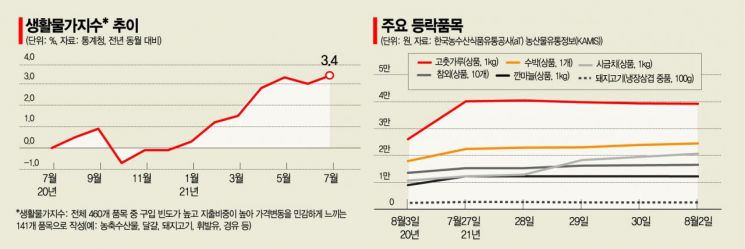
As prices of items closely related to daily life rose significantly, the consumer price index for living necessities recorded 107.96 last month, up 3.4% from the same month a year ago. This is the largest increase in 3 years and 11 months since August 2017 (3.5%). The consumer price index for living necessities is a separate indicator compiled for 141 items out of a total of 460 items, selected based on high purchase frequency and expenditure share, meaning that the perceived inflation rate is higher.
◆ What about the impact of disaster relief funds next month? Diverging forecasts for second-half inflation= Last month, the inflation rate recorded 2.6%, marking four consecutive months of inflation in the 2% range since April (2.3%). The government initially expected inflation to stabilize gradually after showing around 2% in the second half of the year, but it started off exceeding the mid-2% range, missing the forecast.
There are concerns that the COVID-19 coexistence national support fund (250,000 KRW per person), which is expected to begin distribution as early as the end of this month, will further fuel this inflation trend. There are criticisms that inflation stabilization and the national support fund policy are conflicting.
Professor Andong-hyun of Seoul National University’s Department of Economics said, "Since the fiscal support fund is given in cash, even if some leakage occurs, it will definitely be used for consumption," adding, "Fiscal spending inevitably acts to induce inflation." He also added, "Considering the recent increase in gold consumption demand, there seems to be an inflation expectation sentiment."
Opinions on the inflation outlook for the second half of the year are divided between government authorities and experts. Professor Kim Sang-bong of Hansung University’s Department of Economics expressed concern, saying, "Currently, inflation in South Korea is at a very high level compared to growth. While supply-side factors were dominant due to production constraints, now demand-side pressures could become very strong." He added, "With herd immunity expected in November, demand-side pressures will increase further, and demand such as travel will rise earlier from October, potentially pushing prices up."
◆ Inflation Becomes a Complex Equation... Electricity and Rebar Prices Also Variables= Risks of electricity bill hikes for small business owners and rising raw material prices such as rebar are also significant. Last month, electricity, gas, and water charges rose 0.3% compared to a year ago, marking an upward trend for the first time in 1 year and 1 month since June last year. Water charges increased by 2.7%, and city gas by 0.3%. Electricity charges fell by 0.4%. A Statistics Korea official explained, "The effect of the city gas fee reduction implemented in July last year disappeared, leading to the price increase. Electricity charges were affected by the application of the oil price linkage system and the reduction of the essential usage discount for residential customers."
© The Asia Business Daily(www.asiae.co.kr). All rights reserved.


















