Delta variant acquires Beta variant's 'K417N' mutation
Experts warn of possible combination of Delta's 'transmissibility' and Beta's 'vaccine evasion'
Emergency alert in quarantine amid stagnation of 4th wave
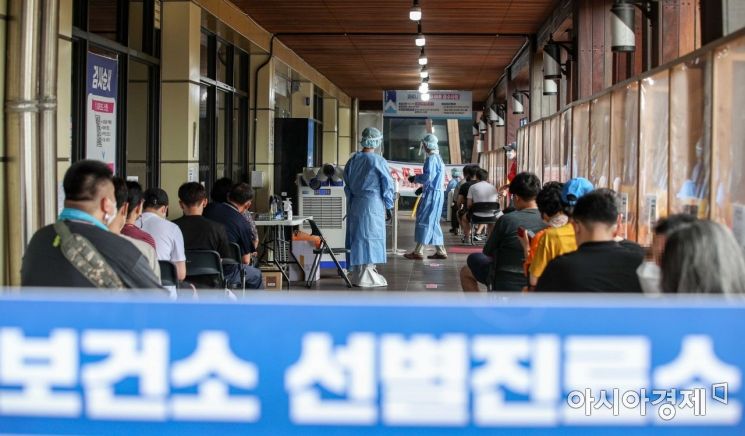 On the 3rd, 1,202 new COVID-19 cases were reported, marking the fourth consecutive week with daily cases in the 1,000 range. Citizens waiting to be tested at a screening clinic set up at Songpa-gu Public Health Center in Seoul. Photo by Jinhyung Kang aymsdream@
[Asia Economy Reporters Jihee Kim and Chunhee Lee] As the ‘Delta variant,’ a type of COVID-19 variant virus, rapidly emerges as the dominant strain, cases of the ‘Delta Plus’ variant infection have also been confirmed domestically. The Delta Plus variant, an evolved form of the Delta variant, is known to have a stronger transmissibility than the Delta variant, raising concerns.
According to the Central Disease Control Headquarters on the 3rd, two cases of Delta Plus variant infections were recently confirmed. Among the two infected with the Delta Plus variant, one person entered the country from abroad, but the other had no history of overseas travel. Regarding the case of a man in his 40s who may have been infected domestically, tests of contacts such as family members and coworkers have so far revealed no additional confirmed cases except for one cohabiting family member. Although the cohabiting family member who was confirmed positive is also presumed to be infected with the Delta Plus variant, genome analysis results to confirm the variant have not yet been released. The Central Disease Control Headquarters stated that the infection route is currently under investigation concerning the case with no overseas travel history.
The Delta Plus variant is a type of COVID-19 variant virus derived from the Delta variant. It combines the ‘K417N’ mutation trait found in the South African ‘Beta variant’ and the Brazilian ‘Gamma variant’ with the India-origin Delta variant. It is presumed to have stronger transmissibility than the Delta variant, but due to the small number of global infection cases, detailed research results have not yet been published. The Delta Plus variant was first reported in Europe in March this year, and infection cases were confirmed in more than ten countries worldwide, including Japan, the United States, and Israel, in early last month. Professor Eunmi Cheon of the Respiratory Medicine Department at Ewha Mokdong Hospital explained, “The Delta Plus variant carries the K417N mutation of the Beta variant, which has strong vaccine evasion ability. Therefore, it is likely to exhibit not only the strong transmissibility of the Delta variant but also a strong ability to evade vaccines or antibody treatments.”
There is also analysis suggesting that more attention should be paid to the continuous influx of new variants rather than the significance of the Delta Plus variant itself. Professor Jaehun Jeong of the Department of Preventive Medicine at Gachon University Gil Medical Center said, “It should be understood as meaning that evolved variants are continuously appearing and entering the country,” adding, “To respond to variants, it is necessary to raise the vaccination rate to at least 70% to lower the risk of COVID-19 and keep transmissibility at a manageable level.”
With the spread of the Delta variant compounded by the Delta Plus variant, efforts to block the fourth wave of the pandemic are expected to become more challenging. As of midnight on the day, 1,202 new COVID-19 cases were reported, marking the second consecutive day with over 1,200 cases. Although four weeks of four-digit case numbers continue, the number is 11.8% lower than the same day last week (1,363 cases), indicating a plateauing trend.
Authorities are deliberating adjustments to social distancing measures to be applied from next week. The current social distancing levels?Level 4 in the metropolitan area and Level 3 in non-metropolitan areas?are set until the 8th. The authorities plan to observe the trend of the outbreak a bit longer this week and announce the final discussion results around the weekend. Prime Minister Koo Kyung-hwan said, “This week is the last chance to stop the outbreak,” urging, “Local governments should carefully analyze the regional quarantine situation and boldly implement additional quarantine strengthening measures if necessary.” Professor Cheon emphasized, “The current plateau is a kind of optical illusion caused by reduced population movement in the metropolitan area during the vacation season,” adding, “We need to plug gaps in quarantine by increasing remote work, strengthening restrictions on operating hours of multi-use facilities, and banning gatherings at entertainment venues in non-metropolitan areas.”
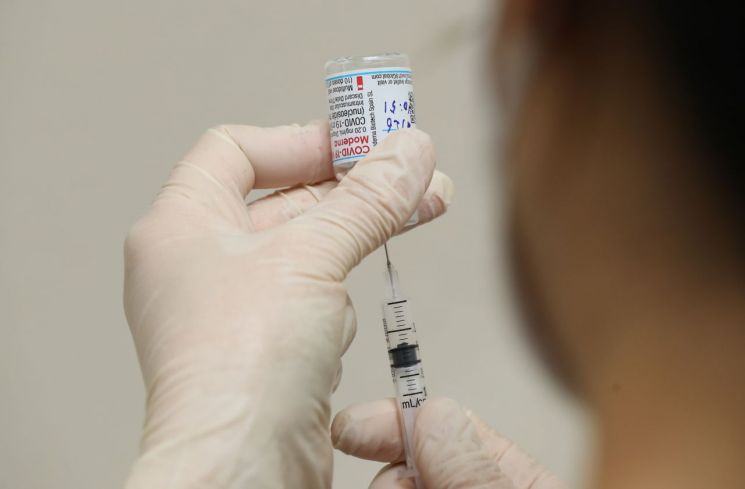
Meanwhile, as of 10:20 a.m. on the same day, the number of people who received the first dose of the COVID-19 vaccine surpassed 20 million, reaching 20,004,714. It has been 159 days since the first vaccination started on February 26. This corresponds to about 39% of the total population.
© The Asia Business Daily(www.asiae.co.kr). All rights reserved.


















