[Asia Economy Reporter Kwangho Lee] The ‘Interest Rate Rise Risk Mitigation Mortgage Loan’ product, reintroduced after two years, is being ignored in the market. Despite extensive promotion by financial authorities, the total number of subscriptions at major commercial banks is a meager 15 cases, falling far short of expectations. This is because, amid the ongoing ‘interest rate inversion phenomenon’ where mixed-type (5-year fixed) mortgage loan rates are lower than variable mortgage loan rates, there are few borrowers willing to use the interest rate rise-type mortgage loan product that includes an additional margin rate. Banks also appear reluctant to actively recommend subscriptions for this reason.
Reintroduced under Financial Authorities’ Initiative After 2 Years... Only 14 Subscriptions in 19 Days
According to the banking sector on the 3rd, as of the 2nd, the subscription performance for interest rate rise-type mortgage loans at the five major banks?KB Kookmin, Shinhan, Hana, Woori, and NH Nonghyup?was 14 cases (2.137 billion KRW). Among these, two banks reported no subscriptions at all.
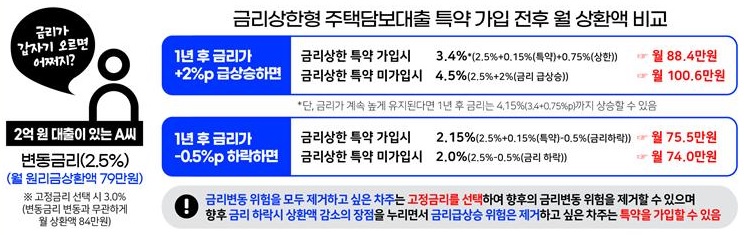
Under the leadership of financial authorities, 15 banks launched the interest rate cap-type mortgage loan on the 15th of last month. This product limits the annual interest rate increase to 0.75 percentage points and the increase over five years to within 2 percentage points. However, an additional margin rate of 0.15 to 0.2 percentage points is applied.
For example, a borrower who took out a 200 million KRW 30-year variable mortgage loan (2.5% annual interest rate, monthly principal and interest payment of 790,000 KRW) and subscribes to the interest rate cap-type mortgage loan special contract would, even if the interest rate soars to 4.5% (monthly 1,006,000 KRW) after one year, only have to bear an interest rate of 3.4% (2.5% + 0.75% + 0.15%, monthly 884,000 KRW) due to the cap (0.75 percentage points). Conversely, even if the interest rate falls to 2.0%, the borrower only needs to pay the additional margin rate of 0.15 percentage points, so the benefit of interest reduction from the rate drop is largely preserved.
Variable Mortgage Loan Rates Stable, No Customers Switching Despite Margin Rate
Nevertheless, the product receives little attention in the market because the gap between mixed and variable mortgage loan rates is judged to be larger than the expected future increase in variable mortgage loan rates.
Variable mortgage loans typically move in line with COFIX (Cost of Funds Index) and the 5-year financial bond rates. As of the 16th of last month, the variable mortgage loan rates at these banks ranged from 2.49% to 4.03% annually. Meanwhile, mixed mortgage loan rates ranged from 2.89% to 4.48%, with both the upper and lower bounds more than 0.4 percentage points higher than variable mortgage loan rates. In other words, to benefit from principal and interest reduction by choosing the interest rate cap-type mortgage loan, the interest rate must rise at least above the special contract rate, which currently makes subscription unnecessary.
A bank official explained, "Conditions vary by bank, and in some cases, the gap between mixed and variable mortgage loan rates is close to 1 percentage point," adding, "It is difficult to recommend the interest rate rise-type mortgage loan to borrowers since it includes an additional margin rate."
Another official said, "As far as I know, no borrowers have inquired about the interest rate rise-type mortgage loan at sales counters yet," and predicted, "With variable mortgage loan rates based on COFIX remaining stable, there will be no customers willing to switch to the interest rate rise-type mortgage loan and pay more interest."
For these reasons, variable mortgage loans accounted for 81.5% of new household loans at banks at the end of June, marking the highest level in 7 years and 5 months since January 2014 (85.5%).
A financial authority official emphasized, "Whether to extend the system will be decided based on operational performance over the next year," and added, "We will continue to improve measures to respond to the increasing household burden due to rising interest rates."
© The Asia Business Daily(www.asiae.co.kr). All rights reserved.
![Clutching a Stolen Dior Bag, Saying "I Hate Being Poor but Real"... The Grotesque Con of a "Human Knockoff" [Slate]](https://cwcontent.asiae.co.kr/asiaresize/183/2026021902243444107_1771435474.jpg)
















