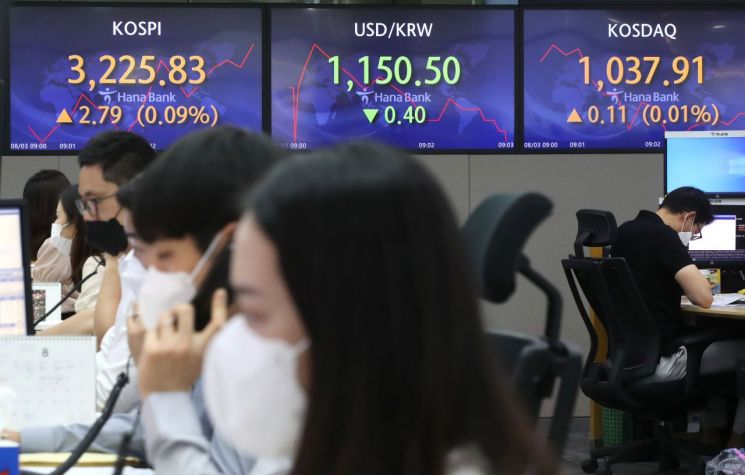
[Asia Economy Reporter Lee Seon-ae] As foreigners turn their backs on the domestic stock market, concerns about a prolonged correction are growing, and voices are rising that attention should be paid to large-cap stocks whose prices have fallen due to the "foreigners' selling offensive." It is expected that once macro uncertainties ease, foreigners will resume net buying centered on large-cap stocks, creating a selling vacuum that calls for so-called "large-cap looting."
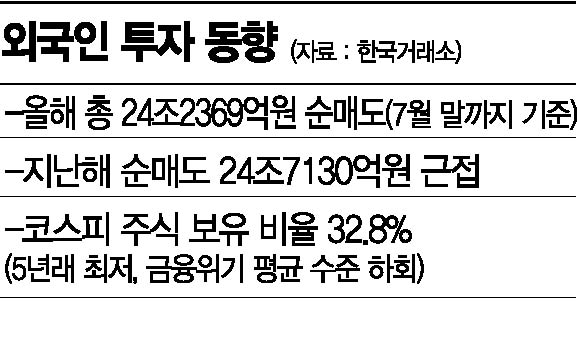
According to the Korea Exchange on the 3rd, foreigners have net sold a total of 24.236 trillion KRW in the domestic stock market through the end of July this year. This amount is close to last year's total annual net selling by foreigners (24.713 trillion KRW). Except for April (net buying of 83 billion KRW), foreigners consistently net sold for the other six months, thoroughly ignoring the market. The background of foreigners' net selling is mainly attributed to macroeconomic burdens such as the sharp rise in US inflation and uncertainty over the Federal Reserve's tightening cycle.
Currently, the proportion of foreigners in the KOSPI market (stock holding ratio) has fallen to 32.8%, below the average level during the financial crisis. This is the lowest level in over five years since August 17, 2016 (34.03%). Over the past decade, there have been four periods, including this one, when foreigners' holding ratio shrank. The average selling period for each phase ranged from six months to one year. Among them, 2018-2019 was a period marked by profit declines due to the US-China trade dispute. The 2014-2015 period was a profit growth phase, but downward revisions to profit consensus reduced the attractiveness of the domestic stock market.
Experts believe that it is only a matter of time before foreigners return. When macro uncertainties ease, it is highly likely that foreigners will resume increasing their Korean holdings. The Korean stock market is attractive in terms of valuation. The KOSPI valuation dropped to 11.3 times (based on Bloomberg) last week, approaching the lowest level since the beginning of the year. Moreover, the current period is neither a profit decline phase nor a period of downward consensus revisions. Lee Jae-sun, a researcher at Hana Financial Investment, analyzed, "The 2021 operating profit consensus for KOSPI has been steadily revised upward, and the strength of profit improvement since the beginning of the year is relatively strong compared to other regions."
Accordingly, the securities industry judges that now is the time to build an investment portfolio strategy in preparation for the return of foreigners. The focus of experts is on large-cap stocks. Kiwoom Securities researchers Han Ji-young and Choi Jae-won said, "The fact that semiconductor sectors such as Samsung Electronics and SK Hynix account for over 30% of the domestic stock market capitalization means these sectors can be considered the Korean stock market itself (Samsung Electronics and other semiconductor stocks are commonly included among the top in value and growth indices)," adding, "Therefore, when macro uncertainties ease, foreigners are expected to resume net buying centered on these sectors."
In fact, foreign demand for large-cap stocks such as semiconductors and automobiles is currently absent. In July alone, foreigners' net selling in the KOSPI was about 5 trillion KRW, of which approximately 3.4 trillion KRW was in the semiconductor sector, followed by automobiles at 1 trillion KRW.
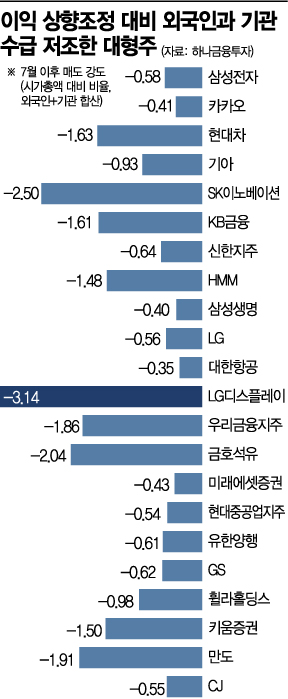
Large-cap stocks have shown weakness continuously since the beginning of the year due to thin institutional and foreign demand. Their relative strength compared to small and mid-cap stocks is near the lowest level since 2019, a period of profit decline. The estimated proportion of operating profits for large-cap stocks within the KOSPI began to rebound again in July 2021. The researcher said, "Attention should be paid to large-cap stocks where foreign and institutional demand has been weak despite upward profit revisions within the KOSPI." Based on the combined selling intensity of foreigners and institutions as of July, he listed Samsung Electronics, Kakao, Hyundai Motor, Kia, SK Innovation, KB Financial, Shinhan Financial Group, HMM, Samsung Life Insurance, LG, Korean Air, LG Display, Woori Financial Group, Kumho Petrochemical, Mirae Asset Securities, Hyundai Heavy Industries Holdings, Yuhan Corporation, GS, Fila Holdings, Kiwoom Securities, Mando, and CJ as stocks of interest.
A private banker at a securities firm hinted, "Undervalued large-cap stocks are more stable because they have a lower possibility of loss compared to small and mid-cap stocks," adding, "Major retail investors are already showing investment movements in large-cap stocks that have been placed at the lower end of the short-term box range and ignored in terms of demand."
© The Asia Business Daily(www.asiae.co.kr). All rights reserved.
![Clutching a Stolen Dior Bag, Saying "I Hate Being Poor but Real"... The Grotesque Con of a "Human Knockoff" [Slate]](https://cwcontent.asiae.co.kr/asiaresize/183/2026021902243444107_1771435474.jpg)

















