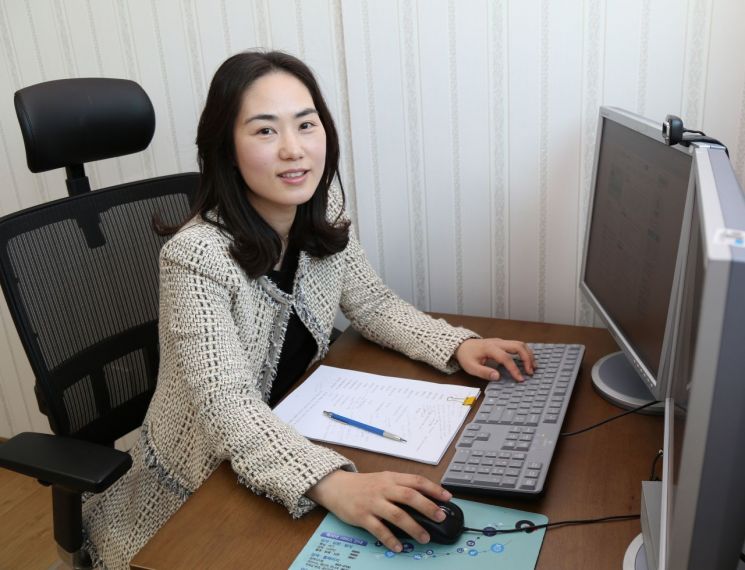
 The Korean Intellectual Property Office (KIPO) is increasing the proportion of employees working from home to over 50% to prevent the spread of COVID-19 within the public sector. A KIPO employee working from home is handling tasks remotely. Photo by KIPO
[Asia Economy (Daejeon) Reporter Jeong Il-woong] The Korean Intellectual Property Office (KIPO) announced on the 3rd that it will expand the telecommuting rate to over 50% to prevent the spread of COVID-19 in the public sector.
As of the end of June, the telecommuting rate at KIPO was 36% of all employees (628 people). However, with the daily average of new COVID-19 cases in Daejeon, where the headquarters is located, exceeding 70 and the implementation of social distancing level 4, KIPO explained that it proactively increased the telecommuting rate.
One reason KIPO could increase the telecommuting rate is that a remote work environment has been established where no work gaps occur even if all employees work from home.
Previously, KIPO pre-distributed dedicated PCs, laptops, monitors, and other IT equipment to telecommuters, and considering the nature of handling unpublished patent information, strengthened security by enabling the use of encrypted networks at home.
Additionally, KIPO plans to proactively respond to COVID-19 by actively utilizing flexible work systems such as staggered working hours, selectable working hours, and non-face-to-face work environments like video conferencing.
At the early stage of the COVID-19 outbreak, major patent offices in the United States, Europe, Singapore, and other countries also implemented telecommuting for all employees except a few essential staff to prevent the spread of COVID-19 and create an efficient work environment.
KIPO Commissioner Kim Yong-rae said, “With the nationwide unprecedented increase in COVID-19 spread risk due to the Delta variant, it is time for the government, public institutions, and general companies to actively adopt and expand telecommuting to join forces in overcoming COVID-19.”
Meanwhile, KIPO has operated a telecommuting system since 2005, the first in the public sector. It is recognized as a ministry where work-life balance and an efficient work environment have been established by activating flexible work systems such as telecommuting and staggered working hours.
© The Asia Business Daily(www.asiae.co.kr). All rights reserved.
![Clutching a Stolen Dior Bag, Saying "I Hate Being Poor but Real"... The Grotesque Con of a "Human Knockoff" [Slate]](https://cwcontent.asiae.co.kr/asiaresize/183/2026021902243444107_1771435474.jpg)
















