Public Land Development Promoted but Zero Districts Designated
Resident Opposition Creates Obstacles for Taereung Golf Course Development
Public Maintenance Projects Also Slow
Only Five Sites Secure Resident Consent for Public Redevelopment

[Asia Economy Reporters Kim Hyemin and Lim Onyu] The government's plan to supply about 130,000 households in the Seoul area, announced last year as the August 4th measures, has failed to gain momentum for a year because it has not properly managed the strong public opinion of residents. Critics point out that the 'one-way' policy of blindly increasing supply without a systematic urban plan that considers the living conditions and interests of nearby residents is rather causing the supply to drift.
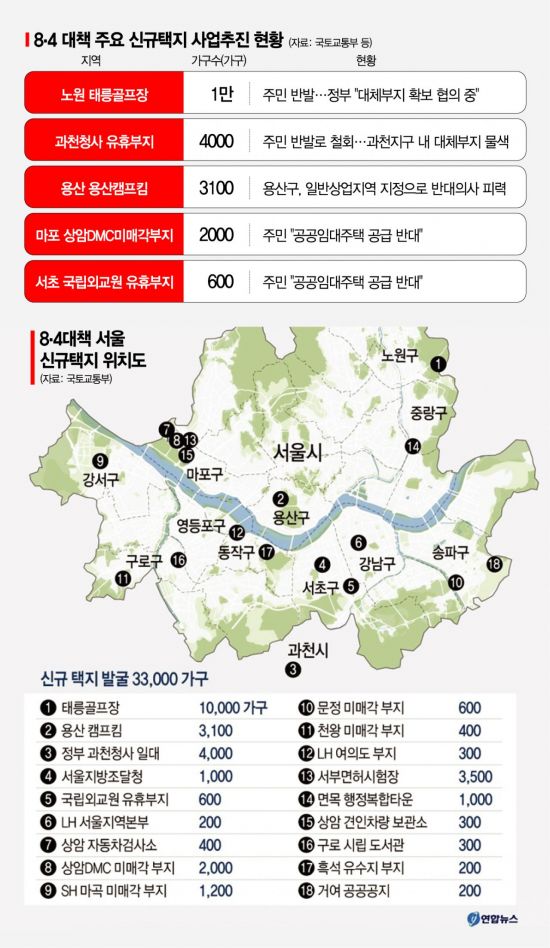
◆ Stalled or canceled... sluggish land development = The August 4th measures marked a turning point where the government acknowledged the limitations of its regulation-focused real estate policy and shifted toward expanding supply. At the time, the government pledged to develop prime land such as the Taereung Golf Course in Nowon-gu, Seoul (10,000 households) and Yongsan Camp Kim in Yongsan-gu (3,100 households). The plan was to develop a total of 18 sites and supply 33,000 households in downtown Seoul.
However, so far, no site has gone through the approval procedures such as district designation, district planning, or project plan approval. It is uncertain whether housing supply will proceed as the government desires. Fierce opposition from residents and local governments continues over new land development. The plan to supply 4,000 households around the Gwacheon government complex was fully revised in June. As opposition continued, including a recall of Mayor Kim Jongcheon of Gwacheon, the government canceled the plan entirely. As an alternative, the number of houses in the Gwacheon district of the 3rd new town will be increased, but the supply volume will be significantly reduced compared to before.
The largest-scale Taereung Golf Course development has also hit obstacles. Nowon-gu residents strongly oppose apartment supply due to traffic congestion and green space destruction. Nowon-gu has also requested that the supply volume be halved to 5,000 households. The Ministry of Land, Infrastructure and Transport says it may consider alternative sites if secured, but realistically, this is difficult. Since large-scale complexes have been built in Nowon-gu since the 1980s, the apartment residence rate is currently about 80%, leaving no vacant land.
The Yongsan Camp Kim site, vacated due to the relocation of U.S. Forces Korea, is also facing active opposition from local governments as it conflicts with the existing plan to develop the area as a commercial zone. Residents are also strongly opposing public rental-focused supply at the Seobu Driver's License Test Site in Mapo-gu and the unsold site in Sangam DMC.
◆ Public redevelopment projects with difficult resident consent = Public redevelopment and public reconstruction projects are also progressing slowly. Public redevelopment selected a total of 28 candidate sites in Seoul and Gyeonggi Province within a year, but only 5 sites have secured resident consent rates (50% or 66.7%). Among these, only 4 sites have designated or are in the process of designating Korea Land & Housing Corporation (LH) and Seoul Housing & Communities Corporation (SH) as joint project implementers. Public reconstruction initially promised to supply 50,000 households, but currently, there are only 4 candidate sites with a planned volume of just 1,537 households.
The slow progress is because the government has not properly managed the pros and cons of public opinion based on interests. For example, in Heukseok 2 District, Dongjak-gu, Seoul, a redevelopment district cancellation petition was submitted simultaneously with the joint project implementer designation consent form. The supporters plan to complete the approval process within the year, but commercial property owners, who hold 70% of the land, strongly oppose it.
In Gangbuk 5 District, Gangbuk-gu, an administrative lawsuit to cancel the district designation is underway, led by an emergency countermeasure committee centered on commercial property owners. The Yongdu 1-6 District in Dongdaemun-gu, which has designated a joint project implementer, includes Cheongnyangni Fish Market, raising concerns about conflicts with merchants during compensation negotiations. As the resident consent rate has been lowered, conflict management capabilities are more required than ever, but these have not been properly handled.
Jang Jaehyun, head of research at Realtoday, said, "The housing price problem should be solved by supply, but public supply has been insufficient throughout the four years of the Moon Jae-in administration," adding, "Trying to speed up recklessly without incentives inevitably leads to resident opposition."
© The Asia Business Daily(www.asiae.co.kr). All rights reserved.


















