Local Consumption Tax to Increase by 4.3%P from Next Year
1 Trillion Won Regional Extinction Response Fund Established
Additional 1%P Tax Rate Increase Effect
Experts: "Prioritize Efficiency... Local Governments Should Also Strive to Expand Revenue"
[Asia Economy Reporter Jang Sehee] As the ruling party and government accelerate fiscal decentralization efforts, concerns are emerging that the central government's fiscal capacity may decline further compared to the current level. With plans to raise the local consumption tax rate from the current 21% to 25.3% and simultaneously establish a 1 trillion won Regional Extinction Response Fund, rapid structural changes are expected in the short term.
◆Local government debt decreases... but fiscal decentralization accelerates= According to the ruling party and government on the 2nd, the local consumption tax rate, currently at 21%, will be increased by 4.3 percentage points starting next year. Additionally, if the concurrently pursued 1 trillion won Regional Extinction Response Fund is established, it will have the effect of an additional 1 percentage point increase in the tax rate. The central government subsidy rate for the basic pension, which averaged 79.2%, is also planned to be raised to a maximum of around 90% by the ruling party and government.
This aligns with the Moon Jae-in administration's policy direction to expedite fiscal decentralization, but considering the rapid increase in central government debt, concerns are raised about the central government's fiscal management capacity. Even if unpredictable emergencies like COVID-19 occur, there may be insufficient capacity to push for supplementary budgets through central government resources. The government poured 49.8 trillion won in fiscal resources for additional COVID-19 responses as of the first half of this year.
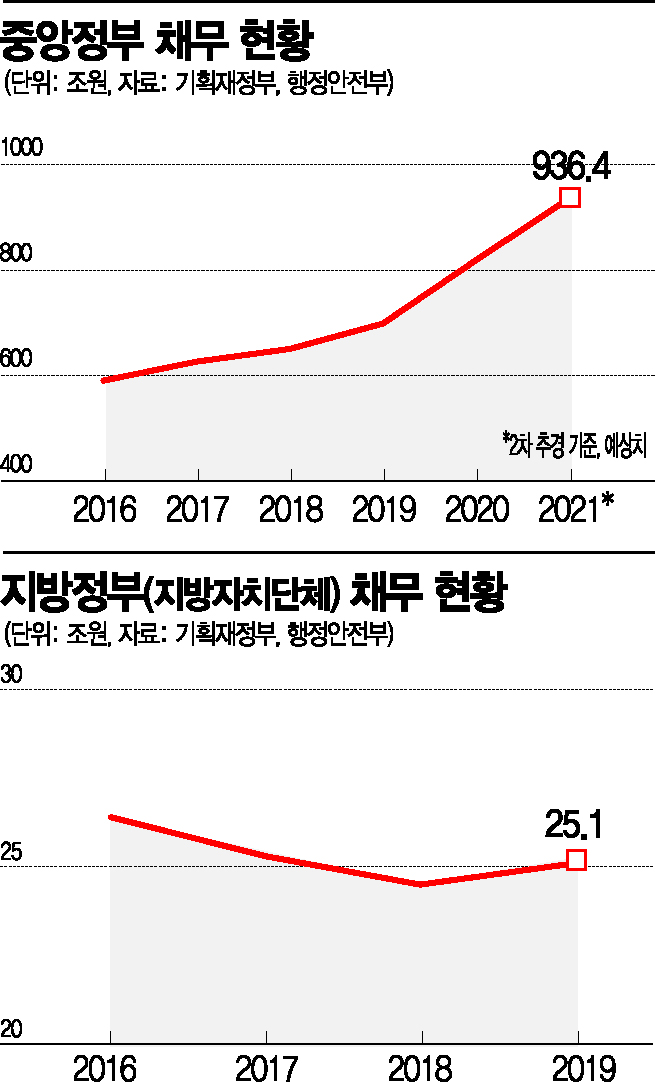
Central government debt rose from 591.9 trillion won in 2016 to 819.2 trillion won in 2019, an 18% increase over three years. With the expansionary fiscal stance solidified during the COVID-19 response, the debt size is expected to surpass 900 trillion won, reaching 936.4 trillion won based on the second supplementary budget this year. In contrast, local government debt decreased by about 5%, from 26.4 trillion won to 25.1 trillion won during the same period. The nationwide debt ratio (relative to budget size) also dropped from 11.8% in 2016 to 6.5% in 2019.
The Ministry of Economy and Finance, responsible for national finances, is in a difficult position. Since the Ministry of the Interior and Safety, local governments, and the National Assembly are pushing for fiscal decentralization, passive responses could only attract criticism.
◆Experts: "Efforts to increase revenue and accountability in fiscal decentralization are necessary"= Experts point out that efficiency should be prioritized in the fiscal decentralization process. Professor Sung Tae-yoon of Yonsei University's Department of Economics explained, "It is not appropriate to only allow autonomous spending of expenditures. Metropolitan governments should make autonomous efforts to increase revenue." He added, "There also needs to be a control mechanism so that if performance is insufficient after project evaluation in the future, the central government can reclaim the funds."
According to a research report published by the Korea Institute of Public Finance, the UK induces reduced central government interference and increased local government autonomy and responsibility under the 'Local Government Act.' However, if key performance indicators are insufficient, the central government restricts local governments' service provision authority and transfers the project to the central government, thus establishing a minimum control mechanism.
With the upcoming presidential election, pressure for fiscal decentralization is expected to intensify. On the 1st, Lee Jae-myung, Governor of Gyeonggi Province, also argued that the local tax rate should be raised to 40%.
© The Asia Business Daily(www.asiae.co.kr). All rights reserved.

















