As Apartment Subscription Thresholds Rise, Alternative Housing Products Gain Attention
Average Competition Rate in First Half Hits 19.8 to 1, Doubling from Last Year
No Subscription Account Needed, Good Location... Popular Among Low-Score 2030 Generation
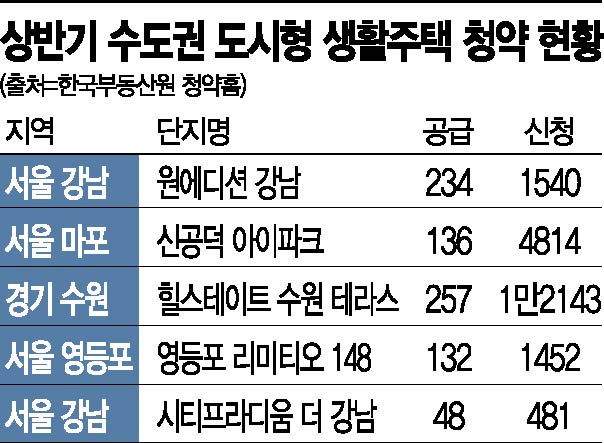
[Asia Economy Reporter Ryu Tae-min] As the subscription competition rate and winning score for apartments in the metropolitan area increase, the popularity of alternative housing products is growing. In particular, urban-style residential housing is emerging as an escape route for homeownership among demanders with low scores, as it does not require a subscription savings account.
According to the Korea Real Estate Board's Subscription Home on the 2nd, a total of 21,309 applicants applied for 1,074 urban-style residential housing units nationwide that were supplied in the first half of this year. The average subscription competition rate reached 19.8 to 1. Compared to last year's annual average competition rate of 9.97 to 1, the competition rate has doubled. Last year, 16,247 people applied for 1,630 units supplied.
Competition in the metropolitan area is even fiercer. In the first half of the year, 20,430 people flocked to apply for 807 units, showing an average competition rate of 25.3 to 1. Last year, 16,234 people applied for 1,510 units, recording an average of 10.7 to 1.
In June, the urban-style housing of "Hillstate Suwon Terrace," supplied by Hyundai Engineering in Seodun-dong, Suwon, showed a competition rate of 47.2 to 1, comparable to general apartments. For the 55㎡ (exclusive area) units in this complex, 3,023 people applied for 11 units, pushing the competition rate up to 274.8 to 1.
The popularity of urban-style residential housing is attributed to its lower subscription barriers compared to apartments. Urban-style residential housing does not require a separate subscription savings account when applying, so anyone aged 19 or older can apply. Because of this, it has become an alternative means of homeownership among 2030 demanders with low subscription scores. Additionally, due to the nature of urban-style residential housing, which can only be built in urban areas under the Building Act, supply is mainly on small leftover urban plots, making the location favorable and contributing to its popularity.
Since it is classified as housing, installations such as bathtubs or balconies are possible, similar to apartments. The average exclusive area ratio is also around 70-80%, not much different from general apartments. The practicality of the space is also high.
However, the polarization of subscription applications between regions should be considered. For example, the M urban-style residential housing supplied in Busan in May this year had only 45 applications for 91 units supplied. The H complex supplied in Jeju Island also had only 13 applications for 120 units supplied.
It is also necessary to be cautious about the inflated subscription competition rates. Unlike apartments, urban-style residential housing does not have strict re-subscription restrictions even if the contract is not signed after winning the subscription. Therefore, the industry explains that there are many applications from family units or applications made with a "let's just apply first" attitude.
Song Seung-hyun, CEO of City and Economy, said, "Urban-style residential housing seems to have gained interest mainly from real demanders because it is relatively free from various regulations compared to apartments and has low subscription entry barriers." However, he added, "There are many unsold units in local areas, and many do not sign formal contracts even after winning the subscription, so caution is needed when deciding whether to purchase."
© The Asia Business Daily(www.asiae.co.kr). All rights reserved.
!["The Woman Who Threw Herself into the Water Clutching a Stolen Dior Bag"...A Grotesque Success Story That Shakes the Korean Psyche [Slate]](https://cwcontent.asiae.co.kr/asiaresize/183/2026021902243444107_1771435474.jpg)
















