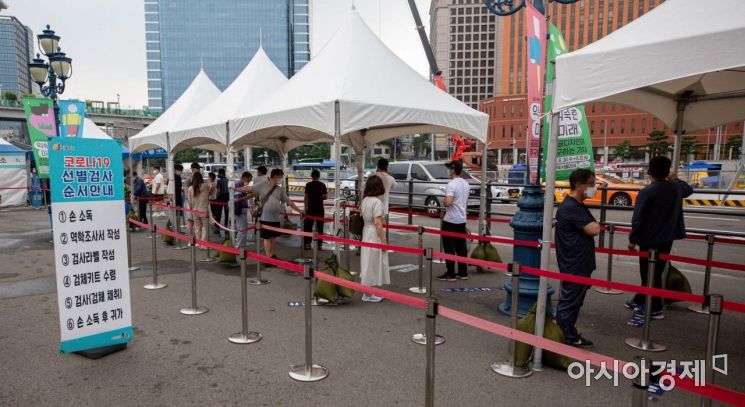
 Citizens waiting to get tested at a temporary screening clinic set up at Seoul Station Plaza on the 1st./Photo by Jinhyung Kang aymsdream@
[Asia Economy Reporter Lee Chun-hee] On the 2nd, the number of new domestic COVID-19 cases reached 1,219, pushing the cumulative total over 200,000. However, the daily case count, which had been setting record highs based on the day of the week, appears to be showing signs of slowing growth.
The Korea Disease Control and Prevention Agency's Central Disease Control Headquarters announced that as of midnight, the cumulative number of COVID-19 cases increased by 1,219 from the previous day to 201,002. This marks 560 days since the first domestic COVID-19 case was reported on January 20 of last year. Among the new cases, 1,150 were locally transmitted and 69 were imported.
Of the locally transmitted cases, 749 cases, accounting for 68.5%, were reported in the Seoul metropolitan area: Seoul 339 cases (31.5%), Gyeonggi 328 cases (28.5%), and Incheon 59 cases (5.1%).
There were 401 cases outside the metropolitan area. By region, the cases were as follows: Busan 68, Daegu 26, Gwangju 16, Daejeon 62, Ulsan 12, Sejong 2, Gangwon 24, Chungbuk 26, Chungnam 35, Jeonbuk 11, Jeonnam 3, Gyeongbuk 27, Gyeongnam 77, and Jeju 12.
There were 69 imported cases, with 25 detected during quarantine and 44 confirmed in the community. Among them, 34 were Korean nationals and 35 were foreigners.
The total number of tests conducted the previous day was 65,442. Due to the holiday effect, the number of tests was about half compared to weekdays. At temporary screening clinics set up in the metropolitan area, 32,917 tests were conducted, confirming 224 new cases, while 11,705 tests were conducted at temporary screening clinics outside the metropolitan area, confirming 60 cases.
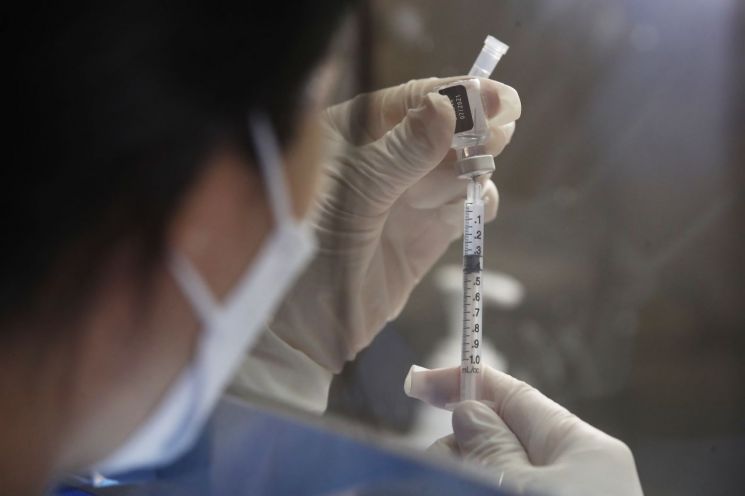 On the afternoon of the 30th of last month, medical staff were preparing vaccines at the Dongjak-gu Citizens' Sports Center, where the COVID-19 vaccination center was set up in Dongjak-gu, Seoul.
 [Image source=Yonhap News]
Meanwhile, as of midnight, 27,892 people received new COVID-19 vaccinations. The cumulative number of first-dose vaccinations reached 19,472,376, representing a vaccination rate of 37.9% of the population. Among the new vaccinations, 19,634 were Pfizer vaccines and 8,258 were Moderna vaccines. There were no new vaccinations for AstraZeneca (AZ) or Janssen.
The number of people who completed vaccination increased by 480 from the previous day to 7,146,409. The second-dose vaccination rate relative to the population is 13.9%. Nine people who received the first dose of the AZ vaccine received a second dose of the Pfizer vaccine as a cross-vaccination. Additionally, 471 people received a second dose of the Pfizer vaccine only, bringing the total number of fully vaccinated individuals to 3,948,567.
Reports of suspected adverse reactions following vaccination increased by 1,279 over two days, totaling 117,762 cases. Among these, 28 were related to AZ, 928 to Pfizer, 4 to Janssen, and 319 to Moderna. The cumulative adverse reaction reporting rates are 0.67% for AZ, 0.26% for Pfizer, 0.67% for Janssen, and 0.24% for Moderna.
Among the newly reported cases, common adverse reactions such as muscle pain, headache, fever, chills, and nausea accounted for 1,243 cases, making up the majority.
Serious adverse reactions included 11 suspected anaphylaxis cases and 24 additional reports of major neurological adverse reactions. There was also one reported death following Pfizer vaccination.
Regarding the first-dose AZ and second-dose Pfizer cross-vaccination ongoing since last month, 48 additional adverse reactions were reported over two days, bringing the total to 2,633. The adverse reaction reporting rate for this cross-vaccination is 0.28%. All newly reported adverse reactions were common reactions. Cross-vaccination adverse reactions are included in the Pfizer vaccine adverse reaction statistics.
© The Asia Business Daily(www.asiae.co.kr). All rights reserved.


















