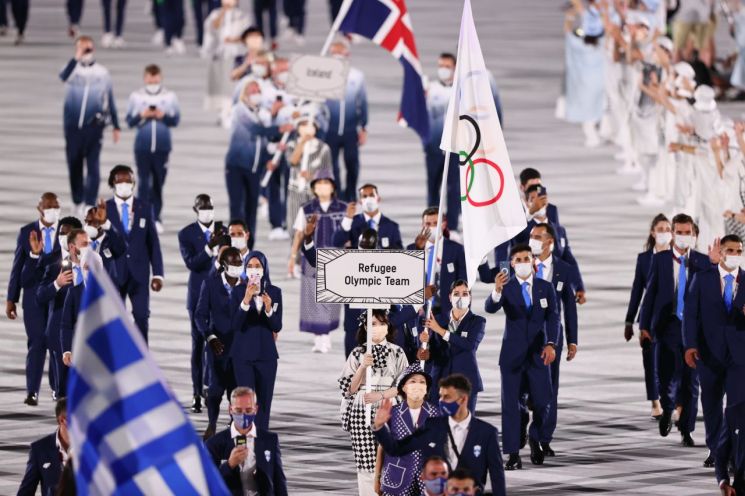
[Asia Economy Reporter Hyunju Park] There are people who come together through the single spirit of sports, despite having different nationalities. They are the refugee team. Their stories, who fled their homelands due to persecution based on gender, race, religion, and yet never lost their passion for sports, are drawing attention.
The refugee team, which entered the Tokyo Olympics opening ceremony waving the Olympic flag instead of a national flag, is participating for the second time following the Rio Olympics. The team size has grown from 10 athletes in the previous Olympics to a total of 29 athletes competing in 12 events this time. This is thanks to the Olympic scholarship program established by the International Olympic Committee (IOC) and the United Nations High Commissioner for Refugees (UNHCR) to support refugee athletes.
Sanda Aldas (judo), who had to move between refugee camps due to the Syrian civil war, has been able to pursue her dream again. After settling in the Netherlands, she was invited to the International Judo Federation (IJF)’s refugee athlete support program. Overcoming six years of hardship after seeking asylum, Aldas finally stands on the dream stage and said, "I am happy to participate in the Olympics not just as a refugee but as a member of society. Sports gave us great motivation, and now we are moving toward that goal."
Kimia Alizadeh Zenoorin (taekwondo) took off her hijab. She was the first Iranian female Olympic medalist who won a bronze medal at the Rio Olympics but fled to escape the oppression of women in her Islamic homeland. Competing in the women’s 57kg category, Alizadeh did not win a medal this time but advanced to the semifinals by defeating Jade Jones (UK), the world number one, and Iranian athlete Nahid Kiyani Chande, achieving the best result among the refugee team.
There are athletes whose goal is simply to finish rather than set records. Masoma Ali Zada (cycling) comes from Afghanistan, where it was taboo for women to ride bicycles. Being from an ethnic minority added to the threats to her safety, but she did not give up. Before the race, Masoma said, "Even if the result is not good, finishing is important," and she kept her promise. On May 28, Masoma competed in the women’s individual road cycling event and, although she finished last, she kept pedaling without giving up. "I am happy to represent the refugee team. Regardless of the record, I gave dreams and peace to refugees worldwide. Dreams come true."
Even without medals around their necks, the refugee team has become a symbol of hope just by existing. Yusra Mardini (swimming), a UNHCR goodwill ambassador and member of the refugee team, said, "Sometimes it is hard to bear, but this small team gives great hope not only to refugees but also to countless young people around the world." Filippo Grandi, the UN High Commissioner for Refugees, urged the refugee team athletes, "You have one more responsibility besides achieving good results. You represent and make proud the tens of millions of refugees and forcibly displaced people worldwide who will watch your games and take pride in your achievements."
© The Asia Business Daily(www.asiae.co.kr). All rights reserved.
![Clutching a Stolen Dior Bag, Saying "I Hate Being Poor but Real"... The Grotesque Con of a "Human Knockoff" [Slate]](https://cwcontent.asiae.co.kr/asiaresize/183/2026021902243444107_1771435474.jpg)
















