Yellen Treasury Secretary "Irreversible Damage to All Citizens if Default Occurs"
[Asia Economy Reporter Kim Suhwan] Concerns are growing that a government default (debt default) crisis could occur as the US government's debt ceiling suspension period officially ends.
In response, the US Treasury Department warned that a default could occur as early as October, stating it would "inflict irreversible damage on all citizens."
On the 31st (local time), Bloomberg reported that the government debt ceiling suspension period ended on that day, and the ceiling is expected to be reinstated from the 1st.
Currently, the government's debt ceiling is set at approximately $22 trillion. During the Trump administration in 2019, it was decided to suspend this ceiling for two years.
According to the Treasury Department, as of the end of June, the total government debt reached $28.5 trillion. Since the government debt has already exceeded the ceiling, the government can no longer issue additional national bonds. If the debt ceiling is not adjusted or the suspension period is not extended again, in the worst case, it could lead to a federal government default crisis.
Therefore, the government must implement so-called "extraordinary measures," such as using tax revenues or reallocating other federal budgets to fulfill budget expenditure items. On the 30th of last month, the Treasury Department decided to suspend the sale of securities used to support state government bond investments as part of these extraordinary measures.
Additionally, the Treasury Department is reportedly considering further measures, such as halting new investments in civil servant retirement pensions.
However, since these extraordinary measures are only temporary fixes, if the debt ceiling is not adjusted, a default crisis cannot be avoided.
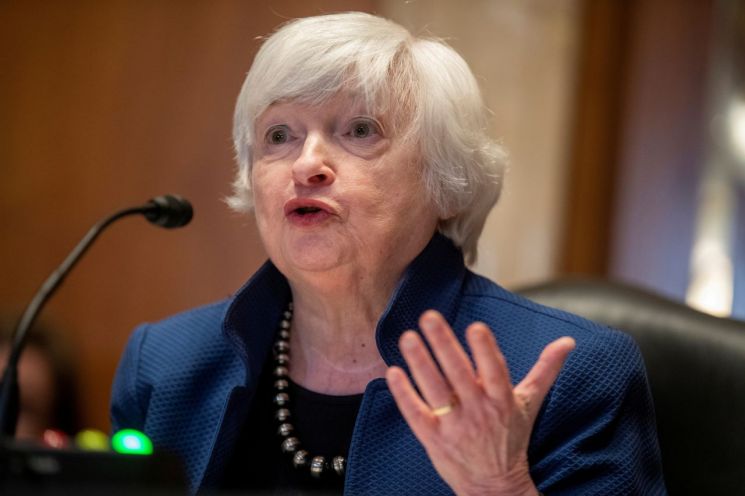
Earlier, on the 23rd of last month, Treasury Secretary Janet Yellen warned in a letter to lawmakers that "all extraordinary measures of the Treasury Department are likely to be exhausted by September," and "a default could occur as early as October. This would inflict irreversible damage on all citizens."
In fact, the US Treasury's cash reserves are rapidly depleting. According to Treasury data, as of June 29, the cash balance was $711.3 billion. However, by the 29th of last month, the cash balance had dropped to $501.2 billion, showing a decrease of about $200 billion in one month.
Secretary Yellen also added, "There are mandatory budget items that must be spent on October 1, which could deplete $150 billion in cash in just one day."
Secretary Yellen further urged Congress to revise the debt ceiling amid increasing uncertainty in fiscal policy due to signs of a resurgence of COVID-19 caused by the Delta variant.
The US Congress is scheduled to enter recess during August. The session is expected to resume in September, so negotiations on adjusting the debt ceiling are likely to begin as early as September.
Currently, foreign media report that the Republican side opposes raising the debt ceiling. In response, the Democratic Party is considering raising the debt ceiling through a unilateral budget process or increasing it through bipartisan agreement by conceding some bills to the Republicans.
However, Bloomberg reported that some Democratic lawmakers oppose conceding specific bills to Republicans to adjust the debt ceiling, causing negotiations between the two parties to stall.
Historically, the United States has never experienced a default crisis. Since the debt ceiling system was introduced in 1939, the ceiling has been adjusted more than 90 times to overcome crises.
© The Asia Business Daily(www.asiae.co.kr). All rights reserved.
![Clutching a Stolen Dior Bag, Saying "I Hate Being Poor but Real"... The Grotesque Con of a "Human Knockoff" [Slate]](https://cwcontent.asiae.co.kr/asiaresize/183/2026021902243444107_1771435474.jpg)
















