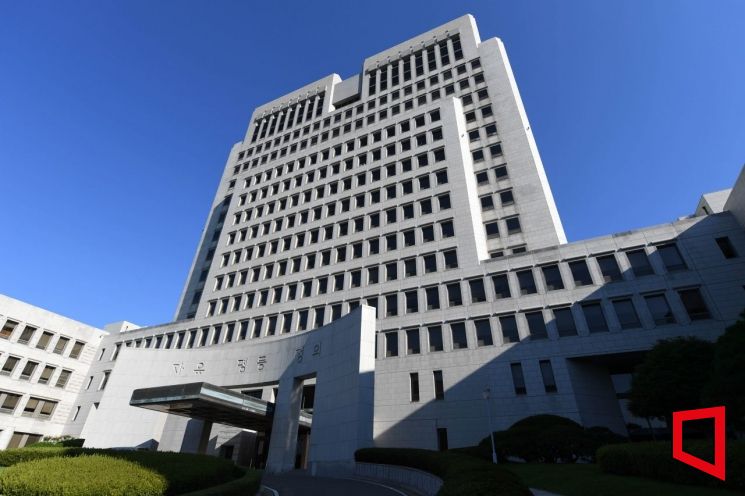
 Supreme Court, Seocho-gu, Seoul. Photo by Mun Ho-nam munonam@
[Asia Economy Reporter Kim Daehyun] The Supreme Court has ruled that if a fire breaks out in an old car due to a short circuit in its parts and spreads to an adjacent vehicle, the car owner who failed to properly manage the parts and their insurance company bear liability for compensation.
On the 1st, the Supreme Court's First Division (Presiding Justice Lee Gitaek) announced that it overturned the lower court's ruling, which had dismissed the damages claim filed by Mr. A against Mr. B and B’s insurance company, and remanded the case to the Seoul Southern District Court.
Previously, in March 2018, Mr. A had parked his vehicle in an empty lot in Hwaseong City, Gyeonggi Province, but suffered damage when a fire broke out in the vehicle parked next to his, owned by Mr. B, and spread to his car. It was found that Mr. B’s vehicle was an old car produced in 2001, which had already exceeded 1 million kilometers in cumulative mileage by 2013.
The National Forensic Service analyzed the cause of the fire, stating, "Unless there are special circumstances, the insulation of parts within Mr. B’s vehicle was damaged, causing a short circuit." Accordingly, Mr. A filed a damages claim lawsuit, arguing that the fire occurred because Mr. B failed to properly maintain the vehicle.
The first trial sided with Mr. A. Considering the National Forensic Service’s expert opinion and other evidence, the cause of the fire in the old car was attributed to Mr. B’s poor maintenance. The court ordered Mr. B and the insurance company to jointly compensate Mr. A approximately 160 million KRW for vehicle repair costs.
However, the second trial ruled against Mr. A. It judged that the problematic insulation parts could not be considered consumables that Mr. B was responsible for managing. Additionally, it added that there was no evidence that Mr. B had violated safety standards by modifying the vehicle’s structure or devices, nor that the vehicle’s age compromised its safety.
Nevertheless, the Supreme Court ordered a retrial and reconsideration of the case. The court emphasized, "When the risk of a structure materializes and causes damage, it is fair to hold the person who manages or owns it liable for compensation," adding, "The greater the risk of the structure, the higher the degree of protective measures required by social norms in proportion."
It further stated, "The lower court erred in its understanding of the legal principles regarding defects in the installation and preservation of the structure, which affected its judgment."
© The Asia Business Daily(www.asiae.co.kr). All rights reserved.
![Clutching a Stolen Dior Bag, Saying "I Hate Being Poor but Real"... The Grotesque Con of a "Human Knockoff" [Slate]](https://cwcontent.asiae.co.kr/asiaresize/183/2026021902243444107_1771435474.jpg)















