"Incineration Followed by Landfilling of Ash" Policy Yet SRF Power Plants Perceived as Nuisance Facilities
Over 10 Sites Halted in Construction, Operation, and Management
In Europe, Used as Community Rest Areas... Located in Densely Populated Areas like Vienna and Malmo
"Government Should Reduce Psychological Resistance... Power Plants Must Become Shared Facilities with Residents"
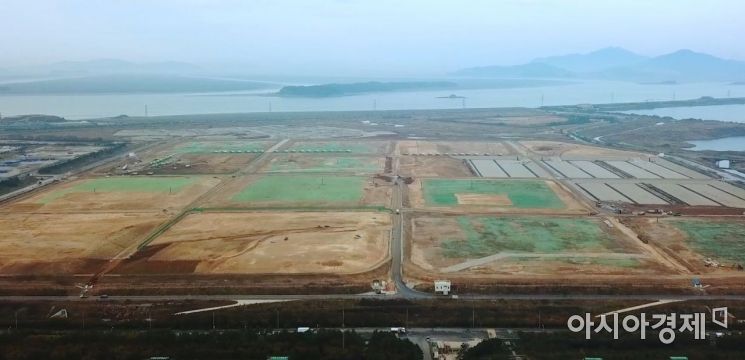 A view of the 3rd landfill site at the Sudokwon Landfill. It will cease operation by 2025. [Photo by Sudokwon Landfill Management Corporation]
[Asia Economy Reporter Kim Jong-hwa] "There will be no extension of the use of the Sudokwon Landfill Site."
In October last year, Park Nam-chun, Mayor of Incheon, declared the closure of the Sudokwon Landfill Site by 2025, stating, "The waste discharged at the Sudokwon Landfill Site consists of 22% from Incheon and 78% from Seoul and Gyeonggi Province. This violates the principle of treating waste where it is generated and does not align with environmental justice."
The Sudokwon Landfill Site in Seo-gu, Incheon Metropolitan City, is located on a coastal reclamation area between Incheon and Gimpo City, Gyeonggi Province, covering an area of 16 km², roughly the same size as Dongjak-gu in Seoul. The first and second landfill sites have been completed, and the third landfill site is currently in use. Waste has been brought in since 1992, and it was originally scheduled to be used until the end of 2016. However, since no alternative landfill site was found by 2015, the three metropolitan area governors extended the usage period to 2025 in June of that year.
The Sudokwon Landfill Site receives an average of 12,691 tons of household waste, construction waste, and industrial waste daily from 64 basic local governments in the metropolitan area. Creating a new landfill site takes at least 4 to 5 years, but with less than four years remaining, Seoul and Gyeonggi Province have yet to find an alternative landfill candidate site.
Accordingly, the Ministry of Environment is reportedly considering reducing the amount of waste brought into the Sudokwon Landfill Site to extend its use until 2027, but due to opposition from Incheon City, an extension seems unlikely.
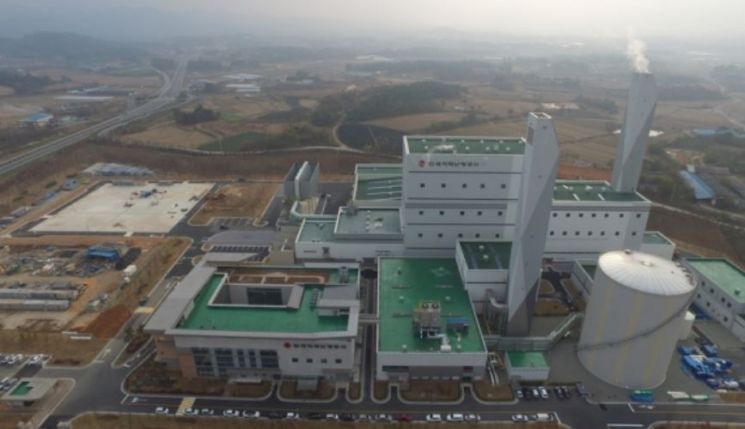 Naju SRF Power Plant panorama. It has not been operational for 3 years and 8 months due to opposition from local residents.
 [Photo by Korea District Heating Corporation]
Ministry of Environment's Policy to "Land Only Incineration Residue"... Faces Obstacles Due to Local Residents' NIMBY
The Ministry of Environment announced a policy to "incinerate waste first and landfill only the remaining residue," and in February, it proposed an amendment to the Waste Management Act, which would implement this policy starting in 2026 for the metropolitan area and 2030 for other regions.
However, the Ministry's plan has encountered obstacles due to NIMBY (Not In My Backyard) sentiments. The construction of SRF (Solid Refuse Fuel) power plants, which reduce incinerated waste volume to less than 15%, has been stalled. According to the Korea Environment Corporation, the number of SRF power plants, which was 152 in 2017, has decreased to 148 currently, with four closures. Moreover, since 2018, no new projects have been applied for. As of the 30th, more than 10 SRF power plants nationwide are suffering from construction, operation, or suspension issues.
Not only the Sudokwon Landfill Site but also nationwide, a waste crisis is imminent. By 2031, 102 out of 215 public landfill facilities across the country, accounting for 47%, will reach saturation.
Hong Soo-yeol, director of the Resource Circulation Social Economy Research Institute, said, "If SRF power plants, which are incineration facilities but also resource circulation facilities, cannot be built, which local governments would allow landfill sites?" He added, "Nevertheless, landfill sites are necessary. Discussions on whether to extend the current site or find alternatives are urgent."
Major countries in Europe have SRF power plants located in densely populated areas without any issues. SRF power plants in Vienna, Austria; Copenhagen, Denmark; Malm?, Sweden; and Amsterdam, the Netherlands, are used as tourist attractions and local residents' recreational spaces. The United States operates 84 SRF power plants, Japan has 328, and the UK gained attention by exporting 3.5 million tons of SRF in 2016 alone.
The 'Naju SRF Usage Opposition Citizens' Committee (Committee),' composed of residents around the Naju SRF power plant in Jeollanam-do, conducted a three-month trial operation and environmental impact assessment of the plant, which concluded "no harmful effects." However, the Committee refuses to accept these results.
Dr. Yoon Kyun-deok of the Korea Testing Laboratory pointed out, "Emissions below the harmful substance threshold are legally acceptable. The opposition from residents is due to some agitators spreading misinformation."
"Emissions Below Harmful Substance Threshold Are Not a Problem... Government Needs to Make More Efforts to Gain Residents' Understanding"
Director Hong said, "The Committee's distrust of the results indicating no harmful effects stems from accumulated distrust toward the government and operators," and advised, "The government needs to make more efforts to help residents, who have strong psychological resistance, understand the situation."
There are also opinions that efficiency should not be the sole focus, and large-scale facility construction should not be the only approach. Dr. Yoon argued, "Incineration is now the only alternative," adding, "While large-scale incineration facilities at the metropolitan level are efficient, regardless of cost issues, the option of building several small-scale facilities regionally should also be actively considered."
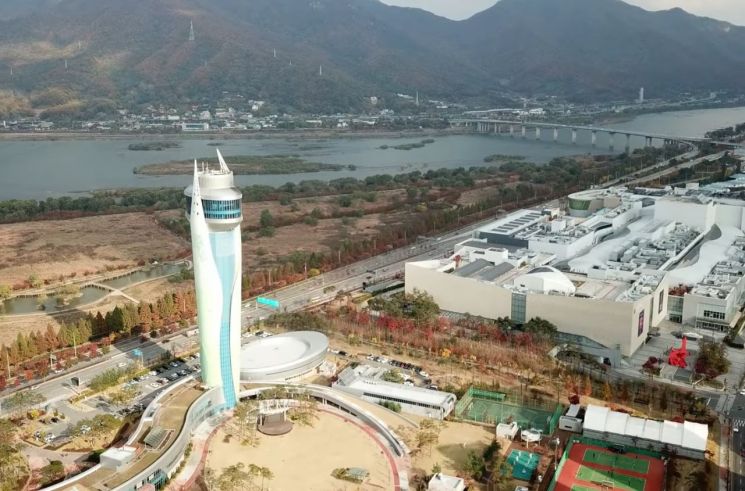
Domestically, Hanam Union Park is a nationwide benchmarking target. Underground, it houses sewage treatment facilities, household waste incineration facilities, food waste recycling facilities, and recycling sorting facilities. Above ground, it features the Union Tower, which serves as an observation tower, an ecological pond, water play facilities, and an outdoor stage. It has become a major attraction visited by 340,000 people annually and the largest resting place for Hanam citizens.
Dr. Yoon emphasized, "Building impressive structures to offset the stigma of noxious facilities is important," and added, "It should be a facility that residents can share."
Solutions to overcome NIMBY were also suggested. Professor Yoo Seung-hoon of the Department of Energy Policy at Seoul National University of Science and Technology said, "It is necessary to unify the locations of waste generation and disposal," and explained, "If the waste generation site and disposal site differ, a levy can be imposed on the generation site and paid to the disposal site."
Director Hong stressed, "Efforts from residents of local governments that bring waste to landfill sites are also necessary. They should actively show that they share the burden locally."
© The Asia Business Daily(www.asiae.co.kr). All rights reserved.
![User Who Sold Erroneously Deposited Bitcoins to Repay Debt and Fund Entertainment... What Did the Supreme Court Decide in 2021? [Legal Issue Check]](https://cwcontent.asiae.co.kr/asiaresize/183/2026020910431234020_1770601391.png)


















