[Asia Economy New York=Correspondent Baek Jong-min] Major indices on the New York Stock Exchange closed higher despite the second-quarter gross domestic product (GDP) growth rate falling short of expectations.
On the 29th (local time), the Dow Jones Industrial Average rose 153.60 points (0.44%) to close at 35,084.53, the S&P 500 index increased by 18.51 points (0.42%) to 4,419.15, and the Nasdaq index gained 15.68 points (0.11%) to finish at 14,778.26.
Following the Federal Reserve's hint the day before about the possibility of tapering asset purchases within the year, the second-quarter growth rate announced that day came in at an annualized 6.5%, significantly below the expected 8.4%, yet investors intensified their buying. The S&P 500 again approached an all-time high.
Although the GDP size has recovered to pre-COVID-19 levels, concerns about growth in the second half of the year were raised, but the market was not significantly affected.
Rather, the fact that consumer spending led GDP growth became a factor increasing interest in cyclical stocks. Energy, materials, and financial stocks were strong.
The weekly initial jobless claims also remained sluggish at 400,000, exceeding the expected 380,000 by 20,000, indicating that employment recovery is still slow.
Given that Fed Chair Jerome Powell stated that employment recovery must be confirmed before tapering, the confirmation of employment weakness and the possibility of growth slowdown are interpreted as factors stabilizing investor sentiment.
On the day, the yield on the U.S. 10-year Treasury note remained steady at 1.264%, the same level as the previous day.
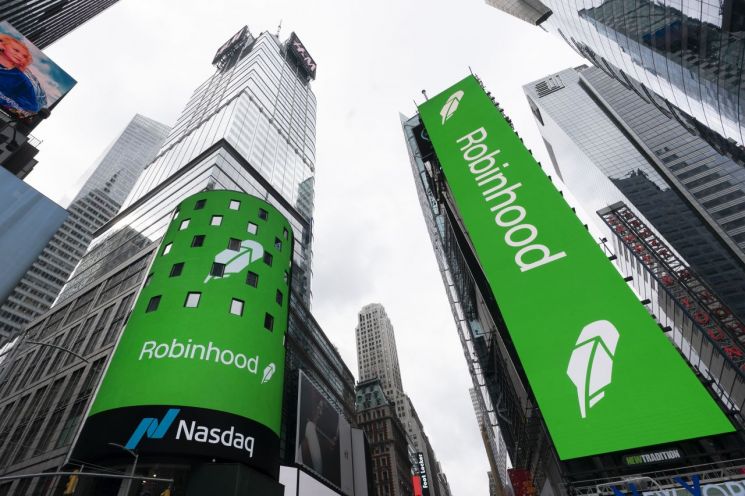
The popular stock trading app Robinhood fell 8% in its first Nasdaq market trade that day.
Robinhood started its first trade at an underwhelming IPO price of $38 and immediately plunged about 10%. Although it later recovered most of the losses, it could not shake off the selling pressure. Robinhood allocated 35% of the new shares to its own customers, and valuation concerns were cited as the cause of the stock price decline.
Semiconductor companies AMD and Qualcomm showed strong performances, rising about 5% and 6%, respectively.
Uber fell more than 3% after reports emerged that SoftBank plans to sell about one-third of its stake, influenced by the sharp drop in Didi Chuxing's stock price.
Hydrogen truck maker Nikola plunged 15% following news that founder Trevor Milton was indicted on fraud charges by federal prosecutors.
Facebook fell more than 4% after announcing that advertising revenue is expected to slow due to Apple's changes in privacy policies. PayPal's stock dropped over 6% on news of a decline in quarterly net profit.
© The Asia Business Daily(www.asiae.co.kr). All rights reserved.
![Clutching a Stolen Dior Bag, Saying "I Hate Being Poor but Real"... The Grotesque Con of a "Human Knockoff" [Slate]](https://cwcontent.asiae.co.kr/asiaresize/183/2026021902243444107_1771435474.jpg)
















