2Q Annualized Growth Rate 6.5%... Consumption Offsets Investment Slump
Significantly Below Expected 8.4%
Challenges Include Delta Variant Spread, Reduced Government Fiscal Support, and Supply Chain Bottlenecks
[Asia Economy New York=Correspondent Baek Jong-min] Although the United States has recovered to pre-COVID-19 economic levels, the spread of the Delta variant has made it difficult to be optimistic about the second half of the year.
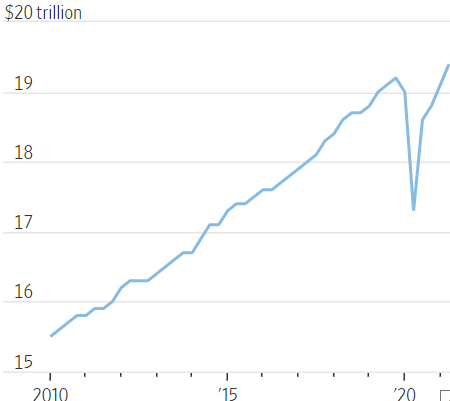
On the 29th (local time), the U.S. Department of Commerce announced that the second-quarter gross domestic product (GDP) growth rate was 6.5% annualized. The quarter-over-quarter growth rate was 1.6%. The first-quarter growth rate was revised down slightly from 6.4% to 6.3%.
The U.S. economy has continued to grow for four consecutive quarters, recovering to pre-COVID-19 levels after 18 months, but the market has expressed opinions that the second-quarter GDP fell short of expectations. The Dow Jones consensus forecast by experts was as high as 8.4%. This is why the theory of a second-quarter growth peak has resurfaced.
The Wall Street Journal stated, "The U.S. economic outlook was bright until before the spread of the Delta variant," and predicted that growth in the second half of the year will slow down. The WSJ noted that the increase in new COVID-19 cases due to the Delta variant and the reinstatement of mask mandates for businesses are increasing economic uncertainty. The WSJ's surveyed growth forecast for the U.S. this year is 7%.
One day earlier, Federal Reserve Chairman Jerome Powell predicted that the economic damage from the Delta variant would not be significant, but analysis suggests that fears of uncertainty still remain. If new COVID-19 infections increase, consumers may again reduce travel and dining out.
In particular, the lack of fiscal stimulus plans like the cash payments provided by the U.S. government in the first half of the year, which boosted consumer spending power, increases the possibility of losing growth momentum.
Personal consumption expenditures surged by 11.8% (annualized) in the second quarter alone, leading the overall GDP growth rate. The first-quarter consumption growth rate was 11.4%.
Supply chain bottlenecks limiting production of vehicles, computers, and other goods are also negative factors. The lack of improvement in maritime logistics could affect the year-end shopping season.
Professor Son Sung-won of Loyola Marymount University predicted, "It will be difficult for supply chain bottlenecks to improve quickly, and if COVID-19 spreads again, economic growth will certainly face difficulties."
However, the common expectation is that even if the Delta variant spreads, the situation will not be the same as last year. Ben Hursten, director at IHS Markit, asserted, "The situation we saw last spring will not happen again."
Rising inflation and labor shortages are also unstable factors that could lead to slower growth.
Some expect strong growth to continue. Aneta Makowska, economist at Jefferies, said, "Although the second-quarter figures were overall disappointing, the sustained strength of private demand is very encouraging," and forecasted a 7.5% growth rate for the second half of this year.
White House Press Secretary Jen Psaki, in a statement on the day, praised the second-quarter GDP growth rate as an amazing sign of progress toward revitalizing the economy, but also emphasized that "there is still much work to be done to recover a better economy, and we cannot be complacent when many Americans still face economic uncertainty."
The White House expects that with the Senate moving closer to passing a $1 trillion infrastructure investment bill, it will be used as a 'firestarter' for U.S. economic growth in the second half of the year and beyond.
© The Asia Business Daily(www.asiae.co.kr). All rights reserved.