KOSPI Ends Slightly Higher
Institutions Solely Drive Index
Foreign Funds Concentrate in Greater China Region
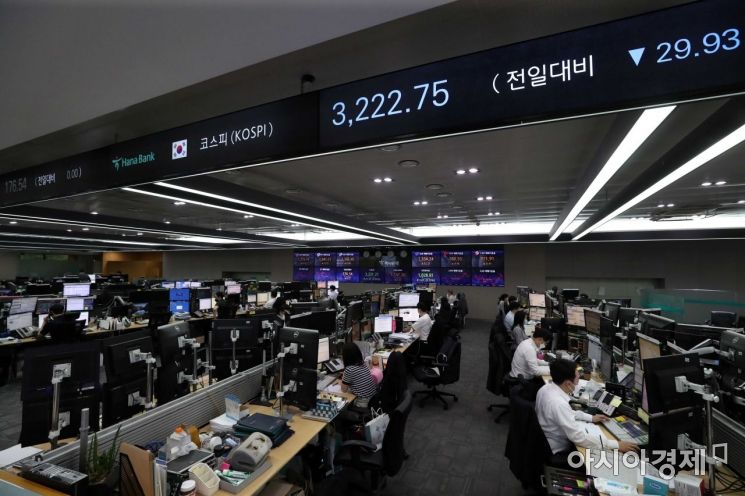 On the 9th, as the spread of COVID-19 intensifies, the KOSPI index is displayed in the Hana Bank dealing room in Euljiro, Seoul. On this day, the KOSPI started at 3,245.52, down 7.16 points (0.22%) from the previous session, showing a downward trend. Photo by Moon Honam munonam@
[Asia Economy Reporter Junho Hwang] On the 29th, the KOSPI reversed to a decline in the afternoon but closed slightly higher as institutional investors continued their net buying. The strength of institutions was highlighted as foreign investors withdrew following the revival of the Greater China stock markets.
On that day, the KOSPI closed at 3,242.62, up 5.67 points (0.18%) from the previous day's closing price. Individuals and foreign investors net sold 5.9 billion KRW and 276 billion KRW respectively, but institutions supported the index by continuing net purchases of 295 billion KRW.
Among all stocks, 504 rose while 310 fell. The top market capitalization stocks closed slightly lower. Samsung Electronics closed at 79,000 KRW, down 0.25% from the previous day's closing price. Samsung Electronics held its Q2 earnings conference call that day, but it was not enough to boost the stock price.
On the same day, Han Jinman, Samsung Electronics Vice President, said, "We view the possibility of meaningful mergers and acquisitions (M&A) within three years positively." He added, "We have prepared extensively for M&A, but due to many internal and external uncertainties, it is difficult to specify the timing of execution," and explained, "As I mentioned in January, we view the possibility of executing meaningful M&A within three years positively."
SK Hynix also closed flat that day. After falling for four consecutive trading days from the 23rd to the 28th, it barely maintained a flat close. This is analyzed as weakness due to the slowdown in the memory semiconductor market. NAVER, a leading stock in the internet sector, closed at 440,500 KRW, down 0.24% from the previous day, showing a two-day decline. On the other hand, Kakao, ahead of Kakao Bank's listing, closed at 148,500 KRW, up 0.34%.
Park Gwangnam, a researcher at Mirae Asset Securities Digital Research Team, evaluated, "The Korean stock market showed mixed trends despite the reduced tapering concerns from the U.S. Federal Open Market Committee (FOMC) the previous day and the rise in the Chinese stock market. In the case of Samsung Electronics, despite strong earnings, the expansion of foreign selling of major semiconductor companies limited the index's rise."

The major sectors that rose that day included food and beverage, textiles and apparel, non-metallic minerals, pharmaceuticals, and distribution. Among the food and beverage sector, Lotte Chilsung (6.25%), Sajo Daerim (5.71%), Sajo Dongawon (6.71%), SPC Samlip (4.11%), and CJ CheilJedang (3.23%) showed relatively large gains.
The KOSDAQ also closed higher that day, finishing at 1,044.06, up 0.81% from the previous session. Contrary to the KOSPI, individuals and institutions net sold while foreign investors net bought, driving the index's rise. Among all stocks, 792 rose and 489 fell.
Among the top market capitalization stocks, EcoPro BM, which was spun off from EcoPro's secondary battery materials business division, rose 2.30%. Expectations increased as Samsung SDI announced it would transfer a new cathode material production line to EcoPro EM, a joint venture with EcoPro BM.
Lee Kyungmin, a strategic market analyst at Daishin Securities FICC Research Department, analyzed, "The KOSPI briefly surpassed the 3,250 level early in the session, but the reduction in foreign investors' net buying of futures caused the morning gains to be given back," adding, "Due to the phenomenon of foreign funds flowing into the Greater China stock markets, the KOSPI showed relatively weak performance that day."
© The Asia Business Daily(www.asiae.co.kr). All rights reserved.


















