Business Workforce Survey Results... Growth Continues Due to Economic Recovery
July Indicators Expected to Worsen Again Due to COVID-19 4th Wave
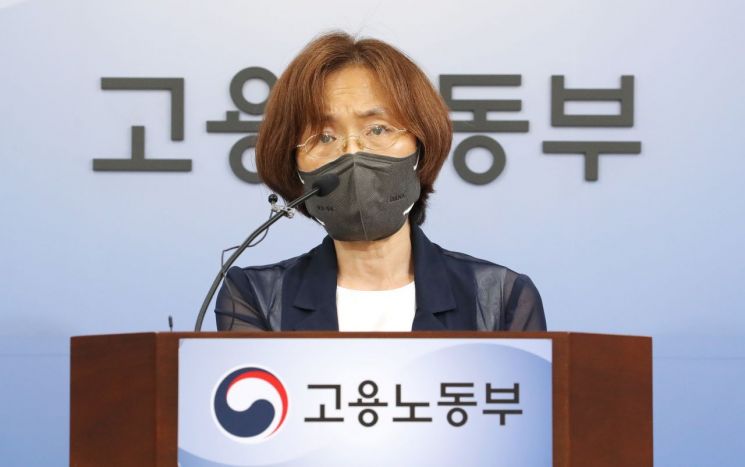 Jung Hyang-sook, Director of the Labor Market Survey Division at the Ministry of Employment and Labor, is seen announcing the results of the June 2021 Establishment Labor Force Survey on the morning of the 29th at the Government Complex Sejong in Sejong City. (Photo by Yonhap News)
[Sejong=Asia Economy Reporter Moon Chaeseok] The increase in the number of workers employed by domestic businesses has continued at over 300,000 for three consecutive months. Although this is a result of economic recovery, the sharp rise in temporary and daily workers makes it difficult to view the quality of employment positively.
According to the June Business Workforce Survey results announced by the Ministry of Employment and Labor on the 29th, the total number of workers employed by domestic businesses with one or more employees as of the last business day of last month was 18,812,000, an increase of 323,000 (1.7%) compared to the same month last year.
The number of workers employed by businesses had decreased for 12 consecutive months from March last year due to the COVID-19 pandemic but turned to an increase in March this year and has maintained an increase of over 300,000 since April.
This is interpreted as a result of the recent economic recovery trend as well as the base effect from the decrease in workers employed by businesses last year. However, due to the impact of the fourth wave of COVID-19, the July figures to be announced next month are expected to worsen again.
Looking at the changes in the number of workers by employment status last month, the number of regular workers, whose employment is relatively stable, increased by only 65,000 (0.4%), while temporary and daily workers surged by 241,000 (14.2%). This can also be seen as reflecting the base effect from the sharp decline in temporary and daily workers last year. Other workers, including special employment types such as insurance planners, increased by 17,000 (1.5%).
By industry, the number of workers increased significantly in health and social welfare services (99,000), including participants in government job projects, and public administration (60,000). The number of workers in professional, scientific, and technical services also rose sharply by 57,000.
On the other hand, workers in accommodation and food services, which were hit hard by social distancing measures, decreased by 51,000, continuing a decline for 17 consecutive months. Workers in business facility management, including travel agencies, also decreased by 17,000.
The number of manufacturing workers turned to an increase in May for the first time in 16 months and further increased by 19,000 last month, expanding the growth.
In May, the total wage per worker at domestic businesses with one or more regular employees was 3,418,000 KRW, up 131,000 KRW (4.0%) from the same month last year.
The wage for regular workers was 3,595,000 KRW, up 144,000 KRW (4.2%), and for temporary and daily workers, it was 1,698,000 KRW, up 57,000 KRW (3.5%).
The average working hours per worker were 151.9 hours, an increase of 1.7 hours (1.1%) compared to the same period last year.
The Business Workforce Survey targets domestic businesses with fixed business establishments, excluding agriculture and similar sectors, so workers in household service industries without fixed establishments are excluded.
© The Asia Business Daily(www.asiae.co.kr). All rights reserved.
![Clutching a Stolen Dior Bag, Saying "I Hate Being Poor but Real"... The Grotesque Con of a "Human Knockoff" [Slate]](https://cwcontent.asiae.co.kr/asiaresize/183/2026021902243444107_1771435474.jpg)
















