"Maintain Full In-Person School Policy... Announce Academic Measures After Assessing Social Distancing Level Adjustments"
3 Trillion Won Invested by 2024 to Prioritize Resolving Overcrowded Classes with 28+ Students per Class
2nd Semester Launches Intensive Curriculum Support Program 'Haksaeng Dowmdatgi' Supporting 2.03 Million Students
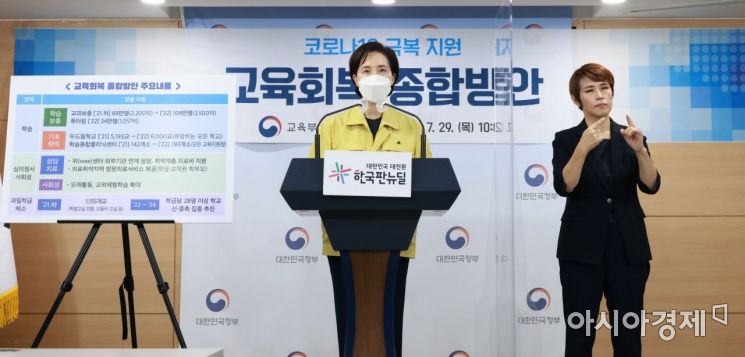
[Asia Economy Reporter Han Jinju] The Ministry of Education has decided to finalize and announce the schedule for full in-person attendance and academic operations for the second semester by the second week of August.
On the 29th, Yoo Eun-hye, Deputy Prime Minister and Minister of Education, stated at a briefing on the "Comprehensive Plan for Educational Recovery" held at the Government Seoul Office, "There is no change in the policy stance to promote full in-person attendance in the second semester, but currently, social distancing is at level 4, and academic operations are linked to the social distancing level, so adjustments to the distancing level need to be identified."
Deputy Prime Minister Yoo added, "We will gather opinions from the Korea Disease Control and Prevention Agency, quarantine authorities, and experts regarding the current situation and future trend forecasts, and announce our position on the academic operation schedule for the second semester by around the second week of August."
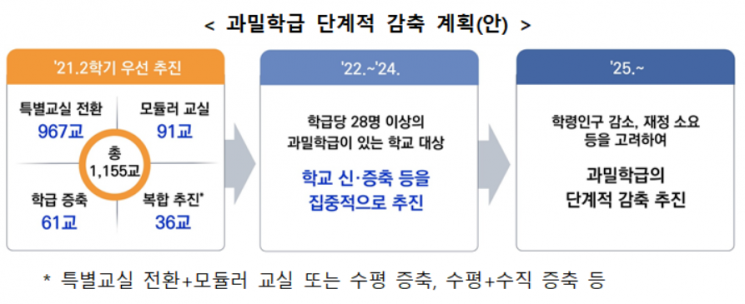
On the same day, the Ministry of Education announced that it will invest 3 trillion won by 2024 to resolve overcrowded classes with more than 28 students per class. Starting from the second semester, additional classes will be secured by converting special classrooms, installing modular classrooms, and expanding classes in 1,155 schools. From next year, regional student placement plans will be reestablished, and after investment reviews, expansions, renovations, or new school establishments will be pursued.
An official from the Ministry of Education explained, "Overcrowded classes with more than 28 students are most prevalent in Gyeonggi, Seoul, and Chungnam, and among the places starting additional class securing from the second semester, 89% are in the metropolitan area. Once the metropolitan and provincial offices of education establish plans to resolve overcrowded classes and class placement plans, specific implementation measures will be prepared."
Regarding the appropriate number of students per class, Deputy Prime Minister Yoo Eun-hye said, "There are some differences and various opinions on the appropriate number of students per class depending on the school level?elementary, middle, or high school. Setting the appropriate class size and promoting new plans by school level will be done more gradually after 2024."
Gyeonggi Province Superintendent of Education Lee Jae-jung said, "Considering full in-person attendance next semester or thereafter, realistically, when setting the standard number of students per class at 28 in Gyeonggi Province, the number of additional classes to be expanded from 2021 to 2023 is 2,849 classes, and the required budget is about 118 billion won. At this stage, I think this number is the most reasonable and efficient, so we set it at 28."
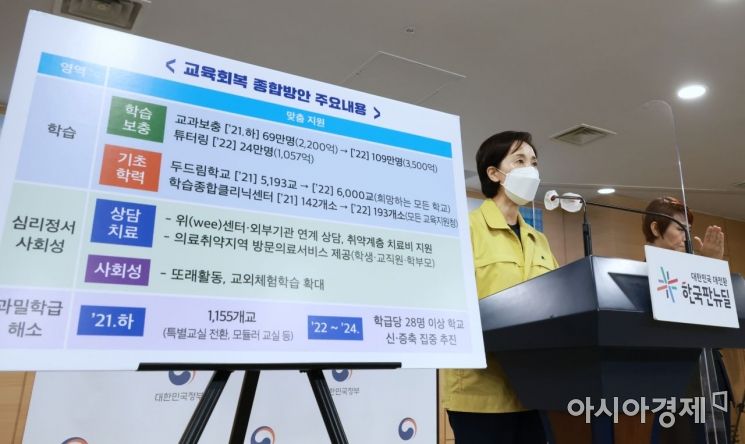
From the second semester, a focused curriculum supplementation program called ‘Student Help Run’ will also be conducted. Students who wish to participate and are recommended by teachers will receive customized programs in small groups of 3 to 5 students per teacher after school or during vacations. The program supports not only students with basic academic skills deficiencies but also those in the middle tier whose academic performance has declined and need supplementation. Full tuition support will be provided to 2.03 million students, which is more than one-third of all elementary, middle, and high school students.
The goal is to raise the number of students estimated to be below basic academic achievement level (Level 1) in academic achievement assessments to the pre-COVID-19 level, which is 3 to 6 times the current number. The Ministry of Education will support 1.78 million students with a special grant of 570 billion won and will increase the number of beneficiaries by additional local education finance grants from metropolitan and provincial offices of education. An official from the Ministry of Education explained, "The goal is for both academic performance and student psychology to return to pre-COVID-19 levels. If metropolitan and provincial offices of education invest their own budgets, the scale of program support will increase further, and there will be few students who cannot receive help due to budget limitations."
After the start of the school year, all students will be diagnosed for learning gaps through EBS’s AI learning diagnostic system (Danchoo) and emotional-behavioral characteristic tests, and linked to recovery programs. In addition to the curriculum supplementation program, ‘tutoring’ will be conducted to assist small-group learning supplementation and counseling by students from education universities and teacher training colleges. Furthermore, the number of elementary schools operating cooperative classes to improve basic academic skills will expand from 1,700 to 2,200 schools. Considering the decline in language, emotional, and physical development of young children due to COVID-19, after-school program models will also be operated in 600 kindergartens nationwide. Support will be provided for qualification exam fees to assist employment in vocational high schools, and employment linkage will be supported through job training courses connected to hiring.
Deputy Prime Minister Yoo said, "In a situation where concerns about learning gaps have greatly increased, we will intensively invest the curriculum supplementation program not only for students with basic academic skill deficiencies but also for all students who wish to participate, to supplement and support learning gaps and deficits. We will comprehensively support children to recover from these deficits quickly."
© The Asia Business Daily(www.asiae.co.kr). All rights reserved.
![User Who Sold Erroneously Deposited Bitcoins to Repay Debt and Fund Entertainment... What Did the Supreme Court Decide in 2021? [Legal Issue Check]](https://cwcontent.asiae.co.kr/asiaresize/183/2026020910431234020_1770601391.png)


















