2020 Population and Housing Census
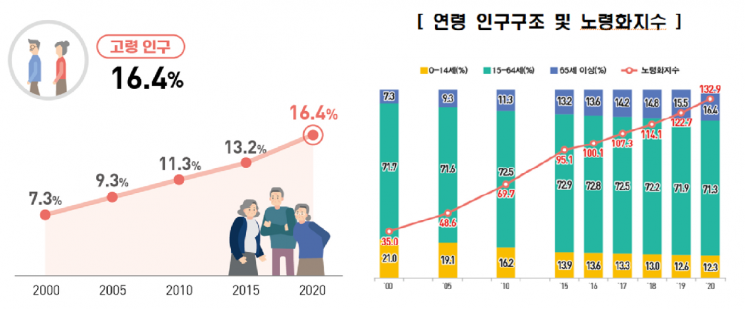
[Sejong=Asia Economy Reporter Son Seon-hee] South Korea is aging rapidly. In just one year, the working-age population (ages 15-64) decreased by 190,000, while the elderly population (65 and older) increased by 460,000, more than twice that amount. The proportion of elderly people in the total population rose to 16.4%.
According to the "2020 Population and Housing Census" released by Statistics Korea on the 29th, the total population residing in Korea (including foreigners) was 51.83 million (as of November 1, 2020), an increase of 50,000 compared to 51.78 million in 2019.
Examining the population structure by age confirms that the aging of Korean society is progressing rapidly. First, the median age of Korean nationals in 2020 was 44.3 years, up 0.6 years from 43.7 years a year earlier.
The youth population aged 0-14 decreased from 6.31 million to 6.18 million, and the working-age population aged 15-64 decreased from 35.94 million to 35.75 million. In contrast, the elderly population aged 65 and over increased from 7.75 million to 8.21 million.
The "aging index," calculated as the ratio of elderly population to youth population per 100 youths, recorded 132.9. This is an increase of 10.1 compared to 122.7 a year earlier. The aging index has been rising sharply every year since it first reached triple digits (100.1) in 2016.
The proportion of elderly population was highest in Jeonnam at 23.7%, followed by Gyeongbuk (21.6%) and Jeonbuk (21.3%).
Meanwhile, although the total population increased last year, the cause was analyzed to be different from previous years. The domestic population increased by 130,000 to 50.13 million, while the foreign population decreased by 80,000 to 1.7 million.
The total resident population in Korea has shown a continuous increasing trend recently, mainly due to the influx of foreigners rather than domestic population growth. However, last year was unusual in that the foreign population decreased and the domestic population increased, driving the overall population growth.
Jung Nam-su, head of the Population Census Division at Statistics Korea, explained, "In 2020, the factors affecting population growth changed due to the COVID-19 pandemic. Although the foreign population decreased significantly, the total population slightly increased due to the return of Koreans who had been staying abroad long-term."
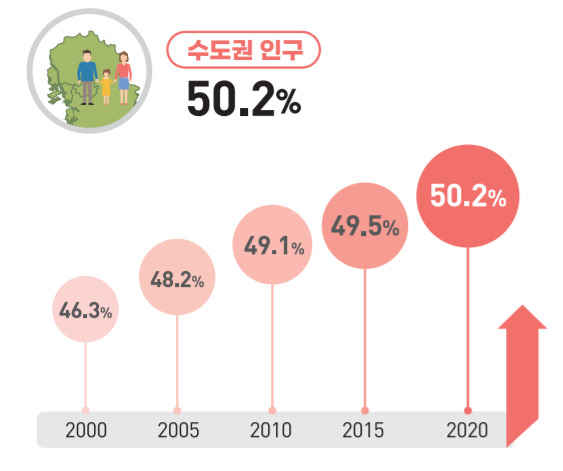
The phenomenon of population concentration in the metropolitan area also continued. Last year, the metropolitan area population ratio was 50.2%, up 0.2 percentage points from 50.0% a year earlier. However, looking at the metropolitan regions individually, Gyeonggi's population increased by 210,000, while Seoul and Incheon decreased by 50,000 and 10,000 respectively. This is understood to be due to the recent surge in Seoul housing prices, which forced residents to move to Gyeonggi Province.
Looking at the population by province, Gyeonggi accounted for the largest share at 26.1% of the total population. However, in terms of growth rate, Sejong was highest at 4.7%, followed by Gyeonggi at 1.6% and Jeju at 0.9%.
Jung, the division head, said, "Overall, the trend shows population inflow toward Gyeonggi Province. We believe this is due to housing issues."
© The Asia Business Daily(www.asiae.co.kr). All rights reserved.
!["The Woman Who Threw Herself into the Water Clutching a Stolen Dior Bag"...A Grotesque Success Story That Shakes the Korean Psyche [Slate]](https://cwcontent.asiae.co.kr/asiaresize/183/2026021902243444107_1771435474.jpg)

















