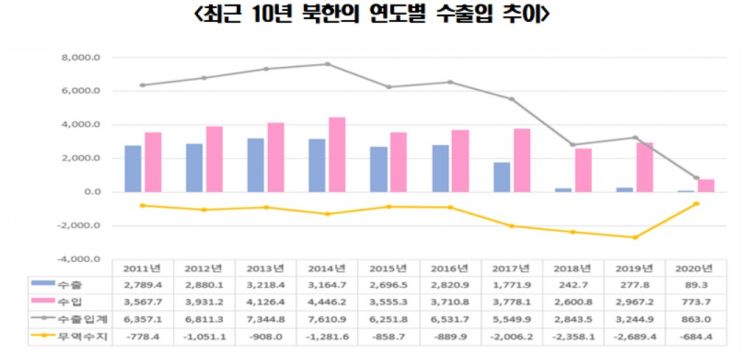
[Asia Economy Reporter Jeong Hyunjin] North Korea's foreign trade volume last year recorded $863 million (approximately 996 billion KRW), a 73.4% decrease compared to the previous year. This is interpreted as a significant decline in both exports and imports due to ongoing UN sanctions against North Korea and border closures caused by COVID-19.
KOTRA announced on the 29th in its '2020 North Korea Foreign Trade Trends' report that North Korea's exports last year amounted to $89.3 million, down 67.9% from the previous year, and imports were $773.67 million, down 73.9%. The trade deficit improved, shrinking by 74.6% from $2.689 billion in 2019 to $684.37 million last year.
According to KOTRA, trade with China, North Korea's largest trading partner, decreased by 75.4% from 2019 to $760.8 million (exports $48 million, imports $712.8 million). The trade deficit with China sharply narrowed from $2.663 billion in 2019 to $664.8 million last year, marking the lowest level in the past decade.
China's share in North Korea's total trade slightly shrank from 95.4% in 2019 to 88.2% last year, but the heavy dependence on China remains significant.
Following China, Russia, Vietnam, and India ranked as North Korea's 2nd, 3rd, and 4th largest trading partners for two consecutive years. Mozambique, Tanzania, Ghana, and Thailand newly entered the top 10. However, except for China, Russia, and Vietnam, each of the other seven countries in the top 10 accounted for less than 1% of North Korea's foreign trade, with their combined share totaling only 2.5%, indicating a minimal level.
North Korea's largest export item, steel, decreased by 60.9% to $13.8 million, rising to the top export item last year after ranking second in 2019. Watches and parts, as well as minerals, slag, and concentrates, decreased by 86.3% and 73.9% respectively but remained among the top exports following 2019. Beverages, alcohol and vinegar, steel products, and zinc and its products showed high growth rates of 169.8%, 54.1%, and 60.3%, respectively.
Last year, North Korea's largest import item was mineral oil, including crude oil and refined oil, imported at $238.69 million, accounting for 30.9% of total imports, continuing from 2019. Animal fats and their derivatives, plastics and their products were also among the top imported items as in 2019, with tobacco and milling industry products newly included in the top import items.
A KOTRA official stated, "The heavy dependence on China and the major trade items in North Korea's foreign trade last year did not change significantly. However, due to border closures caused by COVID-19, trade with China decreased along with a slowdown in trade of light industry items. Additionally, the significant decline is characteristic of the ongoing UN sanctions besides COVID-19." The official added, "While the share of trade with China decreased compared to 2019, there were differences such as the advancement of Russia and Vietnam and the addition of new African countries."
© The Asia Business Daily(www.asiae.co.kr). All rights reserved.

















