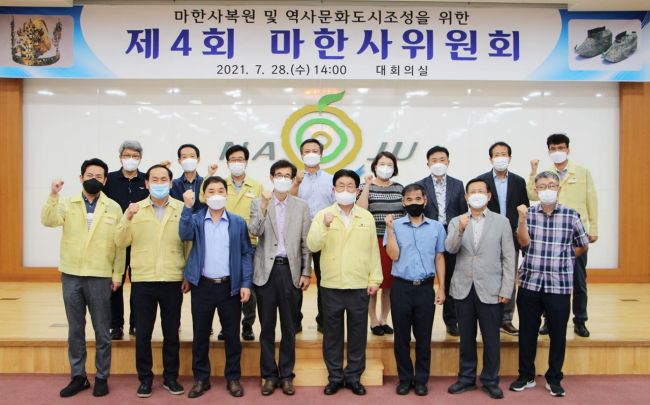
[Naju=Asia Economy Honam Reporting Headquarters Reporter Kim Yuk-bong] Jeollanam-do Naju City (Mayor Kang In-gyu) announced on the 28th that it held the ‘4th Meeting of the Public-Private Joint Committee Mahan History Committee’ at the main conference room of the city hall.
At the meeting, Mayor Kang In-gyu, the standing chairman of the public-private joint committee, Im Young-jin, director of the Mahan Research Institute and co-chairman of Mahan History, Park Jung-hwan, curator of the Ministry of Culture, Sports and Tourism, Lee Eun-seok, director of the National Naju Cultural Heritage Research Institute, Lee Gye-han, professor of Forest Resources at Chonnam National University, and Ryu Young-guk, CEO of Geocity Co., Ltd., attended.
Also attending for a special lecture were Kwon Jeom-su, officer of the Cultural Heritage Administration’s Ancient City Preservation and Promotion Division, Kim Yong-ok, head of the public-private joint committee promotion team (Naju City General Affairs Bureau chief), Na Sang-in, director of the Future Strategy Industry Bureau, and heads of relevant departments, who gathered to discuss together.
Eun Hwa-su, director of the National Naju Museum, Lee Sung-joo, dean of the College of Humanities at Kyungpook National University, Lee Jeong-ho, director of the Naju Bokam-ri Burial Mounds Exhibition Hall, Jung Jae-yoon, professor of history at Kongju National University, Choi Jong-taek, professor of Cultural Heritage Convergence at Korea University, and Ha Seung-cheol, head of the research office of the Gaya Burial Mounds World Heritage Registration Promotion Team, also submitted their opinions in writing.
Mayor Kang In-gyu said, “The 4th meeting is a place to review key projects related to the restoration of Mahan history and the creation of a historical and cultural city, and to discuss practical measures for adoption as a national agenda for the next presidential election,” adding, “Through strategic planning for the Historical and Cultural Zone Maintenance Act, I hope that the investigation and research of Mahan, which is the pride of the Namdo people and the reality of the ancient history of the Yeongsan River, will be revitalized.”
The Mahan History Committee discussed the background, necessity, and location of detailed projects discovered for adoption as the next presidential national agenda for the restoration of Mahan history, including the ‘Establishment of the National Mahan History and Culture Center (tentative name)’, ‘Restoration of Mahan National Town (Royal Palace Site)’, and ‘Creation of the National Mahan History Park and Yeongsan River Mahan Culture East Asian Maritime Network Hub Complex’.
They also reviewed projects related to the creation of a historical and cultural city, such as ‘Restoration and maintenance of Naju Eupseong Fortress and Mokgwana Office’, ‘Construction of Yeongsan River Tower and restructuring of Yeongsanpo Riverside City’, ‘Establishment of the National River Culture Museum (tentative name)’, ‘Creation of the National Yeongsan River Ecological Garden (tentative name)’, and ‘Creation of the Yeongsan River International Network 100-ri Road’.
The committee particularly defined the restoration of Mahan history as a major project to inherit the ethnic historical legitimacy contained in the national name ‘Han’ (韓), which continues from Mahan (馬韓), the hegemonic state of the Three Hans (Samhan), to the Korean Empire (Daehan Jeguk), the Provisional Government of the Republic of Korea (Daehan Minguk), and the Republic of Korea (Daehan Minguk).
Kwon Jeom-su, officer of the Cultural Heritage Administration, gave a special lecture titled ‘How to Develop Naju as a Historical and Cultural City’, covering the definition of ancient cities according to the Ancient City Promotion Act, ancient city preservation and promotion projects, criteria for ancient city designation, scalability, selection of legal cultural cities by local governments, procedures for establishing basic plans for historical and cultural zone maintenance and designation of maintenance areas, and project implementation plans.
Park Gyu-gyeon, policy chairman of the public-private joint committee, said, “Gyeongnam Province proposed to the ruling party this year the Gaya cultural zone development project, which requires an increase in national funding, as a super-regional cooperation project to revitalize the regional economy,” adding, “The Gyeongnam-type New Deal project, which will invest 1.2 trillion won, actively incorporates ancient history into key provincial projects such as the establishment of a smart tourism platform for the Gaya cultural zone.”
He continued, “Since the restoration of Gaya history was adopted as a national agenda for the 2017 presidential election and a comprehensive restoration and maintenance project is underway, Mahan history should also be adopted as a national agenda for balanced regional development,” adding, “To this end, Jeollanam-do should take the lead in establishing a super-regional governance with Gwangju, Jeonbuk, and Chungnam regions so that the next presidential election can be the golden time for the restoration of Mahan history.”
Naju=Asia Economy Honam Reporting Headquarters Reporter Kim Yuk-bong bong2910@asiae.co.kr
© The Asia Business Daily(www.asiae.co.kr). All rights reserved.

















