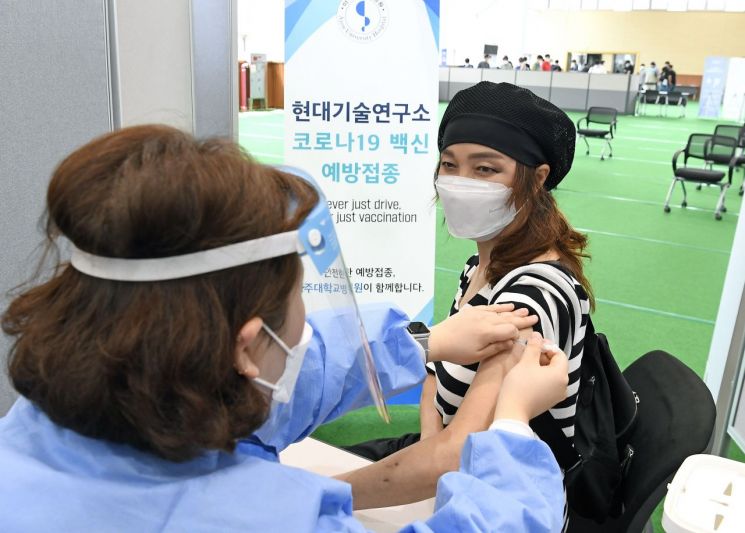
 On the 27th, employees at Hyundai Motor Namyang Research Institute in Hwaseong-si, Gyeonggi-do, are receiving COVID-19 vaccinations. [Image source=Yonhap News]
[Asia Economy Reporter Lee Chun-hee] As cases of 'breakthrough infections'?infections occurring 14 days after completing vaccination?are increasing alongside the spread of the Delta variant (Indian variant), authorities have analyzed that even if breakthrough infections occur, the additional transmissibility is about half that of unvaccinated individuals.
According to the Central Disease Control Headquarters on the 28th, as of the 22nd, there were 779 breakthrough infection cases who were infected with COVID-19 after 14 days of completing the recommended number of vaccine doses, corresponding to 14.1 cases per 100,000 people. By vaccine type, there were 169 cases for AstraZeneca (AZ), 172 for Pfizer, 437 for Janssen, and 1 case for the first dose AZ-second dose Pfizer cross-vaccination. Based on cases per 100,000 people, Janssen was the highest at 38.5, followed by AZ at 16.9, Pfizer at 5, and cross-vaccination at 0.7.
Among 226 randomly selected breakthrough infection cases subjected to variant virus analysis, major mutations were confirmed in 72 cases. The Delta variant was the most common with 54 cases, followed by 17 Alpha variant cases and 1 Beta variant case.
There were 5 severe cases, accounting for 0.6% of the suspected breakthrough infection cases. Two were Janssen vaccine recipients (in their 30s and 50s), and three were Pfizer vaccine recipients (in their 80s). Park Young-jun, head of the epidemiological investigation team at the Central Disease Control Headquarters, stated at the COVID-19 briefing on the 28th, "Variant analysis for severe breakthrough infection cases is currently underway," adding, "So far, Delta variant infection has been confirmed in one person in their 80s." However, no deaths due to breakthrough infections have been reported.
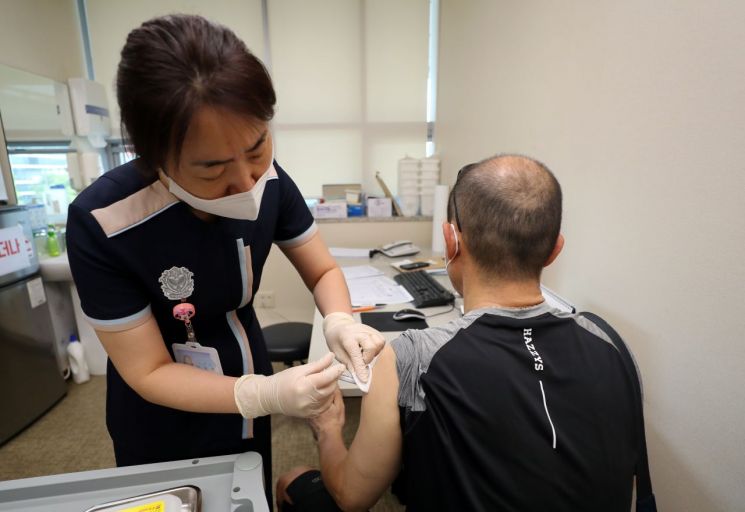 On the morning of the 26th, Moderna COVID-19 vaccinations were administered at a hospital in Buk-gu, Gwangju. [Image source=Yonhap News]
However, the health authorities evaluated the risk as somewhat lower by citing overseas research results indicating that the additional transmissibility of COVID-19 in breakthrough infection cases is about half that of unvaccinated individuals.
Team leader Park explained, "To clarify, (breakthrough infection cases) can transmit the virus to others," but added, "Research shows that the additional transmissibility is lower compared to cases without vaccination. While additional transmission can occur, the risk is reduced by about half."
According to a study published on the 21st (local time) in 'The New England Journal of Medicine' by Dr. Ross J. Harris of Public Health England (PHE), the transmissibility was reduced by about half in cases where AstraZeneca (AZ) and Pfizer vaccines were completed and 21 days had passed.
The study reported that among 960,765 family contacts of COVID-19 confirmed cases who were unvaccinated in the UK from January 4 to February 28, 10.1% (96,898) tested positive for COVID-19. In contrast, among those who completed AstraZeneca (AZ) vaccination and tested positive after 21 days, 5.7% (196) of 3,424 contacts were confirmed positive. For Pfizer vaccine recipients who tested positive after 21 days post-completion, only 6.2% (371) of 5,939 household contacts were infected.
However, the additional transmissibility of breakthrough infections caused by the recently spreading Delta variant has not yet been confirmed. Team leader Park said, "There is currently no data on (additional transmissibility) for the Delta variant," adding, "While it can be realistically assumed that the additional transmissibility of breakthrough infections is lower compared to unvaccinated non-variant infections, this has not yet been confirmed by data."
© The Asia Business Daily(www.asiae.co.kr). All rights reserved.


















