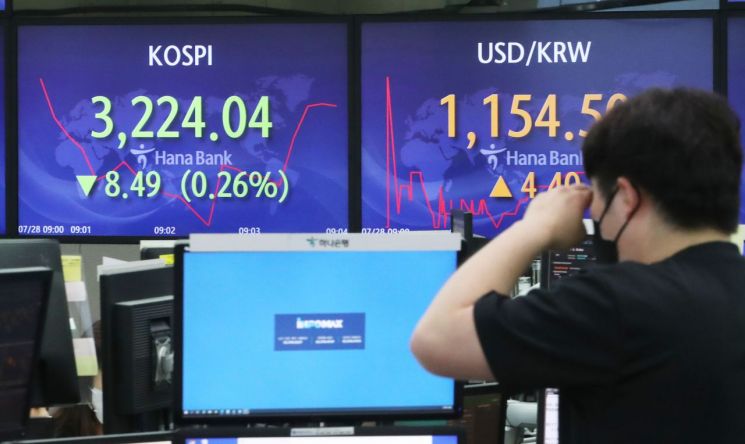
[Asia Economy Reporter Lee Seon-ae] On the 28th, the domestic stock market, which started lower, continued to fluctuate within a box range, moving between gains and losses.
As of 1 p.m. on the 28th, the KOSPI was down 0.12% from the previous day at 3,228.49, and the KOSDAQ was down 0.62% at 1,040.05. The KOSPI index opened at 3,226.06, down 6.47 points (0.20%) from the previous day. The KOSDAQ index also started the session at 1,043.19, down 3.36 points (0.32%).
Foreign investors are showing a net selling position alone. Foreigners sold 369 billion KRW and 119.1 billion KRW worth of stocks in the KOSPI and KOSDAQ markets, respectively. Individuals recorded net buying in both markets, currently purchasing about 87.1 billion KRW and 239.9 billion KRW, respectively. Institutions bought about 283 billion KRW in the KOSPI market but sold about 105 billion KRW in the KOSDAQ market.
In the KOSPI by sector, medical precision (-1.92%), textiles and apparel (-1.32%), and machinery (-0.75%) are slightly down, while strong sectors include telecommunications (+1.66%), distribution (+0.82%), and construction (+0.72%). In the KOSDAQ, broadcasting services (-1.67%), entertainment and culture (-1.50%), and publishing and media reproduction (-1.25%) are weak sectors, while transportation equipment and parts (+1.55%), metals (+0.68%), and construction (+0.49%) are strong sectors.
Seosangyoung, a researcher at Mirae Asset Securities, said, "The U.S. stock market faced selling pressure due to concerns over the spread of COVID-19 and profit-taking in large tech stocks that had risen sharply. The Philadelphia Semiconductor Index fell 1.86%, the Russell 2000 Index dropped 1.13%, and the Dow Transportation Index declined 2.21%. Additionally, the weak Korean won has introduced negative factors for foreign demand, which is a burden." However, he added, "Due to the spread of the COVID-19 Delta variant, concerns about tightening at the Federal Open Market Committee (FOMC) may ease, which is favorable. Considering this, the Korean stock market is expected to show a stock-specific market as it digests selling pressure while waiting for the FOMC, rather than expanding the correction range."
Lee Euntak, a researcher at KB Securities, said, "Concerns about 'economic peak + tightening' may cause volatility for a while, but the price adjustment due to tightening is not the 'start of a bear market.' Rather, it should be understood as a 'speed control process' that relieves valuation pressure." He emphasized, "Therefore, after the correction, the market is expected to return to a bull market, and price fluctuations are another buying opportunity." He added, "Value stocks, which are in a 'good earnings + oversold' state, may rebound in the short term, but growth stocks (KOSDAQ) remain positive in the mid to long term." He recommended, "It is advisable to gradually increase the weighting through incremental purchases during growth stock corrections."
© The Asia Business Daily(www.asiae.co.kr). All rights reserved.

















