Optimal Site Selected After Feasibility Study of Candidate Sites by Location Selection Committee
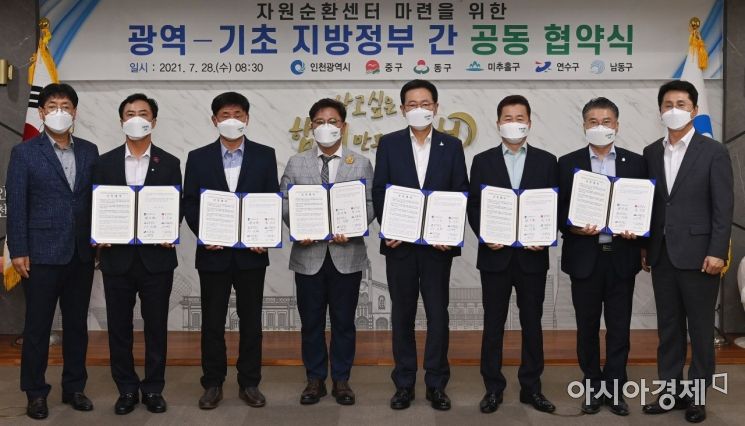 At the 'Metropolitan-Basic Local Governments Joint Agreement Ceremony for Establishing a Resource Circulation Center' held at Incheon City Hall on the 28th, attendees are taking a commemorative photo. From the left: Oh Heung-seok, Incheon City Transportation and Environment Adjustment Officer; Lee Kang-ho, Namdong District Mayor; Go Nam-seok, Yeonsu District Mayor; Kim Jeong-sik, Michuhol District Mayor; Park Nam-chun, Mayor of Incheon; Heo In-hwan, Dong District Mayor; Hong In-seong, Jung District Mayor; Jo Taek-sang, Deputy Mayor for Balanced Development of Incheon City. [Photo by Incheon City]
[Asia Economy Reporter Park Hyesook] Incheon City and five autonomous districts are joining forces to expand waste incineration facilities (Resource Circulation Centers).
Accordingly, the incineration plant candidate sites and incineration capacity expansion issues announced last year based on Incheon City's private service results will be practically reconsidered from scratch, and the optimal candidate sites will be sought again through active communication with local residents.
On the 28th, Incheon Mayor Park Namchun signed a "Joint Agreement between Metropolitan and Basic Local Governments for the Establishment of Resource Circulation Centers" at City Hall with Hong Inseong, Mayor of Jung-gu, Heo Inhwan, Mayor of Dong-gu, Kim Jeongsik, Mayor of Michuhol-gu, Go Namseok, Mayor of Yeonsu-gu, and Lee Kangho, Mayor of Namdong-gu.
The core of the agreement is to unite in building an eco-friendly resource circulation center in preparation for the ban on direct landfill of combustible household waste in 2026.
To this end, Incheon City and the five districts agreed to work together to find the optimal location for constructing a new resource circulation center and to devise ways to minimize waste processing capacity.
The site for the new resource circulation center will be decided after considering both the results of Incheon City's independent service and proposals from basic local governments, followed by forming a legally mandated site selection committee to conduct feasibility studies on candidate sites. The site selection committee will be composed through consultation with each local government, including resident representatives, city or district council members, experts, and public officials.
Accordingly, the current Incheon waste incineration facilities centered on the Yeonsu-gu Songdo Center and Seo-gu Cheongna Center are expected to operate in four major zones: Yeonsu, Michuhol, Namdong (Songdo Center), Seo-gu, Ganghwa (Cheongna Center), Jung-gu, Dong-gu (newly established), and Bupyeong, Gyeyang (to be discussed later). Ongjin-gun, which processes waste independently, will remain unchanged.
Previously, in November last year, Incheon City announced new candidate sites concentrated in the southern region, such as the Namdong-gu Gojan-dong Resource Circulation Center and Jung-gu Sinheung-dong Resource Circulation Center, as preliminary incineration plant candidate sites based on private service results through the "Basic Plan for Establishing Eco-friendly Resource Environmental Facilities."
However, residents of Yeonsu-gu, which owns two incinerators exceeding its own processing capacity, opposed all candidate sites, stating that they are within the environmental impact assessment guideline radius, and strong opposition from surrounding Michuhol-gu and Namdong-gu residents followed.
In response, the three local governments of Yeonsu-gu, Namdong-gu, and Michuhol-gu issued a joint agreement demanding the complete withdrawal of the preliminary incinerator candidate sites and launched a Southern Region Resource Circulation Policy Council to respond.
However, according to this agreement, the preliminary candidate sites concentrated in the southern region will be reconsidered from scratch, and residents from the five districts will participate in the site selection committee to conduct feasibility studies on candidate sites.
Mayor Park Namchun of Incheon said, "Since we have agreed to work together with the five districts to build a new resource circulation center, we will strive to ensure a more transparent and objective site selection process," adding, "Once the installation of the resource circulation center is in full swing, it will lead eco-friendly resource circulation along with Yeongheung Eco Land, which is planned to be developed as an independent landfill site, and further concretize the closure of the metropolitan landfill site in 2025."
Incheon City is promoting the construction of a new waste landfill facility called "Incheon Eco Land" on 894,860 square meters of land at 248-1 Oeri, Yeongheung-myeon, Ongjin-gun, in preparation for the closure of the metropolitan landfill site (Seo-gu, Incheon) in 2025. This facility will only process Incheon’s waste.
Unlike the metropolitan landfill site, which directly landfills waste, Eco Land will bury only incineration ash from household waste processed at incinerators and non-combustible waste at a depth of 30 to 40 meters underground.
© The Asia Business Daily(www.asiae.co.kr). All rights reserved.
![Clutching a Stolen Dior Bag, Saying "I Hate Being Poor but Real"... The Grotesque Con of a "Human Knockoff" [Slate]](https://cwcontent.asiae.co.kr/asiaresize/183/2026021902243444107_1771435474.jpg)











