Ministry of Land, Infrastructure and Transport Official SNS: "Worries About Moving Every 2 Years Have Decreased"
Seoul Apartment Jeonse Prices Rise by 130 Million Won One Year After Enforcement of the Three Lease Laws
Experts Point Out "Law Enforced Amid Insufficient Housing Supply"
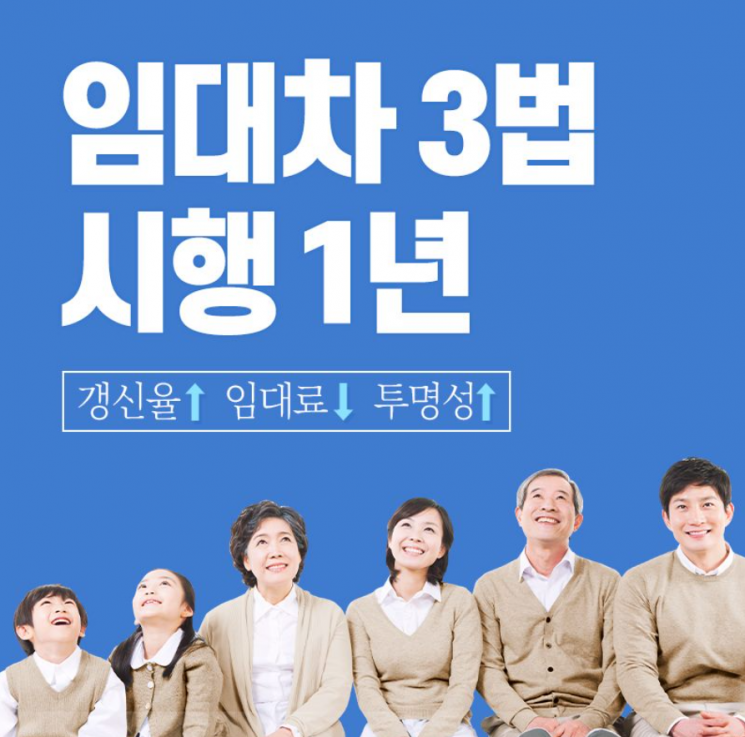 A post uploaded by the Ministry of Land, Infrastructure and Transport marking one year since the implementation of the Three Lease Laws. Photo by Ministry of Land, Infrastructure and Transport Facebook screen capture.
[Asia Economy Reporter Heo Midam] "Can't you see that housing prices skyrocketed because of the Lease 3 Act?"
The Ministry of Land, Infrastructure and Transport (MOLIT) has sparked controversy by posting content claiming that the living conditions of ordinary citizens have stabilized after the implementation of the Lease 3 Act. Critics point out that MOLIT is only self-praising without mentioning side effects such as the "jeonse crisis" caused by the Lease 3 Act.
At the end of July last year, the ruling party passed the bill under the pretext of protecting tenants. However, during the one year after the law was enacted, landlords converted jeonse (long-term deposit lease) listings into monthly rent or semi-monthly rent, reducing the number of jeonse listings. As a result, jeonse prices soared, deepening tenants' worries. Experts pointed out that tax relief is necessary to stabilize the real estate market.
Recently, MOLIT posted content related to the Lease 3 Act on social networking services (SNS) such as Facebook and Instagram. In the related post, tenant A, a young worker, said, "I was worried about whether I had to take out an additional loan because the surrounding market prices rose too much when I tried to renew my lease. Then I learned about the renewal right and the rent ceiling system, and adjusted the rent to less than 5% increase."
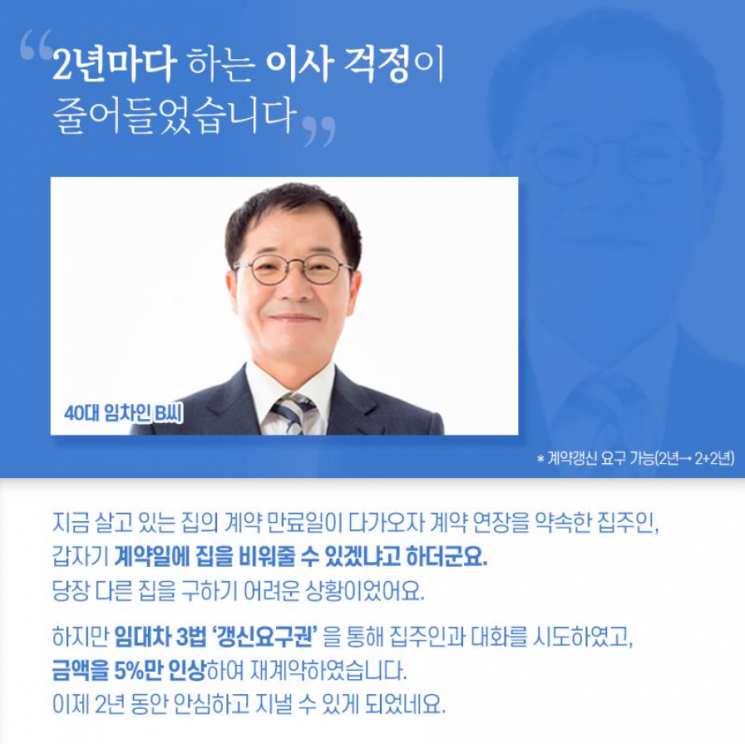
Tenant B, in their 40s, also explained, "The landlord suddenly asked if I could vacate the house on the contract date. However, I renewed the contract with only a 5% increase through the renewal right."
MOLIT mentioned these cases and said, "One year after the Lease 3 Act implementation, worries about loans for young workers have decreased, and worries about moving every two years have also lessened," adding, "Rent can be maintained within 5% annually for four years, and convenience is provided such as automatic certification of fixed dates through the jeonse and monthly rent reporting system."
However, netizens strongly criticized this post. They pointed out that the number of jeonse listings decreased due to the Lease 3 Act, and housing prices surged, deepening the worries of ordinary citizens.
Netizens commented, "The shamelessness has gone too far," "What are you talking about after causing jeonse price surges," "Check how much jeonse prices have risen in the one year after the Lease 3 Act was implemented," and "The reality the government perceives and the reality I experience seem different. I can't sleep worrying about where the problem starts."
Earlier, the Democratic Party introduced the Lease 3 Act at the end of July last year to enhance tenants' housing stability. The core of the law is to allow one extension of the jeonse or monthly rent contract through the right to request renewal and to limit the rent increase to within 5% during this process.
However, landlords raised rents all at once in new contracts in anticipation of restrictions on rent increases during future renewals, causing considerable side effects. In other words, the Lease 3 Act, enacted to protect tenants, ironically became a cause of rising jeonse prices.
This side effect is also confirmed by statistics. According to the monthly housing price trend announced on the 27th by KB Kookmin Bank's Liv Real Estate, the average jeonse price for apartments nationwide is 318.34 million KRW. This is a 24.57% increase compared to July last year (255.54 million KRW) when the Lease 3 Act was implemented. In particular, the average jeonse price for apartments in Seoul rose from 499.22 million KRW to 634.83 million KRW in the past year, an increase of 135.61 million KRW (27.16%).
However, the government maintains that the Lease 3 Act has had effects such as improving tenants' housing stability. Hong Nam-ki, Deputy Prime Minister and Minister of Economy and Finance, said at the real estate market inspection meeting held on the 21st, "To understand the impact of the Lease 3 Act, we separately analyzed lease reporting data and the top 100 apartments in Seoul, confirming that many tenants benefited from the system's implementation."
He added, "For the top 100 apartments in Seoul, the lease renewal rate was just over half (57.2%) in the year before the law was implemented, but it increased to 77.7% after implementation."
 A view of a real estate agency in Seoul. The photo is unrelated to specific expressions in the article. Photo by Yonhap News.
However, citizens are pointing out that even one year after the Lease 3 Act was implemented, housing prices continue to rise steadily. Office worker Kim (28) said, "I can feel that jeonse prices are rising after the Lease 3 Act was implemented. Even though the government has announced more than 20 measures to stabilize housing prices, there has been little effect, and side effects have only increased," adding, "Some acquaintances who couldn't afford Seoul's jeonse prices moved to Gyeonggi Province, but I heard jeonse prices have risen there too. Ordinary citizens like us don't know what to do."
Given this situation, the ruling party has expressed its intention to review supplementary measures for the Lease 3 Act. Yoon Ho-jung, the Democratic Party floor leader, said at the party's supreme council meeting on the 26th, "There was a problem where landlords continuously raised rents in new jeonse contracts," adding, "Legislative measures are needed to improve the unequal contract relationship where rent-setting authority is excessively concentrated in landlords."
Experts suggested that to stabilize the real estate market, capital gains tax should be lowered while property holding tax is raised. Professor Kim Tae-gi of Dankook University's Department of Economics said, "The Lease 3 Act is a bad law. If it had been implemented when housing supply was sufficient, it could have been effective, but since it was implemented when supply was insufficient, side effects such as soaring housing prices have appeared."
He continued, "To solve the housing supply problem, existing houses also need to be released as supply," emphasizing, "To do this, holding tax should be raised and capital gains tax lowered to encourage active transactions."
© The Asia Business Daily(www.asiae.co.kr). All rights reserved.



















