Statistics Korea Announces 'June Domestic Population Movement'
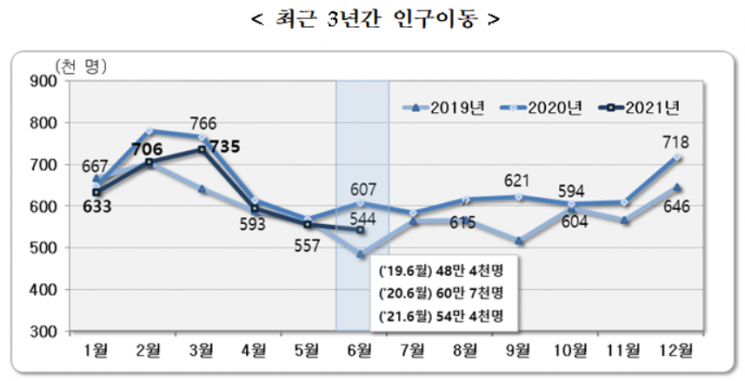
[Sejong=Asia Economy Reporter Son Seonhee] Amid a steady decline in population movement this year, last month marked the first time the decrease reached double digits. This is analyzed to be due to a reduction in housing sales transactions compared to last year.
According to the 'June Domestic Population Movement' statistics released by Statistics Korea on the 23rd, the number of movers last month was recorded at 544,000, a 10.4% decrease compared to the same month a year earlier. This marks six consecutive months of decline following January (-2.2%, year-on-year), February (-9.6%), March (-4.0%), April (-3.4%), and May (-2.2%).
Lee Eunjeong, an official from the Population Trends Division at Statistics Korea, said, "The number of apartments scheduled for move-in from April to June decreased by 23% compared to the same period last year, and the cumulative housing sales transactions from January to May fell by about 2%, which seems to have influenced this decline." She added, "Last June saw an unusually high increase in housing transactions and a high economic index, resulting in a relatively large number of movers. This year reflects the base effect from that."
The population movement rate, which indicates the number of movers per 100 people, was 12.9%, down 1.5 percentage points from the same month a year ago.
Looking at the number of movers by city and province, Seoul saw a net outflow of 8,288 people last month. The population has been declining for a year and a half since March last year. This is attributed to the soaring housing prices in Seoul, which forced people to move to the outskirts of Seoul.
Other regions such as Gyeonggi (10,603 people), Chungbuk (1,150 people), and Chungnam (956 people) among nine cities and provinces experienced net inflows, while Daegu (-2,154 people), Busan (-1,781 people), and eight other cities and provinces saw net outflows.
The net migration rate showed net inflows in Sejong (2.6%), Gyeonggi (1.0%), and Chungbuk (0.9%), while net outflows occurred in Daegu (-1.1%), Seoul (-1.1%), and Ulsan (-1.0%).
© The Asia Business Daily(www.asiae.co.kr). All rights reserved.

















