Parallel Use of Safe Call and Manual Log for Entry Registration
Not Just One or Two Entrances... Burden of Equipment Purchase and Hiring Staff
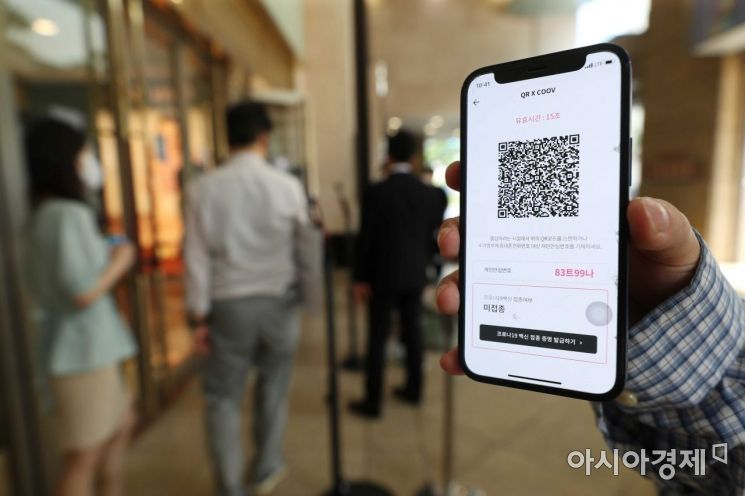 The government has decided to make it mandatory to implement visitor log management for large stores when social distancing level 3 or higher is enforced starting from the 30th. On the 28th, visitors at the Lotte Department Store Main Branch in Jung-gu, Seoul, which began a trial operation, entered after filling out visitor logs using Safe Call and QR codes. Photo by Mun Ho-nam munonam@
"Scanning QR codes doesn't necessarily ensure quarantine..."
As the government mandates the recording of entry logs at large stores such as department stores, large marts, and outlets starting from the 30th, distribution companies are busy purchasing tablet PCs for QR code authentication and assigning staff to manage customer flow.
An industry insider said, "We are willing to actively cooperate with the government's quarantine policy, but the burden of purchasing equipment and hiring additional personnel is significant," adding, "Since there is a considerable amount of foot traffic, it could actually have a negative effect on quarantine by causing congestion at entrances, so we are preparing related countermeasures."
Until now, department stores and large marts have recorded entry logs, including QR code authentication, in places where people gather or remove masks, such as luxury brand stores and food courts. The government also did not enforce this because scanning a QR code takes an average of 10 to 15 seconds per person, and congestion was expected when customers gathered all at once during opening hours. However, as the number of COVID-19 confirmed cases has remained in the four digits daily and has been difficult to control, the government has made entry log recording mandatory even for large stores.
Moreover, large department stores have multiple access routes connected to adjacent buildings or subway stations. For example, Lotte Department Store Main Branch and Hyundai Department Store Trade Center Branch each have about 12 and 13 locations respectively where customers pass through, including the main and rear entrances on the first floor, side entrances, parking lots, and underground passages connected to the subway. QR code authentication devices and staff must be stationed at all these points. Closing some entrances would only cause customers to crowd other entrances, which is also not feasible.
A department store official expressed concern, saying, "We have already introduced contactless fever measurement devices at each store entrance to check customers' health status, but scanning QR codes has nothing to do with COVID-19 prevention," and added, "If customers have to line up to enter the department store or if roads near parking lots become congested, it will cause inconvenience." For this reason, they plan to actively promote alternatives such as 'Call Check-in (Safe Call)' using mobile phones instead of QR code authentication.
Large marts, which have even more stores nationwide, also find operating QR code authentication systems burdensome. An industry insider explained, "Large mart entrances are narrower because of installed theft alarms, so placing QR code readers there would cause significant congestion," and added, "Considering that many elderly customers visit marts, handwritten logs must also be provided."
© The Asia Business Daily(www.asiae.co.kr). All rights reserved.
![Clutching a Stolen Dior Bag, Saying "I Hate Being Poor but Real"... The Grotesque Con of a "Human Knockoff" [Slate]](https://cwcontent.asiae.co.kr/asiaresize/183/2026021902243444107_1771435474.jpg)
















