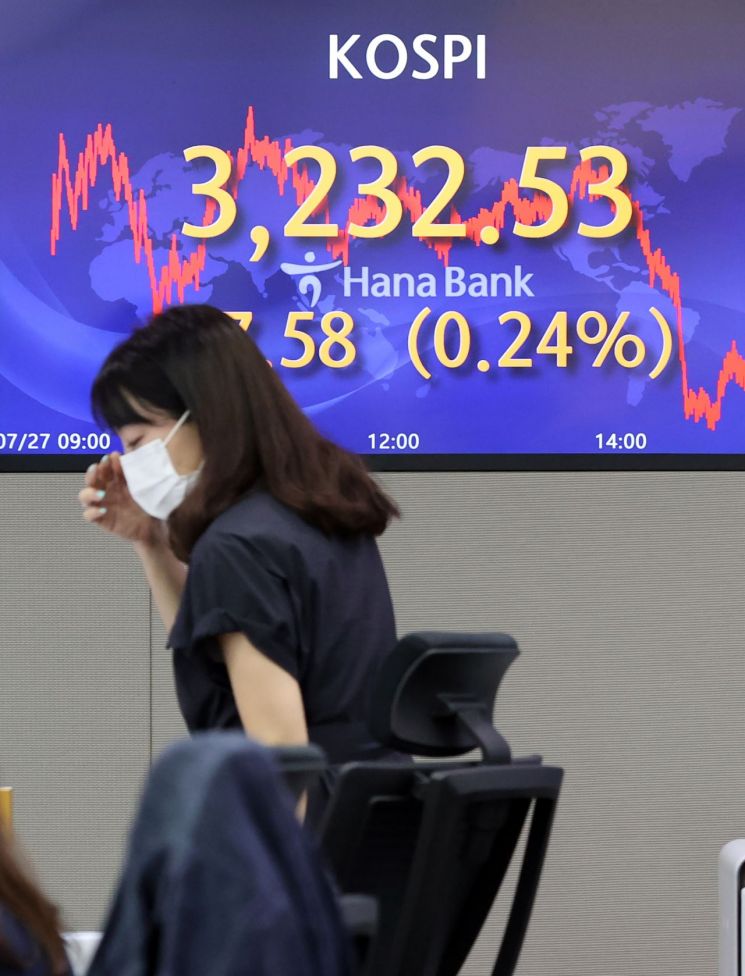
[Asia Economy Reporter Lee Seon-ae] The domestic stock market started lower due to the decline in US and Chinese stock markets and concerns over the spread of COVID-19.
On the 28th, the KOSPI index opened at 3,226.06, down 6.47 points from the previous day (0.20%↓). The KOSDAQ index also started the session at 1,043.19, down 3.36 points (0.32%↓). As of 9:10 AM, the KOSPI was at 3,228.50, and the KOSDAQ was at 1,045.68.
In the early session, only individual investors are net buyers. Individuals are purchasing approximately 24.5 billion KRW and 30.3 billion KRW in the KOSPI and KOSDAQ markets, respectively. Meanwhile, foreign investors are selling about 96.9 billion KRW and 2.7 billion KRW in both markets. Institutions are net buying 72.1 billion KRW in the KOSPI market but net selling 26.6 billion KRW in the KOSDAQ market.
By sector in the KOSPI, most sectors are declining, including Services (-0.48%), Transportation and Warehousing (-0.43%), and Pharmaceuticals (-0.26%), while some sectors such as Construction (+0.32%), Medical Precision Instruments (+0.25%), and Distribution (+0.06%) are showing strength.
By sector in the KOSDAQ, most sectors are also declining, including Publishing and Media Replication (-0.94%), Semiconductors (-0.75%), and Digital Content (-0.63%), while some sectors such as Non-metallic Minerals (+0.32%), Food and Tobacco (+0.26%), and Medical and Precision Instruments (+0.23%) are showing strength.
Seosangyoung, a researcher at Mirae Asset Securities, said, "The US stock market faced selling pressure due to concerns over the spread of COVID-19 and profit-taking in large tech stocks that had seen significant gains, the Philadelphia Semiconductor Index fell 1.86%, the Russell 2000 Index dropped 1.13%, the Dow Transportation Index declined 2.21%, and the weak Korean won also contributed to negative factors affecting foreign investor demand, which is a burden." However, he added, "Considering that the spread of the COVID-19 Delta variant may ease tightening concerns at the Federal Open Market Committee (FOMC), the Korean stock market is expected to show a stock-specific market where individual stocks absorb selling pressure while waiting for the FOMC, rather than an expanded correction."
© The Asia Business Daily(www.asiae.co.kr). All rights reserved.

















