'Olympic Goddess' 'Blonde Woman Who Heated Up Tokyo'
Reports Still Emphasize Athlete Appearance Over Skill
Experts Say "Gender-Highlighting Expressions Are Discriminatory... Should Be Avoided"'
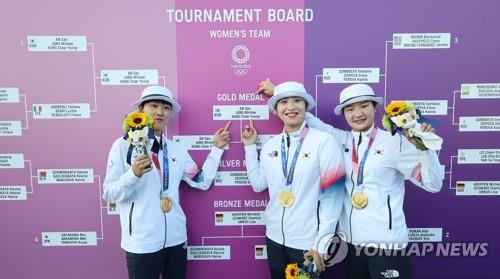 National team archers who won the gold medal in the women's team event at the 2020 Tokyo Olympics. From the left, An San, Jang Min-hee, and Kang Chae-young. Photo by Yonhap News
[Asia Economy Reporter Kang Juhee] There is growing criticism of the media for using sexist terms while reporting on the 2020 Tokyo Olympics, which opened on the 23rd. This issue arose from attaching inappropriate titles such as 'nangja' when introducing female national athletes or using expressions that emphasize appearance like 'goddess' and 'beauty.'
Despite increased awareness of gender discrimination issues compared to the past, outdated reporting practices are still continuing. There are concerns that the indiscriminate use of such expressions could entrench gender biases and discrimination. Since media coverage is exposed to many people and has a significant impact, opinions have been raised that the way terms are used should be handled carefully.
Experts emphasized that expressions highlighting gender themselves can be perceived as discriminatory, and the media should recognize and improve these issues.
Inappropriate remarks began pouring in from the moment the South Korean women's archery team won the gold medal in the team final on the 25th. Many media outlets, including the official Twitter account of the 2020 Tokyo Olympics and Paralympics Korea, increased the use of the term 'Taeguk Nangja' to refer to the athletes when reporting the gold medal news. 'Nangja' is an old term that used to respectfully refer to a 'maiden.'
As a result, criticism flooded social networking services (SNS) and communities, stating that using the term 'nangja' is inappropriate. Questions were raised as to why female athletes are called by such titles while male athletes are not referred to as 'Taeguk Chonggak' or 'Taeguk Doryeong.'
Netizens criticized, saying, "Are they really sane to call them Taeguk Nangja?" "They are all national representatives, so how can they use 'nangja' just because they are women?" "What era are we living in now?" "I burst out laughing as soon as I heard it," and so on.
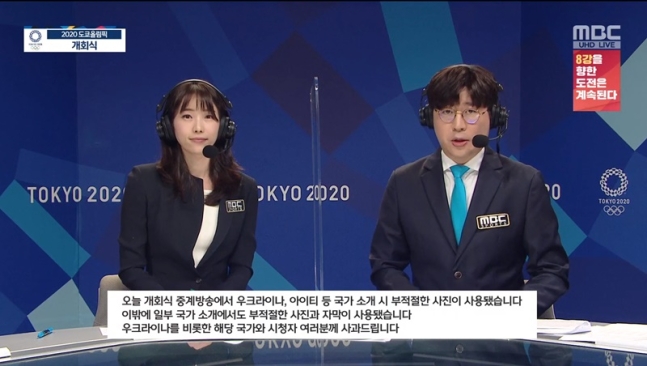 MBC apologized for providing inappropriate commentary about a specific country during the broadcast of the Tokyo Olympics opening ceremony. Photo by MBC
Expressions emphasizing appearance rather than skill also persisted. Terms like 'beautiful swordswoman' and 'Olympic goddess' repeatedly appeared to describe female athletes.
Some media outlets focused on appearance, body shape, or clothing rather than the athletes' achievements, with headlines such as "Is she a princess or what... Who is the blonde woman who energized the tiring Tokyo opening ceremony?" "Attention! The goddesses of the Tokyo Olympics... Thank you for coming out" and "How pretty is she... German athletics goddess draws all the attention in Tokyo."
Discriminatory and prejudiced reporting was not limited to female athletes. Earlier, MBC caused controversy by using a photo of the 'Chernobyl nuclear power plant explosion' when introducing the Ukrainian team during the Tokyo Olympics opening ceremony broadcast, mentioning 'presidential assassination' for Haiti, and referring to 'Bitcoin' for El Salvador, adding inappropriate explanations. This led to criticism that such reporting was rude and could reinforce negative perceptions or prejudices against certain countries.
Among citizens, there is a growing voice wanting to watch an Olympics free from discrimination and exclusion. Mr. Lim, a 30-something office worker, said, "Instead of respecting the athletes who must have had a harder time than ever due to the COVID-19 situation and highlighting their efforts, the broadcast seemed to just ridicule them, which was disappointing. The purpose of the Olympics is world peace, but it seems to be fostering conflict instead," he said.
Experts pointed out that expressions emphasizing gender can reinforce prejudice against a particular gender.
Shin Hyejung, an activist with the Gender Equality Media Team at the Korean Women's Association United, said, "Attaching modifiers like 'beauty' and 'nangja' to female athletes is a wrong expression that has continued from the past. Male athletes are described with terms showing expertise and ability, but expressions showing female athletes' capabilities or careers are used less. Highlighting a woman's gender itself can now be perceived as discriminatory."
She added, "More viewers have become uncomfortable with these wrong expressions that have been used since the past. Continuing to use such expressions without awareness of the problem is a big issue. Korean broadcast content is no longer viewed only by Koreans but by people worldwide. Therefore, terms that can promote discrimination should be avoided, and broadcasters must recognize the rapidly changing thoughts of viewers and change accordingly.
© The Asia Business Daily(www.asiae.co.kr). All rights reserved.


















