UNIST, National Cancer Center, and Gyeongsang National University Develop Titanium Artificial Bone for Customized Reconstruction of Cancer Resection Sites
Joint Preservation Reduces Surgery Costs and Recovery Time ... Mechanical Stability of Implan
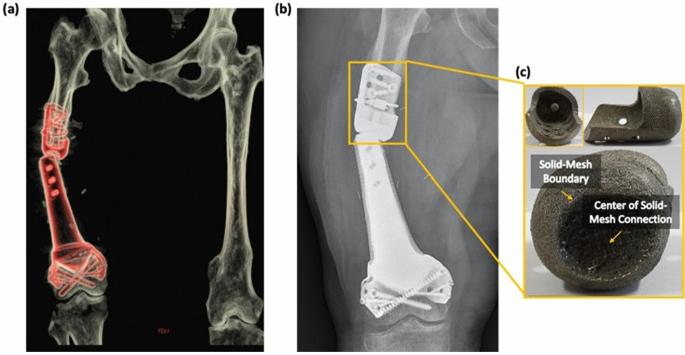
[Asia Economy Yeongnam Reporting Headquarters Reporter Kim Yong-woo] With the development of implant technology, an era has arrived where healthy joints of bone cancer patients no longer need to be removed.
The research team led by Professor Jeong Im-du of the Department of Mechanical Engineering at Ulsan National Institute of Science and Technology (UNIST), in collaboration with Professor Park Jong-woong of the National Cancer Center and Professor Seong Hyo-kyung of Gyeongsang National University, announced on the 27th that they have developed a technology to minimize the resection area of bone cancer (osteogenic tumor) using metal artificial bone (implant) produced by 3D printing.
Until now, if the bone cancer occurred near the patient's joint area, even healthy joints had to be replaced with artificial joints. This problem has been solved through patient-customized 3D printing manufacturing technology.
The joint research team is gaining attention for developing technology that preserves the patient's own joints while reducing surgery costs and recovery time.
Bone cancer mainly occurs in the bones of the arms and legs, and the treatment method involves orthopedic surgery to remove the tumor area. To completely remove cancer cells, sufficient bone resection is performed, followed by complex surgery to implant standardized metal implants.
This method had the problem that even joints not invaded by cancer had to be resected and replaced with standardized artificial joints if they were close to the cancer.
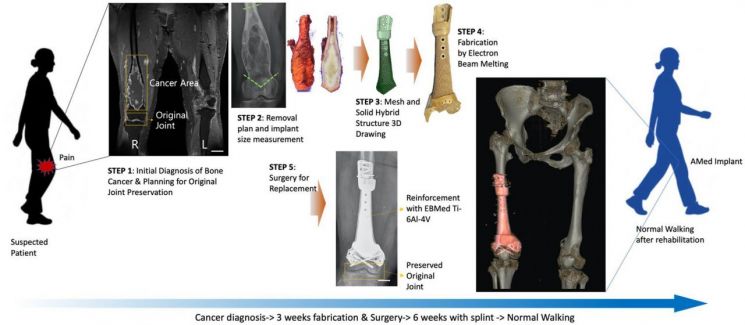 Study diagram of the treatment process for bone tumors using 3D printed Ti-6Al-4V implants (artificial bone).
The joint research team solved this problem with customized 3D printing implant design and manufacturing technology.
They designed and produced 3D printed artificial bone that minimally resects only the cancer-invaded part of the patient's leg bone while preserving the knee joint to help maximize walking function recovery.
To achieve this, the research team conducted various analyses including medical, mechanical, and material mechanics analyses.
For the artificial bone material, they used titanium alloy (Ti-6Al-4V), which has excellent biocompatibility. The customized artificial bone was fabricated using Electron Beam Melting (EBM), a metal 3D printing method. EBM melts alloy powder with an electron beam to shape the artificial bone.
The developed 3D printed artificial bone is produced as a patient-customized, integrated unit, which also has the advantage of reducing surgery and recovery times.
Previously, a separate surgical process was required to wrap special fabric around standardized artificial bones to integrate them with the patient's muscles.
The research team systematically analyzed load during patient walking, artificial bone structure, and material microstructure to additionally identify 3D printed artificial bone structures that can be used stably and for a long time.

Professor Park Jong-woong of the National Cancer Center Musculoskeletal Tumor Clinic, the first author, introduced, “This research conducted an in-depth analysis of the long bone of the lower limb, which is exposed to the most mechanically adverse conditions, laying the foundation to secure mechanical stability for implants in any area in the future.”
Professor Jeong Im-du (3D Printing Convergence Technology Center), the corresponding author who oversaw the research, said, “This is a good demonstration study that goes beyond simply manufacturing 3D printing prototypes and applies technology to the medical industry field that can create high added value.”

Professor Jeong emphasized, “3D printing technology will become an important process technology that can achieve innovation across the entire manufacturing industry through convergence research with various industrial fields such as automotive, aerospace, and defense in the future.”
Professor Kim Nam-hoon, director of the UNIST 3D Printing Convergence Technology Center, explained, “This research is an example of integrating the 3D printing manufacturing technology possessed by UNIST with the knowledge of specialized institutions.”
 Professor Seong Hyo-kyung, Department of Nano New Materials Convergence Engineering, Gyeongsang National University.
The research was conducted with support from the National Cancer Center under the Ministry of Health and Welfare, and the results were published on July 6 in Bio-Design and Manufacturing, an international academic journal in the medical manufacturing field published by Springer Nature.
© The Asia Business Daily(www.asiae.co.kr). All rights reserved.
![Clutching a Stolen Dior Bag, Saying "I Hate Being Poor but Real"... The Grotesque Con of a "Human Knockoff" [Slate]](https://cwcontent.asiae.co.kr/asiaresize/183/2026021902243444107_1771435474.jpg)


















