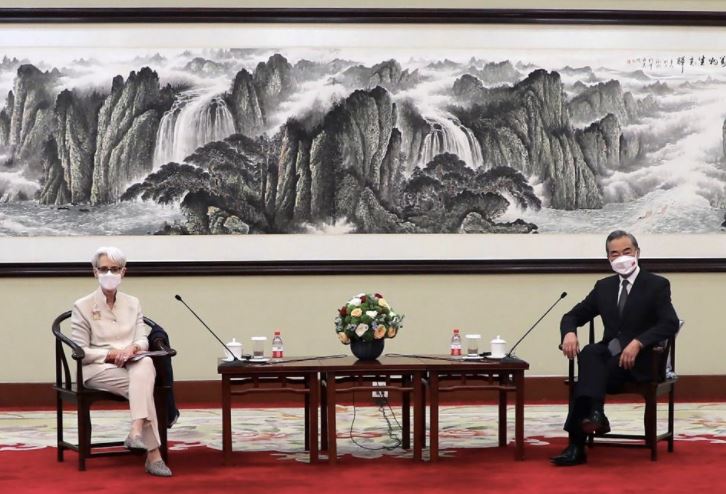
[Asia Economy Reporter Yujin Cho] At the high-level US-China talks reopened after more than four months, China presented its 'three major demands' to prevent the deterioration of US-China relations, continuing a standoff. The two countries, which have clashed comprehensively from the investigation into the origin of COVID-19 to issues concerning Xinjiang, Hong Kong, and Taiwan, once again exposed their differences and clashed.
According to the Chinese Ministry of Foreign Affairs on the 27th, Wang Yi, State Councilor and Foreign Minister in charge of diplomacy, met with Wendy Sherman, US Deputy Secretary of State, in Tianjin the previous day and presented three red lines: attempts to overthrow socialism with Chinese characteristics, interference with China's development, and infringement on China's sovereignty.
Minister Wang opened by saying, "The United States must not challenge or attempt to overthrow the path and system of socialism with Chinese characteristics," adding, "This is the choice of history and the people, related to the long-term welfare of 1.4 billion Chinese people and the future of the Chinese nation, and it is a core interest that must be upheld."
He also asserted, "The United States must not attempt to hinder or stop China's development process. The Chinese people have the right to a better life, and China has the right to achieve modernization."
He further stated that modernization is not the exclusive domain of the United States but a basic conscience of humanity and international justice, urging the US to promptly cancel unilateral sanctions against China, high tariffs, expanded jurisdiction laws (regulations that extend US domestic law jurisdiction to regions where jurisdiction is expected to be avoided), and scientific and technological blockade measures.
Lastly, he warned against interference in sovereignty issues. He said, "Xinjiang, Tibet, and Hong Kong are issues of opposition forces, not human rights and democracy, and no country will tolerate the violation of national sovereignty and security."
Minister Wang emphasized, "The Taiwan issue is even more important. Although the two sides of the Taiwan Strait have not yet unified, the fundamental fact that Taiwan is Chinese territory under one China has not changed and cannot change," warning, "If Taiwan independence is attempted, China has the right to mobilize all necessary means to stop it."
On the same day, Deputy Secretary Sherman emphasized to Minister Wang the need to "uphold a rules-based international order." However, Minister Wang retorted, "What are the so-called rules the United States talks about?" and questioned, "They are rules made by the United States itself and a few countries. China did not participate in their formulation, so on what grounds does the US impose them on China?"
He then listed the US's high tariffs and sanctions against China as typical violations of international norms, stating that if it is a matter of compliance with international norms, the US is the country that should reflect the most. According to the Chinese Ministry of Foreign Affairs, China demanded during the talks that the US withdraw restrictions on visas for Chinese Communist Party members and their families, sanctions on Chinese officials and companies, and the registration of Chinese media as diplomatic missions.
Chinese state media such as Global Times evaluated that China showed a new diplomatic approach by moving away from responding to US demands and instead demanding improvements such as lifting visa restrictions on Chinese Communist Party members, their families, and Chinese students.
Wu Xinbo, Director of the Institute of International Studies at Fudan University, said, "This time, Chinese officials took the initiative to actively engage with the US, departing from the past approach where China only responded to US demands, demonstrating a new diplomatic method," adding, "It showed that US concrete actions are necessary for improving US-China relations and enabling positive changes."
Earlier, Xie Feng, Vice Minister of the Chinese Ministry of Foreign Affairs, who met Deputy Secretary Sherman first the previous day, also claimed that the deadlock in US-China relations is the fault of the US and used harsh language.
He criticized, "The fundamental cause of the strained US-China relations is the US's mistaken view of China as a 'virtual enemy,'" and said, "The US demonizes China and tries to blame all domestic grievances on China."
He further accused the US of likening China to Japan during World War II or the Soviet Union during the Cold War, demonizing China to shift structural contradictions in the US onto China, while mobilizing the government and society to comprehensively pressure China.
This high-level face-to-face meeting was held for the first time in four months since March. In March, US Secretary of State Antony Blinken and White House National Security Advisor Jake Sullivan met with Yang Jiechi, member of the Political Bureau of the Chinese Communist Party in charge of foreign affairs, and Wang Yi, Foreign Minister, in Alaska for high-level talks.
© The Asia Business Daily(www.asiae.co.kr). All rights reserved.
![Clutching a Stolen Dior Bag, Saying "I Hate Being Poor but Real"... The Grotesque Con of a "Human Knockoff" [Slate]](https://cwcontent.asiae.co.kr/asiaresize/183/2026021902243444107_1771435474.jpg)
















