Private Education Stocks Plunge Amid Regulations
Biggest Two-Day Drop Since 2008
US Investors Sell Off One After Another
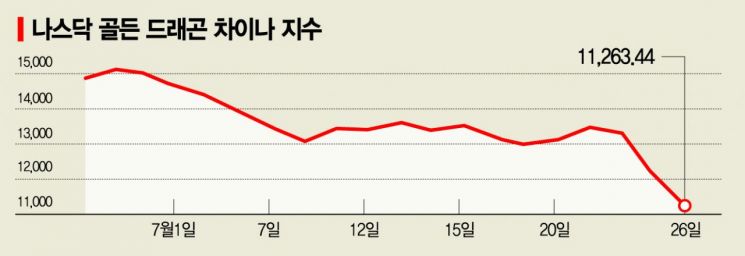
[Asia Economy New York=Correspondent Baek Jong-min] An analysis revealed that the market capitalization of Chinese companies listed on the U.S. stock market has disappeared by as much as $765 billion (883 trillion KRW) in just five months. This means that U.S. investors are suffering greater losses due to China's offensive targeting U.S.-listed companies amid U.S.-China tensions.
According to Bloomberg News, on the 26th (local time), after Chinese authorities announced regulations on private education companies, the Nasdaq Golden Dragon China Index fell by 7.2%.
The market capitalization of companies included in the Nasdaq Golden Dragon China Index plummeted for two consecutive days, decreasing by $765 billion compared to the all-time high recorded in February. The Nasdaq Golden Dragon China Index includes 98 Chinese companies listed on the U.S. stock market.
China's successive regulations are causing companies listed on the U.S. stock market to fall one after another. Bloomberg identified that Chinese companies listed in the U.S. have experienced the largest decline since the 2008 financial crisis over the past two days.
Following the announcement of regulations on private education companies, stocks of New Oriental Education, TAL Education, and Gaotu Techedu, which had plunged 50-70% in last week's final trading session, fell an additional 20-30% on the New York Stock Exchange that day. Bloomberg reported that the market capitalization of Chinese private education stocks traded in the U.S., China, and Hong Kong has disappeared by more than $126 billion.
The stock price of ride-sharing company Didi Chuxing fell by 42% in less than a month after being listed on the U.S. stock market. Alibaba's stock also dropped 7% that day, and representative Chinese tech companies such as Weibo and Baidu saw their stock prices fall by 5%.
China's largest food delivery service provider Meituan saw its market capitalization on the Hong Kong Stock Exchange fall by 13.8% following the Chinese government's announcement on protecting delivery workers.
Following monopoly regulations on Alibaba and Tencent earlier this year, Chinese authorities have recently launched an overt offensive against companies listed on the U.S. stock market, triggered by Didi Chuxing's listing.
Bloomberg evaluated that China's pressure is spreading further after the U.S. warned that it could delist Chinese companies listed on its stock market if they fail to disclose information according to U.S. accounting standards.
U.S. investors are rushing to sell Chinese company stocks. The ARK Innovation ETF, managed by "Money Tree Sister" Cathie Wood, recently reduced its Chinese stock holdings to less than 0.5% from 8% in early February. Well-known Chinese companies such as Baidu, Tencent, and JD.com became targets of selling.
The stock prices of Chinese companies also plummeted on their domestic stock markets. The Shanghai Composite Index fell 2.34% the day before, and the Hong Kong Hang Seng Index dropped 4.1%. This also reflects concerns over the Chinese authorities' tightening grip on companies.
The Hong Kong South China Morning Post reported that global fund managers are turning their backs on Chinese companies due to the strengthening of regulations by Chinese authorities.
Bloomberg News also pointed out that Chinese authorities are not considering how much loss overseas investors are incurring at all.
Oliver Jones, Senior Economist at Capital Economics, expressed concern, saying, "The recent situation clearly shows that Chinese authorities intend to harm investors in pursuit of broad political goals."
© The Asia Business Daily(www.asiae.co.kr). All rights reserved.

















