Decrease in All Regions Except Daejeon, Jeonbuk, and Jeonnam
Nationwide Female Employment Rate at 51.1% as of October
Gyeonggi, Busan, and Ulsan Drop by More Than 2 Percentage Points
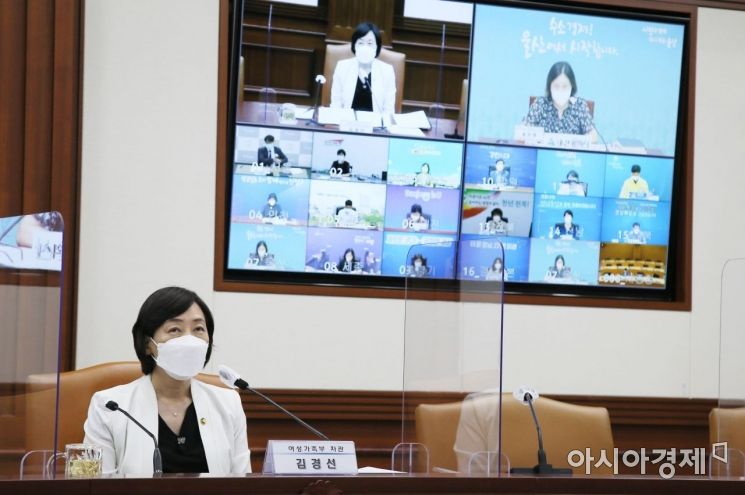 On the afternoon of the 26th, Kim Kyung-sun, Vice Minister of the Ministry of Gender Equality and Family, held the "1st Central-Local Women's Employment Working-Level Council" via video conference to review the progress of the "COVID-19 Women's Employment Crisis Recovery Measures" in the first half of the year and discuss collaboration strategies between central and local governments.
[Asia Economy Reporter Han Jinju] Due to the impact of COVID-19, the number of employed women nationwide in the second half of last year decreased by 270,000 compared to the previous year. The female employment rate in Gyeonggi, Busan, and Ulsan saw a larger decline than in other regions.
Bae Hojung, Associate Research Fellow at the Korean Women's Development Institute, presented the results of an analysis on the status of female employment by region at the 1st Central-Local Women's Employment Working Council held on the 27th. The council included the Ministry of Gender Equality and Family, the Ministry of Employment and Labor, and departments in charge of women's jobs in 17 metropolitan cities and provinces.
According to the data, the number of employed women as of October last year was 11.63 million, a decrease of 270,000 from the previous year. The number of employed women aged 30 to 54 decreased by 244,000. The national female employment rate recorded 51.1%. By age group, women aged 30?54 accounted for the largest share at 52.1%, followed by those aged 55 and over at 31.3%, and those aged 15?29 at 16.6%.
By region, the female employment rate decreased by more than 2 percentage points compared to the same month last year in Busan (-2.0 percentage points), Ulsan (-3.5 percentage points), and Gyeonggi (-3.0 percentage points). Only Daejeon (up 1.0 percentage point), Jeonbuk (up 2.6 percentage points), and Jeonnam (up 1.0 percentage point) showed increases.
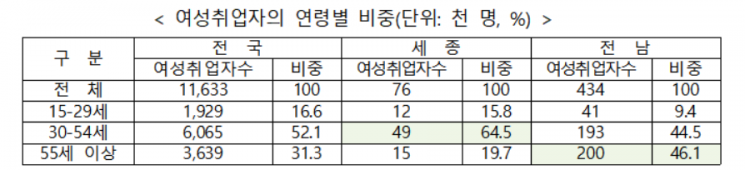
The employment share by age group also varied according to the structure of the regional labor market. In Sejong, Ulsan, and Gyeonggi, the share of women aged 30?54 exceeded 55%. In these three regions, the female employment share was high in the 'education services' sector, which mainly employs women aged 30?49. In Jeonnam, Gyeongbuk, and Jeonbuk, the share of women aged 55 and over exceeded 42%. The employment share was high in sectors such as 'agriculture' and 'social welfare services,' which have many workers aged 50 and above.
Looking at the employment status of female workers, the proportion of regular employees was highest in Sejong (64.5%), temporary workers were highest in Incheon (30.5%), and non-wage workers were highest in Jeonnam (38.2%). Nationwide, the proportions were 50.2% regular employees, 24.4% temporary workers, 21.7% non-wage workers, and 3.6% daily workers.
The industries with the highest proportion of female workers were food service and drinking places, social welfare services, and retail trade (excluding automobiles). In Seoul, Busan, Daegu, Incheon, Gwangju, Daejeon, Ulsan, and Gyeonggi, these three industries had the largest shares of female employment.
Kim Kyung-sun, Vice Minister of the Ministry of Gender Equality and Family, said, "Although female employment indicators are showing signs of improvement, if face-to-face service jobs decrease due to strengthened social distancing measures, the female employment situation could worsen again. Through the Central-Local Women's Employment Working Council, we will carefully monitor the progress of women's job policies to ensure that the current improvement in female employment leads to a sustainable recovery."
© The Asia Business Daily(www.asiae.co.kr). All rights reserved.
![Clutching a Stolen Dior Bag, Saying "I Hate Being Poor but Real"... The Grotesque Con of a "Human Knockoff" [Slate]](https://cwcontent.asiae.co.kr/asiaresize/183/2026021902243444107_1771435474.jpg)

















