President suspends parliamentary functions... Opposition calls it a "coup" and protests
[Asia Economy Reporter Kim Suhwan] The Prime Minister of Tunisia, the birthplace of the "Arab Spring" in North Africa, was dismissed amid anti-government protests protesting the COVID-19 hardships. Analysts say Tunisia is facing its biggest political crisis in 10 years since the Arab Spring.
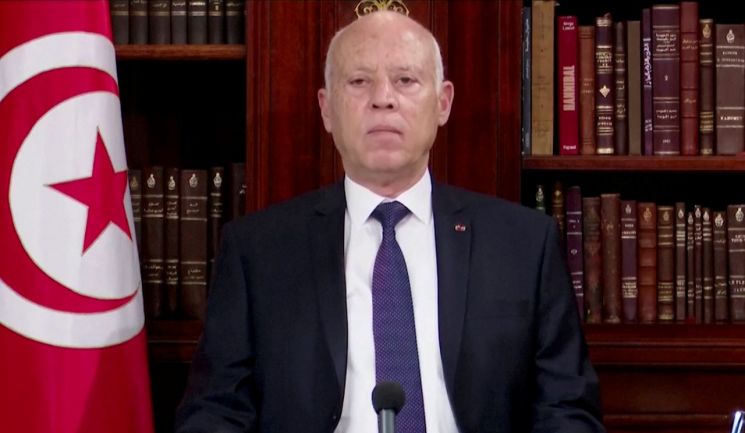
Foreign media reported that President Kais Saied announced on the 25th (local time) that he had dismissed Prime Minister Hichem Mechichi and suspended the functions of the parliament.
In a broadcast speech that day, President Saied said, "The constitution does not allow the dissolution of the parliament, but it does allow its functions to be suspended," announcing the measure. Article 80 of the Tunisian constitution allows the suspension of parliamentary functions in the event of an "imminent danger."
President Saied explained that he would take over administrative power with the help of a new prime minister appointed by himself. He also added that parliamentary immunity for members would disappear following the suspension of parliament.
According to foreign media, after President Saied's announcement, military vehicles surrounded the parliament building.
On the morning of the 26th, Rached Ghannouchi, the Speaker of the National Assembly and leader of the largest party Ennahda, arrived at the parliament to hold an extraordinary session despite President Saied's order to suspend parliament, but was blocked by military forces surrounding the building and could not enter.
Ennahda criticized President Saied's decision in a statement posted on Facebook, calling it a "coup against the constitution, Ennahda members, and the Tunisian people."
Some opposition parties also sided with Ennahda, criticizing President Saied's actions as a "coup." Former President Moncef Marzouki, who played a key role in Tunisia's democratization process, also said, "The situation will worsen."
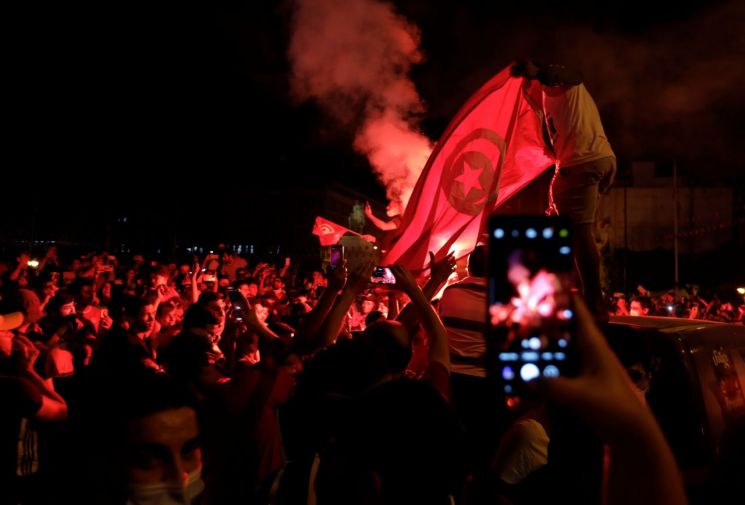
On the day the president announced the suspension of parliament and dismissal of the prime minister, large-scale protests took place in several cities including the capital Tunis, protesting the government's failure to respond to COVID-19.
In Tunis, hundreds of protesters gathered in front of the parliament chanting slogans against Ennahda and the prime minister.
Meanwhile, pro-president demonstrators welcomed the announcement of the suspension of parliament and dismissal of the prime minister by honking car horns.
On the other hand, supporters of Ennahda also held protests that day, leading to clashes with anti-Ennahda demonstrators.
During the police crackdown using tear gas, a reporter covering the protests was injured and some protesters were arrested.
President Saied warned, "Many people have been deceived by hypocrisy, betrayal, and the deprivation of citizenship," adding, "If anyone relies on weapons and tries to shoot bullets, the military will respond with bullets."
Foreign media evaluated that Tunisia is facing its biggest crisis since the 2011 democratization revolution due to this political crisis.
Tunisia was the birthplace of the "Arab Spring" uprisings that swept the Middle East in 2011 and has been considered one of the rare countries in the Middle East to have succeeded in political democratization.
The first local elections after the Arab Spring were held in May 2018, and President Saied was elected through democratic elections in October 2019.
However, amid high unemployment, economic difficulties, political conflicts, and public dissatisfaction with corruption, sporadic anti-government protests have continued, compounded by the COVID-19 crisis.
Tunisia is the second most severely affected country by COVID-19 in Africa after South Africa, with more than 18,000 deaths so far.
© The Asia Business Daily(www.asiae.co.kr). All rights reserved.


















