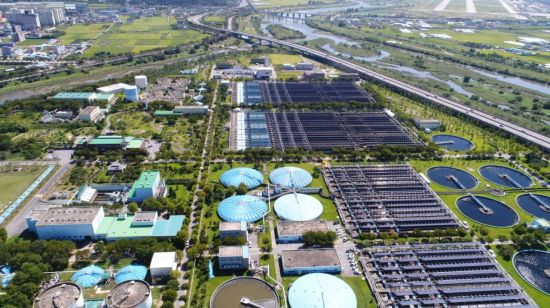
[Asia Economy Honam Reporting Headquarters Reporter Yoon Jamin] Gwangju Metropolitan City is improving sewage facilities to reduce odors and cut operating costs.
The city announced on the 27th that it is steadily promoting an energy self-sufficiency project to improve and modernize sewage treatment facilities, striving to reduce operating expenses and control odors generated at treatment plants.
The energy self-sufficiency project increases the production of biogas generated from digestion facilities that decompose and reduce sludge produced during sewage treatment, using it instead of city gas fuel needed to dry sewage sludge. This lowers sewage treatment plant operating costs and reduces greenhouse gas emissions.
The No. 1 Sewage Treatment Plant located in Chipyeong-dong, Seo-gu, completed the energy self-sufficiency project in 2018 with a project cost of 19.7 billion KRW.
The daily biogas production was increased from 17,000㎥ to 32,000㎥, which is used as fuel for sewage sludge drying facilities, resulting in an annual operating cost saving equivalent to 3.7 billion KRW.
The No. 2 Sewage Treatment Plant located in Bondeok-dong, Gwangsan-gu, plans to complete the energy self-sufficiency project by 2025 with a project cost of 39.4 billion KRW.
Currently producing 3,000㎥ of biogas daily, the plan is to increase this to 16,000㎥, which is expected to save 3.4 billion KRW annually in operating costs.
In addition, to resolve the odor problem inevitably generated during sewage treatment, the city invested 10 billion KRW from 2016 to 2019 in the No. 1 Sewage Treatment Plant to improve facilities by enclosing and chemically washing the grit chambers and thickening tanks, which are the facilities generating the most odor.
As a result, the odor emission concentration from the thickening tanks was reduced by 94%, from an average dilution factor of 2,540 times to 165 times.
The No. 2 Sewage Treatment Plant has also been improving facilities by enclosing odor-intensive areas such as grit chambers and thickening tanks since 2019 with an investment of 4.8 billion KRW, and plans to complete the project by the second half of this year.
Jang Woohyun, head of the city's Sewage Management Division, said, “We will continue to improve sewage treatment facilities and do our best to create a clean and pleasant Gwangju.”
© The Asia Business Daily(www.asiae.co.kr). All rights reserved.
![Clutching a Stolen Dior Bag, Saying "I Hate Being Poor but Real"... The Grotesque Con of a "Human Knockoff" [Slate]](https://cwcontent.asiae.co.kr/asiaresize/183/2026021902243444107_1771435474.jpg)
















