Increase in Manufacturing Costs Due to Carbon Tax... If Not Used for Carbon Neutral Transition, Overall Export Market Competitiveness Will Inevitably Decline
Although Imposed on Imports from China and Others, Trade Retaliation Possible... Australia Abolished It After Two Years of Implementation
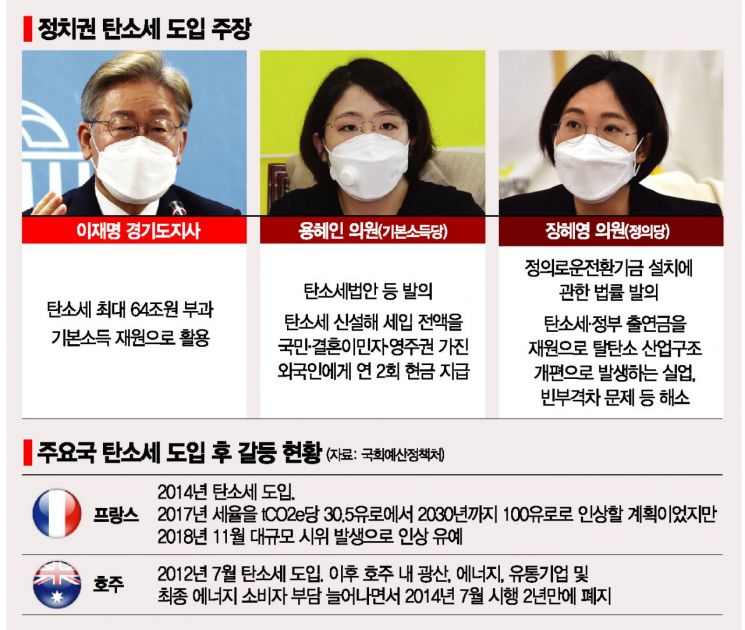
[Sejong=Asia Economy Reporter Kwon Haeyoung] As discussions on the introduction of a carbon tax flood the political sphere around the announcement of the European Union (EU)'s Carbon Border Adjustment Mechanism (CBAM), concerns over the deterioration of industrial competitiveness are rising in the business community. This is because the burden of manufacturing costs increases due to the imposition of a carbon tax on Korean companies, while the actual funds are likely to be provided as a form of political favor. Not only is there a burden from the carbon tax itself, but if the funds are not used for the transition to carbon neutrality, competitiveness is likely to decline not only in the EU but also in other markets such as the United States, China, and India. Both the business community and government insiders express concerns about some political groups and civic organizations using the strengthening of global environmental regulations such as those in the EU as a trigger to significantly raise the national greenhouse gas reduction target (NDC) and to discuss the introduction of a carbon tax.
◆The EU accounts for only 10% of the total export market=According to the Ministry of Trade, Industry and Energy on the 26th, exports to the EU in the first half of this year amounted to $31.4 billion, accounting for 10.4% of the total exports ($303.24 billion). Although the EU is a major export market, its share is lower than that of China (25%), the United States (15.3%), and ASEAN (16.3%), which are the first and second largest export destinations.
An official from the Ministry of Trade, Industry and Energy pointed out, "Some political circles and environmental groups argue that Korea should introduce a carbon tax following the EU's CBAM introduction so that companies would rather pay taxes domestically, but they only know one side of the story and not the other." He added, "Since Korean companies export their products not only to the EU but also to Southeast Asia, India, and the United States, this would result in a decline in competitiveness across the entire export market."
In the political sphere, Yong Hyein of the Basic Income Party proposed a 'Carbon Tax Bill' in March, and Jang Hye-young of the Justice Party introduced the 'Act on the Establishment of a Just Transition Fund' on the 12th of this month, igniting discussions on the introduction of a carbon tax. According to the offices of the lawmakers, the plan is to impose a carbon tax on imported foreign products and refund the carbon tax on Korean exports, but companies believe this will not be easy.
A representative from a major domestic steel company said, "If a carbon tax is imposed on Chinese products entering the domestic market, it could trigger trade retaliation measures, putting companies in an even more difficult situation." He added, "Ultimately, companies will avoid the carbon tax by producing overseas, which will not reduce global carbon emissions but is likely to damage the competitiveness of our industry." This means that companies may accelerate 'carbon leakage,' where production facilities move from countries with strict carbon emission regulations to those with weaker ones.
◆Australia abolished its carbon tax... but concerns over rising environmental costs remain in Korea=In fact, some foreign countries have introduced carbon taxes, but controversies continue due to increased environmental cost burdens on companies and the transfer of these costs to consumers. Australia introduced a carbon tax in July 2012, but as the burden on domestic mining, energy, distribution companies, and final energy consumers increased, the carbon tax system was abolished in July 2014, just two years after its implementation.
Unlike Korea, most countries that have introduced carbon taxes are European countries with low manufacturing dependence and a high proportion of service industries. According to the World Bank, 25 countries have implemented carbon tax systems, 17 of which are in Europe. Even within Europe, there are significant differences by country: Sweden imposes a carbon tax of $119 per ton of carbon emissions, while Poland, one of the production bases in Europe, imposes less than $1 per ton.
Companies are concerned that discussions on strengthening domestic and international carbon regulations may lead to increased environmental cost burdens rather than benefits. After the EU announced its CBAM introduction policy on the 14th (local time), and as domestic decarbonization regulations began to be actively discussed, the price of carbon emission permits, which had been stable this year, more than doubled in just one month. Based on 'KAU20,' the permit price was in the range of 20,000 to 30,000 KRW at the beginning of the year but dropped to 11,550 KRW on the 23rd of last month, then surged to 21,100 KRW on the 23rd of this month. While a price increase was expected as the second half of the year, when permits are actively used, began, the strengthening of domestic and international environmental regulations is also believed to have started affecting the emission permit trading market. The Carbon Neutrality Committee, the government's control tower for carbon neutrality policies, plans to further raise the national greenhouse gas reduction target (NDC) from 24.4% compared to 2017 in October, and depending on the extent of the increase, the emission permit market is likely to become even more volatile.
© The Asia Business Daily(www.asiae.co.kr). All rights reserved.
![Clutching a Stolen Dior Bag, Saying "I Hate Being Poor but Real"... The Grotesque Con of a "Human Knockoff" [Slate]](https://cwcontent.asiae.co.kr/asiaresize/183/2026021902243444107_1771435474.jpg)
















