13 Commercial Banks Plan to Supply 300 Billion Won from Tomorrow Until Year-End
Concerns Raised Over 'Moral Hazard' Due to Surge in Debtors
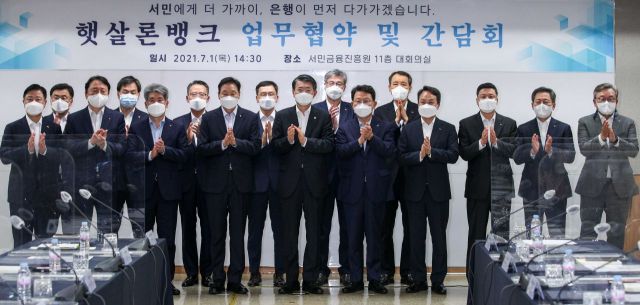 Eun Sung-soo, Chairman of the Financial Services Commission, along with heads of major commercial banks, attended the 'Hetsalron Bank Business Agreement and Meeting' held on the 1st at the Seoul Jung-gu Community Financial Promotion Agency. They are taking a photo after completing the business agreement. Photo by Kang Jin-hyung aymsdream@
[Asia Economy Reporter Kim Jin-ho] The policy financial product for low-income earners, 'Haetsal Loan Bank,' which allows low-credit borrowers to receive bank loans at an annual interest rate of 4.9% with a limit of 20 million KRW, will be launched starting on the 26th. The aim is to ease the burden on low-income individuals struggling due to COVID-19 and to integrate them into the formal banking system. However, some voices express concerns about so-called 'moral hazard' due to a surge in debtors who lack the ability to repay their loans.
According to the Financial Services Commission on the 25th, from tomorrow, Haetsal Loan Bank will be available through face-to-face or non-face-to-face methods at IBK Industrial Bank, NH Nonghyup Bank, Jeonbuk Bank, BNK Gyeongnam Bank, and others. The remaining banks, including KB Kookmin, Woori, Shinhan, and Hana Bank, plan to launch the product sequentially within the year. A financial authority official stated, "We plan to supply 300 billion KRW through pilot operations by the end of the year."
The support targets are low-income and low-credit groups who have used policy financial products for more than one year and whose debt and credit status have improved. Applicants can apply if their household debt balance has decreased or their credit score has increased within the past year as of the guarantee application date.
Additionally, loans are provided up to a maximum limit of 20 million KRW, differentiated according to credit and debt improvements, for those with an annual income of 35 million KRW or less, who fall within the bottom 20% of credit scores, and whose annual income is 45 million KRW or less. The product is characterized by supporting living expenses and other needs without restrictions on specific purposes. Interest rates range from 4.9% to 8% annually, with various preferential rates offered to diligent repayors.
The financial authorities expect that the introduction of Haetsal Loan Bank will alleviate the difficulties low-income and low-credit groups face in accessing financial services due to the reduction of the maximum interest rate. In particular, small business owners and self-employed individuals struggling amid the COVID-19 situation are also expected to benefit.
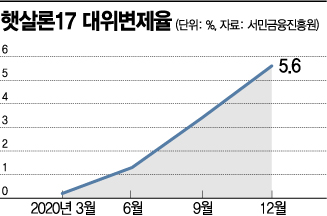
However, concerns have been raised that the simplified loan application process and the increasing subrogation repayment rates in existing low-income financial products may encourage moral hazard. For example, in Haetsal Loan 17, a representative low-income financial product, the rate of requests to the Korea Inclusive Finance Agency, the guarantee institution, to repay debts on behalf of borrowers has been rising. The subrogation repayment rate for Haetsal Loan 17 increased by 4.3 percentage points in six months, from 1.3% in June to 5.6% in December last year.
A financial industry insider said, "I don't understand the structure where nearly 20 million KRW is lent additionally just because the borrower repaid only part of the existing loan without fully paying it off," and pointed out, "There is concern about moral hazard where borrowers pushed to their limits take on more debt and choose personal bankruptcy."
In response, the financial authorities plan to continuously manage to prevent moral hazard by conducting subrogation repayment reviews through the Korea Inclusive Finance Agency and managing recourse claims against delinquent borrowers after subrogation repayment. A Financial Services Commission official said, "Considering that policy financial products target low-credit and low-income groups, relatively high subrogation repayment rates are expected, and supply scale and guarantee fees are determined based on anticipated subrogation repayment rates."
© The Asia Business Daily(www.asiae.co.kr). All rights reserved.
![Clutching a Stolen Dior Bag, Saying "I Hate Being Poor but Real"... The Grotesque Con of a "Human Knockoff" [Slate]](https://cwcontent.asiae.co.kr/asiaresize/183/2026021902243444107_1771435474.jpg)

















