Disability, Children, and Elderly Civic Groups
Request Human Rights Commission Investigation and Petition Against 'Uniform Isolation'
Religious Groups Demand 'In-Person Worship' Permission
Court Grants Conditional Approval
Democratic Labor Union Protests Assembly Ban
Files Petition with Human Rights Commission
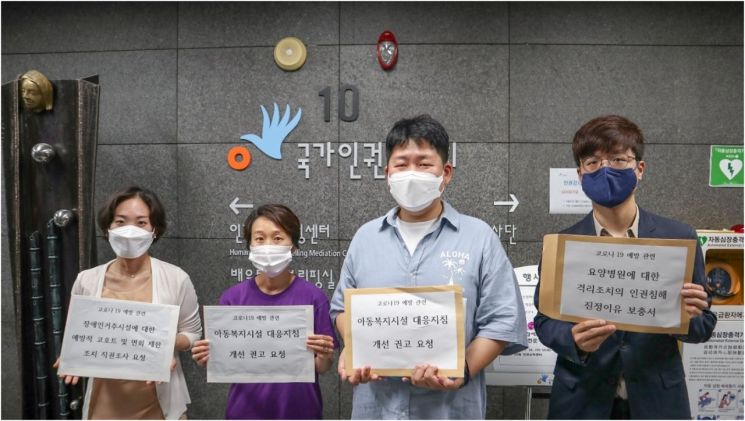 Nine civic groups related to people with disabilities, the elderly, and children have filed a complaint with the National Human Rights Commission regarding facility quarantine measures implemented in long-term care hospitals, child welfare facilities, and residential facilities for people with disabilities due to COVID-19 prevention.
[Asia Economy Reporter Lee Gwan-joo] As the fourth wave of COVID-19 surges, strong social distancing measures have been implemented, reigniting controversy between 'quarantine' and 'human rights.' There has been ongoing backlash, including complaints filed with the National Human Rights Commission of Korea (NHRCK) against the quarantine authorities' bans on gatherings, bans on in-person worship services, and uniform facility quarantine measures.
On the 21st of this month, nine civic groups related to people with disabilities, the elderly, and children jointly filed a complaint with the NHRCK and submitted a request for an official investigation, claiming 'basic rights violations' regarding the facility quarantine measures imposed on nursing hospitals, child welfare facilities, and residential facilities for people with disabilities, citing COVID-19 quarantine reasons.
In their statement, they appealed, "Before transportation systems and medical equipment were even established in nursing facilities, facilities for people with disabilities, and child facilities, isolation measures from society were implemented first," adding, "Patients, the elderly, people with disabilities, and children could not see their families and had to give up their daily lives entirely." They also pointed out that these measures were implemented in the form of 'guidelines' or 'administrative orders' without clearly specified legal grounds and fundamentally are not a method that can restrict citizens' basic rights.
They further stated, "Quarantine is not a war against the virus using citizens as pawns. Quarantine must ultimately be for the people," and added, "To prevent further repetition, we jointly file this complaint and urge an official investigation."
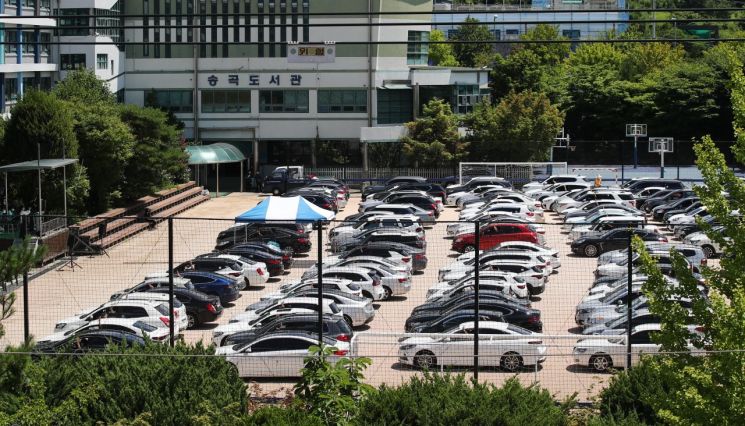 On the morning of the 18th, believers from Seoul City Church are attending a worship service while seated in their vehicles at the playground of Songgok High School in Jungnang-gu, Seoul, to prevent the spread of the novel coronavirus infection (COVID-19). [Image source=Yonhap News]
The regulation that uniformly banned in-person worship services during the fourth stage of social distancing was somewhat eased following objections from religious groups. On the 16th of this month, the Seoul Administrative Court partially accepted an injunction request filed by seven churches and pastors in Seoul against the Seoul Metropolitan Government, seeking to suspend the enforcement of the ban on in-person worship services. The court judged that banning religious events could cause concerns about violations of basic rights.
The court ruled that in-person worship should be allowed if the following conditions are met: ▲ attendance limited to 10% of the facility's capacity ▲ if 10% exceeds 19 people, attendance capped at 19 ▲ spacing seats in front and behind ▲ checking symptoms of entrants and maintaining a visitor log. The quarantine authorities accepted this court ruling and revised the policy to allow in-person worship services at 10% of the church's capacity, with a maximum of 19 people.
The labor sector's voices against the total ban on gatherings are also growing louder. On the 22nd, the Public Transport Workers' Union under the Korean Confederation of Trade Unions (KCTU) submitted a complaint to the NHRCK naming the mayor of Wonju, Gangwon Province, as the respondent. This was in response to Wonju city completely banning a rally planned by the National Health Insurance Service Customer Center Branch, arguing that the ban infringed on constitutional rights such as freedom of assembly and association.
The union particularly claims that while Wonju city applied the third stage social distancing standards to all areas including restrictions on the number of people in multi-use facilities, it applied the fourth stage only to gatherings, constituting a violation of the right to equality. Under the fourth stage of social distancing, only solo protests are permitted.
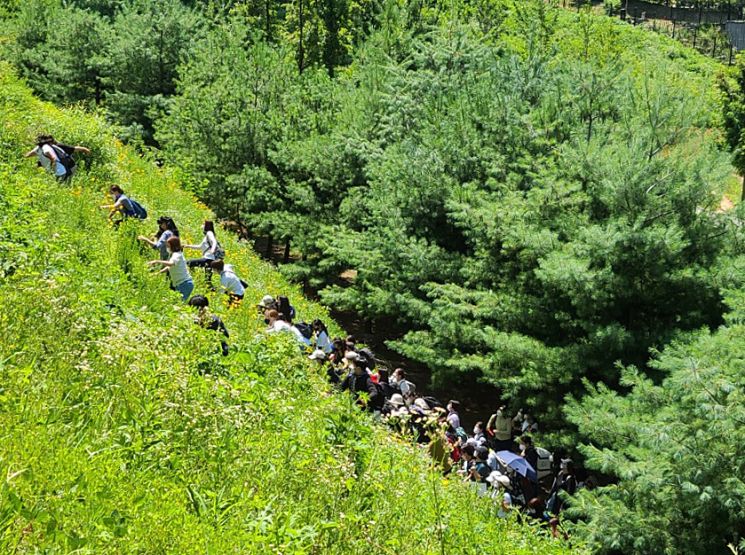 On the 23rd, when the Korea National Health Insurance Corporation in Wonju, Gangwon Province, the venue for the rally planned by the Korean Confederation of Trade Unions (KCTU), was blocked, people presumed to be rally participants were climbing a nearby hill.
 [Image source=Yonhap News]
The KCTU also filed a complaint with the NHRCK on the 29th of last month after Seoul city and the police notified a ban on the nationwide workers' rally scheduled for the 3rd of this month. Ultimately, the KCTU abruptly changed the rally location and proceeded with the nationwide workers' rally in Jongno, Seoul, with approximately 8,000 participants (estimated by the organizers).
The conflict between COVID-19 quarantine measures and human rights was starkly revealed during last year's 'Itaewon club infection' incident. When controversy arose over the disclosure of confirmed patients' movement paths, guidelines were revised to disclose information only when contacts could not be identified, reflecting ongoing efforts to balance quarantine and human rights.
Choi Young-ae, Chairperson of the NHRCK, stated last year in a statement, "The COVID-19 crisis is a test of our society's human rights capabilities." The prolonged nature of COVID-19 is inevitable. The NHRCK's judgment on these recent complaints will serve as a milestone in future debates between quarantine measures and human rights, making the outcome highly anticipated.
© The Asia Business Daily(www.asiae.co.kr). All rights reserved.
![Clutching a Stolen Dior Bag, Saying "I Hate Being Poor but Real"... The Grotesque Con of a "Human Knockoff" [Slate]](https://cwcontent.asiae.co.kr/asiaresize/183/2026021902243444107_1771435474.jpg)


















