[Sejong=Asia Economy Reporter Kim Hyunjung] Controversy continues over the selection criteria for the National Support Fund, which is provided to about 88% of the entire population. As the cutoff criteria become more complicated?excluding the top 12% income earners and disqualifying workplace health insurance subscribers who own homes valued around 2.1 billion KRW or have financial income exceeding 20 million KRW?there are concerns that the payment process may be delayed.
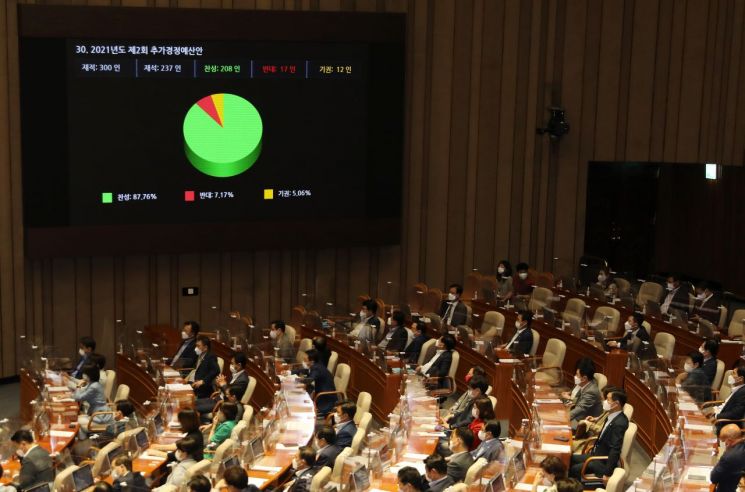
According to the second supplementary budget approved by the Democratic Party of Korea and the People Power Party at the National Assembly plenary session on the 24th, the recipients of the National Support Fund are members of households with income in the bottom 80%. The selection is based on health insurance premium payment information as of June. The bottom 80% household income corresponds to about 180% of the median income standard. This translates to a pre-tax monthly income of approximately 5.56 million KRW for a two-person household, 7.17 million KRW for three persons, 8.78 million KRW for four persons, 10.36 million KRW for five persons, and 11.93 million KRW for six persons.
For dual-income households, one additional household member is considered when applying the income criteria. For example, a dual-income four-person household is treated as a five-person household for health insurance premium standards (annual income about 120 million KRW; monthly 10.36 million KRW) and will receive the support fund if below this threshold. Single-person households can also receive the National Support Fund if their annual income is up to 50 million KRW (monthly 4.16 million KRW). Originally, the bottom 80% income threshold for single-person households was about 40 million KRW annually (monthly 3.29 million KRW), but this cutoff was raised.
The raising of the cutoff thresholds for dual-income couples and single-person households was largely influenced by public opinion. The National Assembly and government accepted the argument that dual-income couples may have higher essential expenses such as childcare costs compared to single-income couples. Similarly, the characteristics of single-person households, which include a relatively large proportion of elderly and economically inactive individuals with lower incomes, were taken into account.
Cutoff criteria excluding wealthy asset holders are also under discussion. The government has been considering a system that excludes individuals with assets above a certain level from receiving the fund, even if they fall within the bottom 80% income bracket. A likely plan under review is to disqualify workplace health insurance subscribers who own homes with a publicly announced price exceeding 1.5 billion KRW (market value about 2.1 billion KRW) or have financial income over 20 million KRW. While regional subscribers’ health insurance premiums reflect their assets, workplace subscribers’ premiums are determined solely based on income.
If the asset holder cutoff criteria are finalized, fairness controversies and backlash are expected. Choi Hyunsoo, head of the Social Security Finance and Policy Research Office at the Korea Institute for Health and Social Affairs, expressed concern: "High-asset individuals identified mainly through real estate and the top income earners filtered by National Tax Service data will be excluded, but the rest remain unknown. If their health insurance premiums happen to be low, they will be included in the bottom 88% and receive the fund, which will exacerbate fairness controversies."
The National Support Fund is expected to be distributed around late August, but there are internal and external concerns about whether the complicated cutoff criteria will allow for timely payments. Prime Minister Kim Boo-kyum has urged related ministries to pay special attention to the speed of implementation. At the 32nd extraordinary Cabinet meeting held at the Government Seoul Office the previous morning, he emphasized regarding the second supplementary budget, "Related ministries must execute the budget as quickly as possible so that those in difficulty can receive help without delay." He particularly stressed, "Please expedite the disbursement of the ‘Hope Recovery Fund’ to support small business owners severely affected by strengthened quarantine measures."
Meanwhile, the second supplementary budget passed by the National Assembly the day before amounts to 34.9 trillion KRW, an increase of 1.9 trillion KRW from the 33 trillion KRW initially submitted by the government.
© The Asia Business Daily(www.asiae.co.kr). All rights reserved.

















